
The term “ventless gas tankless water heater” appears frequently in searches, but it describes something that doesn’t exist in the residential market. Gas combustion always produces carbon monoxide, water vapor, and other byproducts that must be safely exhausted outdoors through a vent pipe. Building codes in every US state require venting for gas-fired water heaters, and no major manufacturer makes a code-compliant tankless gas model that operates without it.
The confusion often comes from three sources: battery-powered ignition systems that eliminate the need for a 120V outlet, compact venting kits that simplify installation in tight spaces, and outdoor-rated models that vent naturally into open air. This guide clarifies what’s actually available, covers the battery-ignition models people search for, and recommends the most practical vented options for homes, garages, cabins, and food trucks where space and power access matter.
Gas Tankless Water Heater Comparison
| Product | Best for | Flow Rate (GPM) | BTU Output | Power Source | Venting Type | Price |
|---|---|---|---|---|---|---|
| Rheem RTG Series 7.0 GPM Natural Gas | Best Overall | 7.0 GPM | 160,000 BTU/hr | — | Direct vent, non-condensing | Check price |
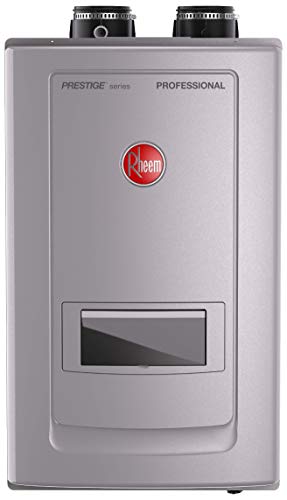
| Rheem Prestige 11.0 GPM Condensing | Best for Large Homes | 11.0 GPM | — | — | Condensing | Check price |
| Westinghouse 5.1 GPM 120,000 BTU | Best WiFi Control | 5.1 GPM | 120,000 BTU | 120V AC | — | Check price |
| Ranein 4.3 GPM 100,000 BTU Natural Gas | Best Preset Modes | 4.3 GPM | 100,000 BTU | — | — | Check price |
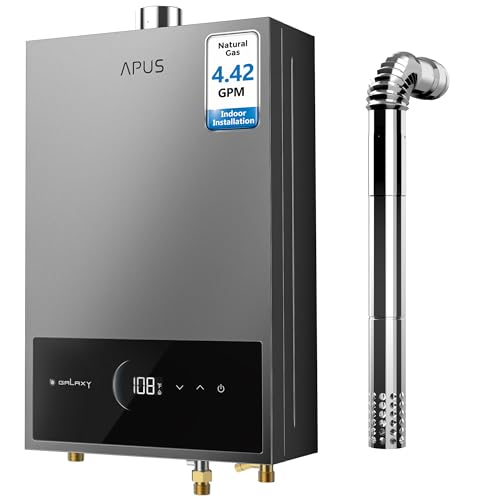
| APUS 4.42 GPM 95,000 BTU Natural Gas | Most Compact | 4.42 GPM | 95,000 BTU | 120V AC | — | Check price |



Top Vented Gas Tankless Water Heaters
Rheem RTG Series 7.0 GPM Natural Gas
- Flow Rate7.0 GPM
- BTU Output160,000 BTU/hr
- Energy Factor0.82 UEF
- VentingDirect vent, non-condensing
- 7.0 GPM handles multiple high-demand fixtures simultaneously
- Direct venting is simpler and less expensive to install than condensing systems
- Digital LED panel with ±1°F precision and built-in freeze protection
- CSA certified with flame failure and multi-point safety shutoffs
- Non-condensing design is less efficient than condensing models
- Requires 120V electrical outlet, not battery-ignition
- Larger footprint than compact 4-5 GPM units
Rheem Prestige 11.0 GPM Condensing
- Flow Rate11.0 GPM
- VentingCondensing
- RecirculationBuilt-in pump with auto-learn programming
- Leak DetectionWater and gas leak shutoff with error code
- 11.0 GPM supports up to four fixtures running at once
- Built-in recirculation delivers instant hot water without long pipe runs
- Auto-learn programming adapts to household hot water usage patterns
- Water and gas leak detection with automatic shutoff
- Condensing venting adds installation complexity and upfront cost
- Higher price than non-condensing models
- Requires condensate drain line for acidic exhaust byproduct
Westinghouse 5.1 GPM 120,000 BTU
- Flow Rate5.1 GPM
- BTU Output120,000 BTU
- ControlWiFi app and LED panel
- Temperature Stability±1°F
- CertificationCSA
- WiFi app shows real-time temperature and daily water consumption reports
- 5.1 GPM supports two showers or a shower plus dishwasher
- ±1°F temperature stability via self-modulating gas and water flow
- Compact wall-mount design with durable copper heat exchanger
- Requires full system drain in temperatures below 5°F or during extended non-use
- 5.1 GPM may not support three simultaneous high-flow fixtures
- WiFi connectivity depends on home network stability
Ranein 4.3 GPM 100,000 BTU Natural Gas
- Flow Rate4.3 GPM
- BTU Output100,000 BTU
- Temperature Range95°F–155°F
- Preset Modes4-season, kitchen, bathtub, shower
- Anti-FreezeDown to 14°F/-10°C
- Four preset modes simplify seasonal and fixture-specific temperature control
- 4.3 GPM supports three to four simultaneous water points
- Oxygen-free copper heat exchanger resists corrosion and improves efficiency
- Anti-freeze protection down to 14°F prevents pipe cracking
- Temperature memory retains last setting but doesn’t adapt to usage patterns
- LED display shows fault codes but no WiFi or remote monitoring
- Requires 120V power outlet
APUS 4.42 GPM 95,000 BTU Natural Gas
- Flow Rate4.42 GPM
- BTU Output95,000 BTU
- Dimensions20.55″ H × 13.27″ W × 5.91″ D
- Energy Factor0.81 UEF, 98% thermal efficiency
- Temperature Range95°F–140°F
- 20.55″ × 13.27″ × 5.91″ footprint fits cramped utility rooms and closets
- 0.66 GPM low-flow start works with single faucets and low-flow fixtures
- 98% thermal efficiency and 0.81 UEF save 30% versus tank water heaters
- LED touchscreen with ±1°F temperature control from 95°F to 140°F
- 4.42 GPM may struggle with three high-flow fixtures running simultaneously
- 140°F maximum temperature is lower than some competing units
- Auto freeze protection requires complete drain if ambient temperature stays at or below 41°F for extended periods
Why Ventless Tankless Gas Water Heaters Don’t Exist
No true ventless gas tankless water heater is manufactured or sold legally in the United States. Every gas-burning appliance produces carbon monoxide during combustion, and building codes require all gas water heaters to vent those exhaust gases outdoors. Natural gas and propane burn cleanly only when the byproducts—CO, CO₂, nitrogen oxides and water vapor—exit through a vent pipe or flue.
The confusion comes from space heaters. Ventless gas wall heaters and ventless gas garage heaters do exist, but they’re limited by federal law to 40,000 BTU input and are required to include oxygen depletion sensors that shut off the unit if oxygen drops below safe levels. A tankless water heater burns 140,000 to 199,000 BTU to heat water on demand. That heat output would consume oxygen and release CO far faster than any sensor could safely manage in an enclosed space.
What people actually want when they search for ventless usually falls into three categories: a model with battery-powered ignition that doesn’t need an electrical outlet, a unit with simplified direct venting that’s easier to retrofit than an old atmospheric vent, or a compact outdoor tankless mounted on an exterior wall. The Rheem RTG Series and similar whole-house models use direct vent or power vent systems that pull combustion air from outdoors and exhaust through PVC or stainless pipe, not a traditional chimney. Battery ignition handles the spark, but the vent remains mandatory.
Battery-Powered Ignition: No Outlet Required
Battery ignition uses two D-cell batteries to spark the gas burner, eliminating the need for a 120-volt outlet near the water heater. When you open a hot water tap, the flow sensor signals the ignition system, the batteries fire a spark across the burner, and the gas lights. Models like the APUS 95,000 BTU and Ranein 4.3 GPM tankless heaters ship with battery trays that hold standard alkaline D cells.
Battery ignition solves two problems: installation flexibility and power outage resilience. You can mount the unit anywhere gas and water lines reach without running electrical conduit. During a blackout, the heater continues to work as long as natural gas or propane flows and water pressure remains adequate. The batteries supply only the ignition spark, which draws minimal current.
Most whole-house tankless models with battery ignition still require AC power for the control board, digital display and modulating gas valve. The Rheem Prestige condensing series, for example, uses battery ignition but plugs into a standard outlet to run the electronics that adjust flame height and monitor temperature. Only portable propane heaters designed for RVs and outdoor use run entirely on batteries, because they use simpler mechanical valves and have no digital controls.
Battery backup is a different feature. A true backup system uses rechargeable batteries or a capacitor to keep the entire unit running when grid power fails. Few gas tankless heaters offer this, because the control electronics and circulation fans draw more current than batteries can sustain for long. What’s commonly marketed as battery backup is actually battery ignition: the burner lights, but if the model needs AC for the gas valve or blower, hot water stops when the power goes out.
How to Choose the Right Gas Tankless Water Heater
Flow rate, measured in gallons per minute, determines how many fixtures you can run at once without the water turning lukewarm. A 4 GPM unit handles one shower comfortably. Two showers running simultaneously need 7 GPM or more, which is why the Rheem RTG Series at 7.0 GPM suits families better than compact models like the APUS at 4.42 GPM.
| Fixture combination | GPM needed |
|---|---|
| One shower | 2.5 GPM |
| One shower + bathroom sink | 3.0 GPM |
| Two showers | 5.0 GPM |
| Two showers + kitchen sink | 6.5 GPM |
| Three fixtures (two showers + sink) | 7.0+ GPM |
BTU output must match your climate because colder inlet water requires more energy to reach the same outlet temperature. A 95,000 BTU heater that delivers 4.4 GPM in Texas may only manage 3 GPM in Minnesota when groundwater enters at 40°F instead of 65°F. The Rheem Prestige at 199,000 BTU handles cold climates and high simultaneous demand; the Ranein at 100,000 BTU works for moderate use in warmer regions.
Temperature rise shows how much hotter the unit can make the water as it flows through. Divide the BTU rating by 500, then divide by your desired flow rate. A 100,000 BTU heater at 4 GPM gives you a 50°F rise, enough to go from 50°F groundwater to 100°F at the tap—but not the 120°F most showers need. That same heater at 3 GPM delivers a 67°F rise, reaching 117°F from the same cold start. Flow rate always drops as you demand hotter water.
Natural gas and propane burn differently, so check what fuel your home supplies before buying. Some models ship configured for one fuel and include a conversion kit; others come dedicated to natural gas or propane and cannot switch. The product manual lists compatible fuels. If you run propane, a dedicated propane tankless water heater avoids the hassle and potential safety issues of field conversion.
Indoor models mount inside a utility room or basement and require venting pipe routed through an exterior wall or the roof, following the manufacturer’s clearance and material specifications. Outdoor models install on an exterior wall with no vent pipe, tolerating weather but needing freeze protection in cold climates. The Westinghouse indoor unit needs concentric or PVC/CPVC vent pipe; an outdoor model bolts to the wall and vents naturally into open air.
For a garage sink, a compact unit like the APUS at 95,000 BTU and 4.42 GPM delivers plenty of hot water for hand-washing and tool cleanup without the cost and complexity of a 7 GPM whole-house model. Mini tankless water heaters work well for single-fixture applications. An EcoSmart electric model avoids venting entirely if you have 240-volt power, though gas units heat water faster when inlet temperatures drop below 50°F. The Rinnai RU199iN at 199,000 BTU handles two-shower bathrooms in any climate, but it costs more to install and run than a mid-range 7 GPM model when you only need moderate flow.
Venting Requirements and Installation Limits
Every gas tankless water heater pulls in air, burns gas, and pushes out exhaust. The venting system handles that exchange, and the type you choose dictates where you can install the unit and how much a professional will charge. Direct vent is the most common setup: a sealed combustion chamber draws fresh air from outside through one pipe and exhausts through another, both running through the same wall penetration. The heater never touches indoor air, so it works safely in closets, utility rooms, and tight spaces.
Power vent models use a fan to push exhaust gases farther, allowing horizontal runs up to 75 feet or vertical rises that exceed gravity-fed limits. You’ll pay more for the fan and the electricity to run it, but power venting solves tight layouts where the heater sits far from an exterior wall. Vent pipe diameter ranges from 3 inches for smaller units to 5 inches for high-BTU models; undersizing the pipe restricts airflow and triggers safety shutoffs.
Outdoor models mount on an exterior wall and vent directly into open air. No ductwork, no interior space lost. They simplify installation but demand freeze protection in climates where temperatures drop below 32°F. Most outdoor units include a small electric heating element that warms internal components during standby; a few require manual drain-down before winter. A tankless propane water heater for a food trailer or food truck usually means an outdoor-rated unit mounted in a weatherproof compartment with LP supply and freeze protection, sized for one or two sinks and a shower.
A ventless gas wall heater is a space heater, not a water heater. Ventless gas wall heaters burn gas to warm a room and rely on oxygen depletion sensors to shut off before CO builds up. Water heaters produce far more combustion gases over longer run times and cannot safely operate without a vent to the outdoors.
Safety and Certification
All gas tankless water heaters sold in the United States must carry CSA, UL, or ETL certification. These marks confirm the unit meets national safety standards for gas combustion, venting, and electrical components. A heater without one of those labels is not legal to install and will fail inspection.
Carbon monoxide detectors are required in the same room as the water heater and on every sleeping level of the home. Gas combustion produces CO, and a blocked vent, cracked heat exchanger, or improper installation can push it indoors. Install detectors even if the heater is outdoor-mounted; exhaust can migrate through wall gaps or open windows. Replace CO detectors every five to seven years and test them monthly.
Modern units include overheat shutoff, flame failure detection, and exhaust blockage sensors. Overheat protection cuts the burner if internal temperature exceeds safe limits, preventing damage to the heat exchanger. Flame failure detection stops gas flow within seconds if the burner goes out, eliminating the risk of unburned gas escaping. Exhaust blockage sensors monitor pressure in the vent pipe and shut down the heater if a bird nest, ice, or debris restricts airflow.
Are ventless gas space heaters safe? Yes, when installed in rooms large enough to supply oxygen and equipped with oxygen depletion sensors that meet ANSI Z21.11.2 standards. How do ventless gas heaters and propane grills differ in regards to indoor safety? Grills produce far more CO per minute and lack sensors; they are designed for outdoor use only. Space heaters certified for indoor use burn cleaner and shut off before oxygen drops to unsafe levels. Is there a safe ventless natural gas heater for a basement? Only if the basement meets the minimum square footage listed in the heater’s manual and includes a working CO detector. For continuous heating, a vented gas heater or electric tankless water heater is safer and more reliable.
Running Cost: What It Takes to Heat Water on Demand
Gas tankless water heaters burn fuel only while hot water flows, eliminating the standby loss that storage tanks have from keeping 40 or 50 gallons hot around the clock. A tankless unit fires up when you open a faucet, heats the water passing through its heat exchanger, and shuts off when you close the tap. Your operating cost depends on how much hot water you use, the unit’s thermal efficiency, and whether you connect to natural gas or propane.
Calculate the cost per hour of operation by dividing the unit’s BTU input by its Uniform Energy Factor, then multiplying by the hours of daily use and the cost per therm of gas. One therm equals 100,000 BTU. A 100,000 BTU heater with a UEF of 0.82 consumes 121,951 BTU per hour of actual burn time; at $1.50 per therm, that works out to $1.83 per hour. Most households run hot water for 30 minutes to an hour each day across showers, dishwashing, and laundry, not continuously.
Condensing models with a UEF of 0.90 or higher extract more heat from the combustion gases before venting them, reducing fuel consumption by 10 to 15 percent compared to non-condensing units rated 0.80 to 0.85. The Rheem Prestige Condensing unit, for example, achieves 0.93 UEF and saves roughly $15 to $25 per year over a standard-efficiency model in a typical household. The difference grows with higher usage.
Efficiency matters more when fuel is expensive. If you heat with propane, a high-efficiency condensing model pays back its premium faster than it would on natural gas. For buyers comparing fuel types, propane tankless water heaters and their operating costs depend heavily on local propane delivery prices, which vary by region and contract terms.
Frequently Asked Questions
Does a propane tankless water heater have an electrical backup if propane is shut off?
Can you install a ventless gas heater indoors safely?
What is the difference between vented and ventless gas heaters?
Do tankless water heaters work during a power outage?
How do you size a tankless water heater for two showers running at the same time?
Are battery-operated tankless water heaters safe for off-grid cabins?
If that sounds like your room, read up on tankless water heaters with backup next.
There is more on tankless water heater operation in a guide of its own.
