
Endless cold showers are a thing of the past with an electric tankless water heater. These units heat water on demand, eliminating the need for a bulky storage tank and providing instant hot water for your shower.
In this roundup, we evaluate the best electric tankless water heaters that combine efficiency, performance, and ease of installation, ensuring you find the perfect fit for your home.
Comparison of Electric Tankless Water Heaters
| Product | Best for | Flow Rate | Power | Dimensions | Price |
|---|---|---|---|---|---|
| Rheem 18kW 240V Tankless Electric Water Heater | Best Overall | 4.4 GPM | 18 kW | — | Check price |
| SIVUATEK 14kW 240V Tankless Water Heater | Best for Small Homes | — | 14 kW | 15.87″ x 11.14″ x 2.87″ | Check price |
| LECLOC 3kW 120V Mini Tankless Water Heater | Best Point of Use | — | 3 kW | 7.1″ x 9.8″ x 2.8″ | Check price |
| CAMPLUX 4.5kW 120V Tankless Water Heater | Best for Compact Spaces | 1.0 GPM | 4.5 kW | 10.95″ x 2.52″ x 7.4″ | Check price |
| Rheem 3.5kW 120V Point-of-Use Tankless Heater | Best for Single Fixture | 0.5 GPM | 3.5 kW | — | Check price |


Top Electric Tankless Water Heaters for Shower Use
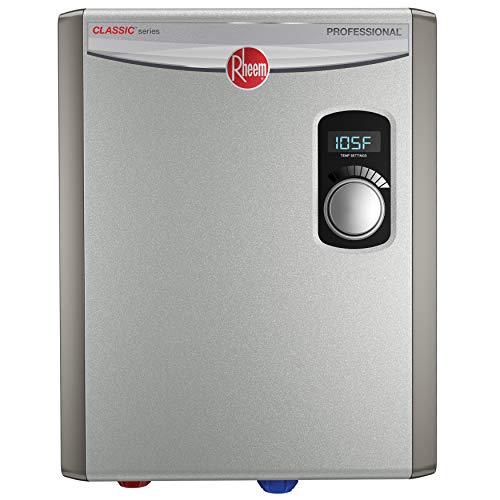
Rheem 18kW 240V Tankless Electric Water Heater
- Flow Rate4.4 GPM
- Power18 kW
- Dimensions—
- High flow rate supports multiple showers at once
- Precise temperature control with +/-1 degree accuracy
- Durable, serviceable heating elements
- Simple installation with standard 3/4 inch NPT connections
- Requires a 240V circuit and professional installation
- Larger footprint than point-of-use models
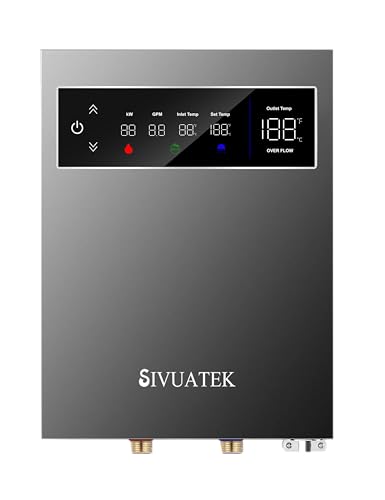
SIVUATEK 14kW 240V Tankless Water Heater
- Flow Rate—
- Power14 kW
- Dimensions15.87″ x 11.14″ x 2.87″
- Energy efficient with no standby heat loss
- Precise digital temperature control
- Advanced safety features including leakage protection
- Compact design with standard 1/2 inch NPT connections
- Requires a 60-amp circuit breaker
- Lower flow rate than larger models
LECLOC 3kW 120V Mini Tankless Water Heater
- Flow Rate—
- Power3 kW
- Dimensions7.1″ x 9.8″ x 2.8″
- Plug-in design for easy installation
- LED display with simple temperature control knob
- Comprehensive safety features including IPX4 waterproofing
- Compact size fits small spaces
- Insufficient power for shower use
- Output temperature affected by inlet water flow
CAMPLUX 4.5kW 120V Tankless Water Heater
- Flow Rate1.0 GPM
- Power4.5 kW
- Dimensions10.95″ x 2.52″ x 7.4″
- Instant hot water with fast temperature rise
- Compact and space-saving wall mount design
- Self-modulating power saves energy
- Easy touch controls with LED display
- Requires hard wiring and 40A breaker
- Limited to single sink use
Rheem 3.5kW 120V Point-of-Use Tankless Heater
- Flow Rate0.5 GPM
- Power3.5 kW
- Dimensions—
- Compact size for small spaces
- Precise digital temperature control
- Energy-saving on-demand heating
- Low flow rate unsuitable for showers
- Requires a 30-amp breaker and proper wiring
How to Choose the Right Electric Tankless Water Heater
The best electric tankless water heater for shower use delivers hot water on demand without running out. Start by understanding flow rates, which measure gallons per minute (GPM). A typical shower needs about 1.5 to 2.5 GPM. Choose a heater that matches or exceeds your peak flow to avoid temperature drops.
Electric tankless water heaters require sufficient power. Most household models run on 240 volts and draw 12 to 18 kilowatts. Check your home’s electrical panel for capacity. Installation often needs dedicated breakers and proper wiring to handle the load safely.
Space for installation matters. Tankless units mount on walls and vary in size from compact point-of-use models to larger whole-house systems. Measure the available wall space and ensure clearance for ventilation and maintenance.
Energy efficiency features reduce operating costs. Look for self-modulating heaters that adjust power based on demand. This prevents wasted energy when water flow is low. A unit with a high energy factor rating converts more electricity into heat, saving money over time.
| Appliance | Watts | Per hour | Per day (1 h) | Per month (30 days) |
|---|---|---|---|---|
| 1,500 W small point-of-use heater | 1,500 W | 26¢ | 26¢ | $7.65 |
Sizing and Heat Output Considerations
Sizing a tankless water heater depends on your household’s hot water needs. Count the number of simultaneous users and fixtures. For example, two showers running at once need about 4 to 5 GPM combined.
Calculate required flow rates by adding the GPM of each fixture you expect to use simultaneously. Remember to include faucets or appliances if they run at the same time.
Temperature rise is the difference between incoming water temperature and desired output. In colder climates, ground water can be as low as 40°F. To reach 105°F for a shower, the heater must provide a 65°F rise.
Electric tankless water heater output per shower varies by model. A typical 18 kW unit can deliver about 4 to 5 GPM at a 60°F temperature rise. Smaller 14 kW models handle about 3 to 4 GPM at the same rise, suitable for one shower or a small household.
Safety Features and Certification
Electric tankless water heaters include several critical safety features to prevent hazards. Look for models with overheat protection that automatically shuts off the unit if the water temperature exceeds safe limits. Leakage detection is another key feature, stopping the heater if water escapes inside the unit.
Certification confirms a heater meets safety and performance standards. Check for UL, ETL or CSA listings. These certifications ensure the unit has been tested for electrical safety, fire risk, and proper operation.
Proper installation is essential for safety. Electric tankless water heaters require a dedicated circuit sized to the heater’s amperage. The manual will specify wiring and breaker requirements. Improper wiring or overloaded circuits can cause fire or damage.
- Confirm circuit specificationsVerify the electrical panel can support the heater’s amperage and voltage requirements.
- Use a licensed electricianHave a professional install the heater to ensure code compliance and correct wiring.
- Install proper groundingGrounding prevents electrical shock and is required by code.
- Maintain clearance and ventilationKeep at least 3 feet of clearance around the unit and ensure any ventilation requirements are met.
Understanding Running Costs of Electric Tankless Water Heaters
The running cost of an electric tankless water heater depends on its power rating, usage hours, and your electricity rate. Calculate cost by multiplying watts ÷ 1,000 × hours used × price per kWh.
For example, a 14,000-watt (14kW) heater running 1 hour daily at $0.17 per kWh costs: 14,000 ÷ 1,000 × 1 × 0.17 = $2.38 per day. Multiply by 30 for monthly cost.
| Model | Power (Watts) | Typical Use (hours/day) | Monthly Cost at $0.17/kWh |
|---|---|---|---|
| Rheem 18kW 240V | 18,000 | 1 | 91.80 |
| 14kW Tankless Water Heater Electric 240V | 14,000 | 1 | 71.40 |
| LECLOC Mini Tankless Instant Water Heater | 3,500 | 1 | 17.85 |
Electric tankless heaters use energy only when hot water flows, unlike traditional tank heaters that maintain temperature constantly. This on-demand operation reduces standby losses and can lower monthly energy bills despite higher wattage.
| Appliance | Watts | Per hour | Per day (1 h) | Per month (30 days) |
|---|---|---|---|---|
| 1,500 W space heater | 1,500 W | 26¢ | 26¢ | $7.65 |
Frequently Asked Questions
What is the average lifespan of an electric tankless water heater?
Can I install an electric tankless water heater myself?
How much space do I need for an electric tankless water heater?
What are the benefits of a tankless water heater over a traditional tank water heater?
Are there any maintenance requirements for electric tankless water heaters?
How do I adjust the temperature on an electric tankless water heater?
We cover best electric heaters for families in its own guide.
If that sounds like your room, read up on reliable tankless options next.