Choosing the right tankless water heater is crucial for ensuring a consistent supply of hot water while minimizing energy costs. With various options available, it’s essential to find a model that fits your household’s specific needs.
Tankless Water Heater Comparison
| Product | Best for | Flow Rate (GPM) | Power (kW) | Dimensions | Weight | Price |
|---|---|---|---|---|---|---|
| Rheem RTEX-24 Electric Tankless Water Heater | Best Overall | 5.9 | 24 | — | — | Check price |
| Rheem 18kW Electric Tankless Water Heater | Best Mid-Range | 4.4 | 18 | — | — | Check price |
| Rheem 8kW Multi Fixture Tankless Water Heater | Best for Small Demand | 1.95 | 8 | — | — | Check price |
| xwdzswgs 3000W Electric Tankless Water Heater | Best Compact Unit | 0.3 – 0.5 | 3 | — | — | Check price |
| 6699 Tankless Water Heater Flushing Kit | Best Maintenance Kit | — | — | 6.3 x 6.3 x 8.7 inches | — | Check price |


Top Picks for Tankless Water Heaters
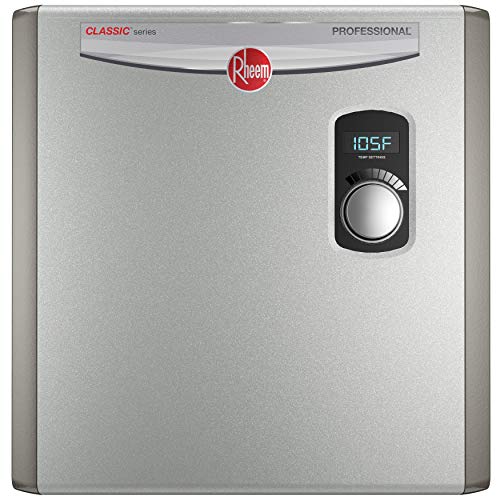
Rheem RTEX-24 Electric Tankless Water Heater
- Flow Rate (GPM)5.9
- Power (kW)24
- Wiring Requirements240V, three 40-amp breakers, #8 AWG copper conductors
- Temperature Range80°F – 140°F
- High flow rate supports multiple fixtures
- Precise digital temperature control
- Energy efficient by heating water on demand
- Requires significant electrical capacity and professional installation
- Not suitable for homes with lower electrical service panels
Rheem 18kW Electric Tankless Water Heater
- Flow Rate (GPM)4.4
- Power (kW)18
- InstallationBottom 3/4 inch NPT water connections
- Temperature ControlExternal digital thermostat with LED
- Self-modulating power adjusts to demand
- Copper heating elements are durable and serviceable
- Simple installation with bottom 3/4 inch NPT water connections
- Lower maximum flow rate than larger models
- Requires 240V power supply
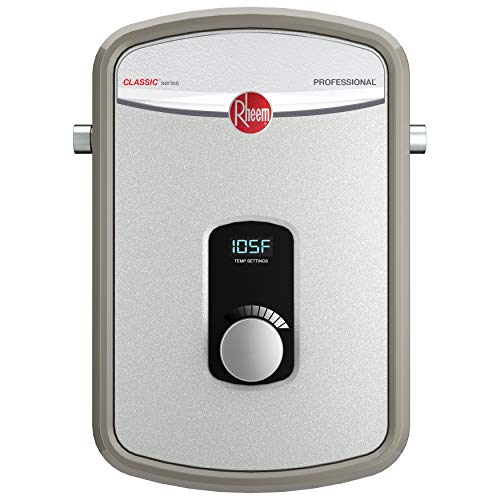
Rheem 8kW Multi Fixture Tankless Water Heater
- Flow Rate (GPM)1.95
- Power (kW)8
- Wiring Requirements240V, one 40-amp breaker
- Temperature Range80°F – 140°F
- Compact size with low electrical requirements
- Digital temperature control in 1-degree increments
- Suitable for multiple small fixture applications
- Low flow rate limits simultaneous use
- Not for whole-house applications
xwdzswgs 3000W Electric Tankless Water Heater
- Power (kW)3
- Flow Rate (GPM)0.3 – 0.5
- Safety FeaturesLeakage protection, dry-burning protection, automatic power-
- InstallationVertical mounting only
- Compact and lightweight design
- Multiple safety features including dry-burning protection
- Easy installation with standard 1/2 inch NPT connections
- Very low flow rate limits use to single fixtures
- Vertical installation only to avoid heating element damage
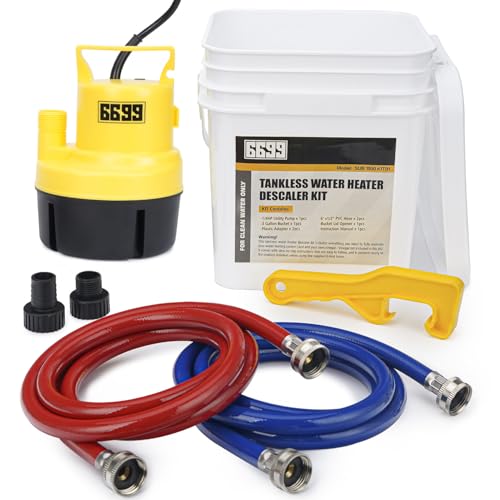
6699 Tankless Water Heater Flushing Kit
- Pump Power1/4 HP
- Pump Flow Rate1500 GPH
- Pump Max Fluid Temperature95°F
- Pump Max Head16.5 FT
- Complete kit for tankless water heater flushing
- Pump with thermal overload protection
- Ergonomic lid opener for easy access
- Not a water heater itself
- Requires some setup and effort for flushing
How to Choose the Right Tankless Water Heater
Choosing a tankless water heater starts with knowing your household’s hot water needs. The key factor is the flow rate, measured in gallons per minute (GPM). This tells you how much hot water the unit can deliver at once. Pick a model that matches or slightly exceeds your peak demand to avoid running out of hot water during busy times.
Next, check the power requirements. Electric tankless heaters like the Rheem RTEX-24 usually need a 240-volt circuit and can draw up to 24 kW. Make sure your home’s electrical panel has the capacity for the heater you want. Oversized breakers or inadequate wiring can cause trips or unsafe conditions.
Size and installation space also matter. Tankless units are compact, but you still need clearance for airflow and maintenance. Measure the wall or area where you plan to mount the heater and compare it to the unit’s dimensions. Some models fit tight spaces better, which is crucial in small utility rooms or apartments.
Energy efficiency ratings help you choose a model that saves on utility bills. Look for units with high energy factor (EF) or uniform energy factor (UEF) ratings. Higher numbers mean less energy wasted heating water. This is especially important if you plan to use the heater frequently or want lower monthly costs.
| Model | Power (kW) | Max GPM | Dimensions (in) | Energy Factor |
|---|---|---|---|---|
| Rheem RTEX-24 | 24 | 5.9 | 17 x 15 x 3.6 | 0.97 |
| Rheem 18kW | 18 | 4.5 | 16 x 14 x 3.4 | 0.95 |
| Rheem 8kW Multi Fixture | 8 | 2.6 | 15 x 13 x 3.2 | 0.92 |
Sizing and Heat Output for Tankless Water Heaters
Sizing a tankless water heater means matching its output to your household’s peak hot water demand. Start by listing all fixtures you expect to use simultaneously—showers, faucets, appliances—and note their typical flow rates.
Add the flow rates to find the total gallons per minute (GPM) needed. For example, a shower uses about 2.5 GPM, a bathroom sink 1 GPM, and a dishwasher 1.5 GPM. If you plan to run a shower and dishwasher at the same time, your heater needs to supply at least 4 GPM continuously.
The inlet water temperature affects the heater’s performance. Colder incoming water requires more energy to heat to your desired temperature. In northern states, inlet water can be as low as 40°F, while southern states may see 70°F or higher. Tankless heaters list their maximum flow rate based on a specific temperature rise, usually 70°F. If your inlet water is colder, the actual flow rate will be lower.
- Calculate Peak DemandList all fixtures used at the same time and note their flow rates.
- Add Flow RatesSum the GPM values to find total hot water needed simultaneously.
- Check Inlet TemperatureEstimate your cold water temperature to understand the required temperature rise.
- Match Heater CapacityChoose a heater with a GPM rating that meets or exceeds your calculated demand at your inlet temperature.
For detailed models and sizing help, see our guide on best propane tankless water heater and other specialized units.
Running Costs of Tankless Water Heaters
Tankless water heater safety features protect users and equipment from electrical and thermal hazards. Look for models certified by UL (Underwriters Laboratories) or ETL (Intertek), which verify compliance with rigorous safety standards.
Essential safety features include overheat protection, which shuts off the heater if water temperature exceeds safe limits, and automatic shut-off that activates during faults or power surges. These prevent damage and reduce fire risk.
Proper installation is critical for safety and performance. Licensed plumbers or electricians should handle wiring and plumbing connections, ensuring the unit meets local codes and manufacturer instructions. Incorrect installation can cause leaks, electrical hazards, or void warranties.
Safety and Certification for Tankless Water Heaters
Tankless water heater safety features protect users and equipment from electrical and thermal hazards. Look for models with UL or ETL certification, which means they meet strict safety and performance standards set by independent labs. These certifications confirm the unit has passed tests for electrical safety, fire risk, and durability.
Overheat protection is essential. It shuts the heater off if the water temperature rises above safe levels, preventing damage and burns. Automatic shut-off features also cut power if the unit detects a fault or if water flow stops unexpectedly.
Proper installation is critical. A licensed plumber or electrician should handle setup to ensure wiring, grounding, and water connections meet local codes. Incorrect installation increases risks of fire, leaks, or electric shock.
| Safety Feature | What It Does |
|---|---|
| UL or ETL Certification | Confirms compliance with safety and performance standards |
| Overheat Protection | Shuts off heater if water temperature gets too high |
| Automatic Shut-Off | Turns power off during faults or no water flow |
| Licensed Professional Installation | Ensures safe, code-compliant wiring and plumbing |
Maintenance Tips for Tankless Water Heaters
How to maintain a tankless water heater starts with regular descaling to remove mineral buildup. Hard water causes scale that reduces heat transfer and flow, lowering efficiency and lifespan.
- Turn off power and water supplySwitch off the unit at the breaker and close the water valves to prevent leaks.
- Attach the flushing kitConnect the flushing kit hoses to the service ports on the heater as per the kit instructions.
- Circulate descaling solutionRun a vinegar or commercial descaling solution through the heater using a pump for 45 to 60 minutes.
- Flush with clean waterAfter descaling, flush the system with fresh water to remove any residue.
- Restore water and powerClose the service ports, open the water valves, and turn the power back on.
Common signs of mineral buildup include fluctuating water temperature, reduced flow rate, and unusual noises from the unit. Flushing at least once a year prevents these issues and keeps the heater running efficiently.
Frequently Asked Questions
What is the best tankless water heater for a large family?
How do I know what size tankless water heater I need?
Are tankless water heaters worth the investment?
What maintenance do tankless water heaters require?
Can I install a tankless water heater myself?
What are the benefits of using a tankless water heater?
The other half of this decision is tankless heating for large families.
Readers in this position usually ask about efficient hot water solutions as well.