
Having a reliable hot water supply is essential for any home. Whether it’s for showers, washing dishes, or laundry, the right electric hot water heater can make all the difference.
Electric hot water heaters come in various types, with tankless options gaining popularity for their efficiency and space-saving benefits.
Electric Hot Water Heater Comparison
| Product | Best for | Power (kW) | Flow Rate (GPM) | Size | Certification | Price |
|---|---|---|---|---|---|---|
| Rheem RTEX-24 24kW Tankless Water Heater | Best Overall | 24 | 5.9 | — | — | Check price |
| Rheem 18kW Tankless Electric Water Heater | Best Mid-Range | 18 | 4.4 | — | — | Check price |
| WINTEMP 18kW WiFi Tankless Water Heater | Best Smart Control | 18 | 4.3 | Compact | ETL | Check price |
| Rheem 11kW Multi Fixture Tankless Water Heater | Best Compact | 11 | 2.68 | — | — | Check price |
| ThermoMate 14kW Tankless Electric Water Heater | Best Space Saver | 14 | 3.4 | Compact | ETL | Check price |



Top Electric Hot Water Heaters for Homes
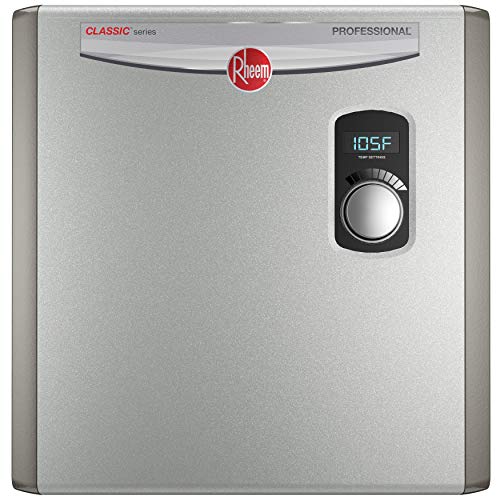
Rheem RTEX-24 24kW Tankless Water Heater
- Power24kW
- Flow Rate5.9 GPM
- Wiring RequirementsThree 40-amp double-pole breakers, #8 AWG copper wiring
- Temperature Range80°F – 140°F
- Voltage240V
- High flow rate for multiple fixtures
- Precise digital temperature control
- Energy savings by heating only when needed
- Requires significant electrical capacity and professional installation
- Three breakers and heavy wiring needed
Rheem 18kW Tankless Electric Water Heater
- Power18kW
- Flow Rate4.4 GPM
- Temperature ControlExternal digital LED display
- Voltage240V
- Self-modulating power for efficiency
- Simple bottom water connections
- Accurate digital temperature control
- Lower flow rate than 24kW model
- Still requires 240V and dedicated circuit
WINTEMP 18kW WiFi Tankless Water Heater
- Power18kW
- Flow Rate4.3 GPM
- Safety FeaturesLeakage, overheat, dry-fire protection
- CertificationETL
- Voltage240V
- WiFi remote control
- Multiple safety protections
- Energy-saving self-modulation
- Requires 150 Amp household service and dual breakers
- Slightly lower flow rate than some models
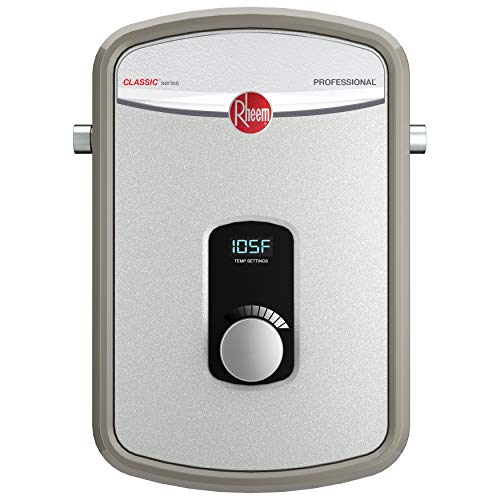
Rheem 11kW Multi Fixture Tankless Water Heater
- Power11kW
- Flow Rate2.68 GPM
- Wiring RequirementsOne 50-amp double-pole breaker, #8 AWG wiring
- Temperature Range80°F – 140°F
- Voltage240V
- Compact size for small spaces
- Energy efficient on-demand heating
- Simple electrical requirements
- Lower flow rate limits simultaneous fixture use
- Not suitable for larger households
ThermoMate 14kW Tankless Electric Water Heater
- Power14kW
- Flow Rate3.4 GPM
- Temperature Range86°F – 131°F
- CertificationETL
- Voltage240V
- Compact, space-saving design
- High thermal efficiency
- Durable heating element and corrosion resistance
- Requires dedicated 60 Amp breaker and 6 AWG wiring
- Flow rate may be low for larger homes
How to Choose the Right Electric Hot Water Heater
Choosing the best electric hot water heater starts with three checks: the heater type, how much hot water you use at once, and whether your electrical panel can support the load.
Choose The Heater Type First
Most homes pick from four electric options: standard storage tank, hybrid heat pump tank, whole-house tankless, or small point-of-use heaters. A fifth option, an indirect tank tied to a boiler, suits homes that already use hydronic heat.
A standard electric tank water heater is the default choice for a straightforward replacement. A 50-gallon electric tank is a normal starting point for 3 to 4 people, which is why many plumbers install a 50-gallon 240 V unit with a 4.5 kW element as their go-to. If you want simple, proven hardware and an easy swap on existing wiring, a conventional tank like a Rheem 50-gallon electric model is usually the safest bet; best tank electric water heaters for home use compares the stronger options.
Hybrid heat pump water heaters look like electric tanks but move heat from the air into the water instead of only using resistance elements. That design can be up to three times more efficient than a basic electric tank, which cuts running cost if you use a lot of hot water or pay a high kWh rate. They need more height and work best in a space that stays above roughly basement temperatures, such as a utility room or warm garage.
Whole-house electric tankless heaters, such as Rheem’s RTEX series, give on-demand heating with no storage tank. They save space, eliminate standby heat loss, and provide continuous hot water as long as the flow rate stays within the unit’s limit. Models like the Rheem RTEX-24 are strong fits where the electrical service is large enough and the goal is compact, endless hot water; our best electric tankless water heater guide focuses on these units.
Point-of-use heaters are small tanks or 110–120 V tankless units sized for a single sink or fixture. A 110 V 3,000 W tankless heater is designed for short runs at one faucet, a hand-wash sink, or tasks like car detailing where you only need a modest stream of warm water near the hose. These units are not whole-house solutions and usually cannot supply a full-flow shower in cold-climate incoming water.
If your home has a boiler, a combination setup using an indirect water heater often beats a stand-alone electric tank in efficiency. An indirect tank lets the boiler heat your domestic hot water through a coil and can be paired with electric elements for backup. For that layout, choose the boiler-friendly tank first, then size any electric backup; best indirect hot water heaters covers those systems.
RV diesel/electric or gas/electric portable water heaters are a different category entirely. They are built for 12 V power plus diesel or propane fuel, need careful venting, and are not interchangeable with 240 V residential electric tanks or tankless units. Use RV-rated or portable outdoor heaters only as their manuals allow, never as a substitute for a fixed indoor home water heater.
Confirm Your Electrical Service Can Handle It
Standard electric tanks are usually the easiest match for existing wiring. A typical 50-gallon electric tank runs a 4.5 kW element at 240 V on a 30 A double‑pole breaker. Many 80-gallon tanks use around 5.5 kW and may call for a 30–35 A breaker, so the jump from 50 to 80 gallons increases power draw but stays in the same general range once wired correctly.
Whole-house electric tankless heaters pull much more current because they heat water instantly instead of storing it. It is common for them to need multiple 40 A double‑pole breakers and, for larger models, a 200 A main service. Before choosing a unit like the Rheem RTEX-24, check your main breaker rating and free breaker slots; older 100 A panels often cannot support a big electric tankless without an electrical upgrade.
Small 110–120 V point-of-use heaters usually plug into a dedicated circuit or hard‑wire to a 20–30 A breaker, which makes them easy adds under a sink or near a single fixture. They are a good fit where running new 240 V wiring is impractical, but their limited wattage caps flow rate and temperature rise.
Match Capacity To How You Use Hot Water
For storage tanks, think in gallons and peak demand. A 50-gallon electric tank suits many 3–4 person homes that take staggered showers and run one major hot-water appliance at a time. Stepping up to an 80-gallon electric tank makes sense for 5+ people, frequent back‑to‑back showers, or a big soaking tub that can empty a smaller tank; best 80-gallon electric water heaters and best 50-gallon hot water heaters compare specific sizes and models.
For tankless heaters, focus on flow rate in gallons per minute (GPM) at your expected temperature rise. A family that may have two showers and a dishwasher or washing machine running at once often needs around 6–8 GPM from a whole‑house unit. The Rheem RTEX-24 can deliver up to 6 GPM at a 35 °F temperature rise, which is enough for multiple fixtures in many moderate‑climate homes; if your incoming water is very cold or you run many fixtures together, you may need to step up in size or consider a large tank instead.
Large soaking tubs are especially demanding. Check the tub’s gallon capacity and choose either a tank whose first‑hour delivery meets or exceeds that volume or a tankless unit sized for the fill rate you want. The next section on sizing walks through fixture counts, first‑hour ratings, and realistic flow rates in more detail so you can dial this in.
Balance Efficiency, Noise, And Maintenance
To compare efficiency, look at the Uniform Energy Factor (UEF) on the yellow EnergyGuide label. Higher UEF means less wasted electricity for the same amount of hot water. Conventional electric tanks cluster in a similar UEF range, while hybrid heat pump models reach much higher UEF values and can cut usage significantly over the life of the heater.
Tank water heaters with glass‑lined steel shells protect themselves from rust with a sacrificial anode rod, usually magnesium or an aluminum‑based alloy. The rod is designed to corrode instead of the tank, which is why checking and replacing it on schedule is one of the main ways to extend an electric tank’s lifespan. The anode types, the “aluminum vs magnesium” choice, and how often to replace them are covered in detail in the anode section later in this guide.
Sizing and Heat Output
Sizing a water heater starts with counting how many fixtures will use hot water at the same time. Showers, sinks, dishwashers, and washing machines all add to the total flow rate needed.
- List Hot Water FixturesCount all fixtures that could run simultaneously, noting their flow rates in gallons per minute (GPM).
- Calculate Total Flow RateAdd the GPM of all fixtures to find the peak demand. A typical shower uses 2.5 GPM, a kitchen sink 1.5 GPM, and a dishwasher about 1.5 GPM.
- Adjust for Incoming Water TemperatureCold winter water requires more heating power. Calculate the temperature rise needed by subtracting the incoming water temperature from the desired output, usually around 120°F.
For example, if your incoming water is 50°F and you want 120°F output, the heater must raise the temperature by 70°F. Tankless models list their GPM capacity at specific temperature rises. Choose one that meets your calculated flow and temperature rise.
The best-rated Rheem 50-gallon electric water heater offers reliable capacity for typical family use. For larger households or heavy simultaneous use, an 80-gallon electric water heater provides more stored hot water, avoiding delays in heating cycles.
| Appliance | Watts | Per hour | Per day (2 h) | Per month (30 days) |
|---|---|---|---|---|
| 50-Gallon Tank Heater | 4,500 W | 59¢ | $1.17 | $35.10 |
Running Costs of Electric Hot Water Heaters
Calculating the running cost of an electric water heater depends on its wattage, usage hours, and your local electricity rate. For example, a 1,500-watt heater running for one hour consumes 1.5 kWh. Multiply this by your electricity price per kWh to get the cost. Most US homes pay about 17 cents per kWh.
| Appliance | Watts | Per hour | Per day (8 h) | Per month (30 days) |
|---|---|---|---|---|
| 1,500 W space heater | 1,500 W | 26¢ | $2.04 | $61.20 |
| Heated blanket | 100 W | 1.7¢ | 14¢ | $4.08 |
Electric water heaters come in 110V and 240V models. A 110V electric water heater usually supports lower flow rates, making it suitable for small uses like a single shower but not for filling a large soaking tub. Large tubs require a 240V connection to deliver enough hot water quickly.
Tankless models heat water on demand, which reduces standby energy loss common in tank heaters. They tend to be more energy-efficient, especially if your household uses water sporadically. Tank models keep a reservoir of hot water ready, which can waste energy maintaining temperature when not in use.
Energy efficiency ratings like Uniform Energy Factor (UEF) help compare models. Higher UEF means less electricity wasted. Tankless heaters often have UEF ratings above 0.90, while tank models vary widely depending on insulation and size.
To lower your running costs, choose a heater sized properly for your household’s peak demand. Oversized units consume more energy maintaining heat, while undersized units may struggle to meet your hot water needs.
Safety and Certification Standards
Electric water heaters should carry UL, ETL, or CSA certification. These marks confirm the unit meets strict safety and performance standards set by independent labs. Certified models reduce risks of electrical faults and fire hazards.
Key safety features include overheat protection, which shuts off the heater if the water temperature exceeds safe limits. Dry-fire prevention stops the heating element from operating without water, avoiding damage and fire risk.
Installation must follow local electrical codes. A licensed electrician should connect and ground the heater properly. Improper installation can cause shock hazards and reduce the lifespan of the unit.
Combination electric and indirect water heaters use a heat exchanger connected to a boiler or furnace. These require professional installation and regular inspection to ensure safe operation.
Top-rated RV diesel/electric water heaters combine diesel fuel heat with electric elements for efficiency on the road. These units have specialized safety features to handle fuel combustion and electrical circuits safely.
Understanding Anodes in Electric Water Heaters
Inside a glass-lined steel electric tank water heater, the anode rod is the main defense against rust. It is a steel core rod wrapped in a more reactive metal and threaded into the top of the tank. That metal corrodes first so the tank wall does not.
As the anode dissolves, it attracts minerals and corrosive ions in the hot water. Once the rod is mostly eaten away, corrosion shifts to the tank itself and leaks often follow a few years later. Keeping a healthy anode in place is one of the few maintenance steps that can meaningfully extend an electric tank water heater’s lifespan, often out toward 10–15 years.
Aluminum, Magnesium, and Powered Anodes
Most residential electric water heaters ship with either aluminum-alloy or magnesium anode rods. Aluminum anodes form a hard aluminum oxide skin as they corrode, which slows further wear and makes the rod last longer, especially in hot or hard water. Magnesium anodes react more aggressively, so they give stronger protection but disappear faster.
Aluminum rods often handle hard or high-sulfate water better and are commonly used when households complain of a rotten-egg odor caused by magnesium reacting with sulfur bacteria. The trade-off is that aluminum can leave more sludge on the bottom of the tank, so regular flushing matters more. Magnesium rods suit soft to moderately hard water where odor is not an issue and you want the strongest corrosion protection.
Powered, or “electric,” anode rods use a small low-voltage power supply and an inert metal probe, often titanium. They do not rely on the rod metal dissolving, so they provide very strong protection in most water chemistries, reduce sediment, and typically do not need periodic replacement, though the electronics can fail over time.
| Feature | Aluminum Anode | Magnesium Anode | Powered (Electric) Anode |
|---|---|---|---|
| Corrosion Protection | Moderate to good | Very strong | Very strong in most water |
| Typical Lifespan | Longer; often more time between changes | Shorter; check more often | Rod does not wear; electronics can age |
| Best Use | Hard or high-sulfate water; odor problems | Soft to medium-hard water | Mixed or aggressive water; long-term installs |
| Maintenance Needs | Flush tank to remove extra sediment | Inspect frequently; replace when mostly consumed | Check indicator light or power supply periodically |
| Relative Cost | Usually least expensive | Similar or slightly higher | Highest upfront cost |
How Often to Check or Replace an Anode Rod
For most electric tank water heaters, plan to inspect the anode every 2–3 years starting around year three of the heater’s life. Replace it any time the rod is more than about half consumed, the steel core wire is exposed along much of its length, or it has broken off.
In very hard or aggressive water, a magnesium anode can be used up in as little as a couple of years, while an aluminum rod may last longer between inspections. In gentle water, either type can often run 5 years or more before it needs changing. A powered anode usually just needs its control box or status light checked; replace it only if the manufacturer says it has failed or if corrosion and odor problems return.
- Shut off powerTurn off the water heater’s circuit breaker and verify the power is off at the unit before you touch any wiring or plumbing on an electric tank.
- Cool and depressurize the tankLet the heater sit until the water is warm, not scalding, then close the cold-water supply valve and briefly open a nearby hot-water tap to relieve pressure.
- Locate the anode connectionFind the hex-head plug or combination hot-outlet/anode on the top of the tank as shown in your manual before choosing a socket and breaker bar.
- Know when to call a proIf the anode will not break loose, the hex head is badly rusted, or the tank shows signs of leaking, hire a licensed plumber instead of forcing it.
Frequently Asked Questions
What is the best electric hot water heater for a small home?
How do I calculate the flow rate needed for my hot water heater?
What are the benefits of tankless electric water heaters?
How often should I replace the anode rod in my water heater?
What is the average lifespan of an electric hot water heater?
Can I install an electric hot water heater myself?
We cover 50-gallon options for households in its own guide.
Readers in this position usually ask about best large gas water heaters as well.
