
Chilly evenings can cut your patio time short, but a tabletop heater can extend your outdoor comfort. These compact heaters provide targeted warmth for intimate gatherings, allowing you to enjoy your space longer without bulky equipment.
Tabletop Patio Heater Comparison
| Product | Best for | Heat Output (BTU) | Heating Radius (sq ft) | Fuel Type | Price |
|---|---|---|---|---|---|
| Cuisinart Tabletop Patio Heater Gray | Best Overall | 11,000 | 30 | Propane | Check price |
| Tangkula Tabletop Propane Patio Heater | Best Safety | 11,000 | Approx. 20 | Propane | Check price |
| MOMOKOVA Electric Tabletop Infrared Heater | Best Electric | — | 330 | Electric | Check price |
| Cuisinart Portable Tabletop Patio Heater Red | Best Color Option | 11,000 | 30 | Propane | Check price |
| Giantex Outdoor Propane Tabletop Heater | Best for Durability | 13,000 | — | Propane | Check price |


Top Tabletop Patio Heaters for Outdoor Dining
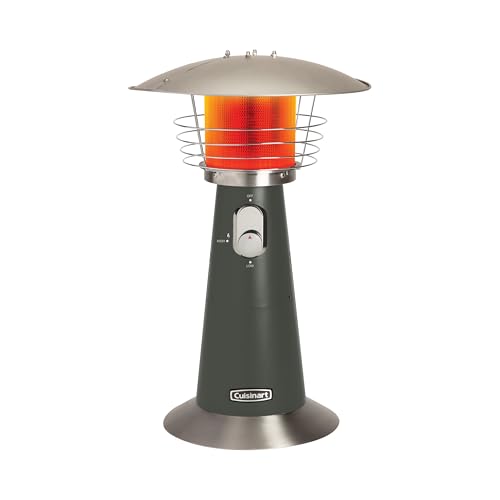
Cuisinart Tabletop Patio Heater Gray
- Heat Output (BTU)11,000
- Heating Radius (sq ft)30
- Fuel TypePropane
- Safety FeatureAnti-tilt automatic shut-off
- ColorGray
- Strong 11,000 BTU heat output
- Anti-tilt safety shut-off and burner guard
- Adjustable heat control dial
- Lightweight and portable design
- Requires propane tanks which may need refilling or replacement
Tangkula Tabletop Propane Patio Heater
- Heat Output (BTU)11,000
- Heating Radius (sq ft)Approx. 20
- Fuel TypePropane
- 360° all-direction heating
- Weighted base prevents tipping
- Pilot flame ignition for safety
- Rust-resistant steel and aluminum construction
- Requires assembly before first use
MOMOKOVA Electric Tabletop Infrared Heater
- Heat Output (BTU)—
- Heating Radius (sq ft)330
- Fuel TypeElectric
- 1500W carbon infrared heating
- IP55 waterproof and dustproof
- 45° tip-over auto shut-off
- Low noise operation
- Requires electric outlet, no propane use
Cuisinart Portable Tabletop Patio Heater Red
- Heat Output (BTU)11,000
- Heating Radius (sq ft)30
- Fuel TypePropane
- ColorRed
- 11,000 BTU heat output
- Anti-tilt safety shut-off
- Adjustable heat settings
- Compact and portable
- Propane tanks sold separately
Giantex Outdoor Propane Tabletop Heater
- Heat Output (BTU)13,000
- Heating Radius (sq ft)—
- Fuel TypePropane
- High 13,000 BTU heat output
- Durable stainless steel construction
- Anti-tilt automatic shut-off
- Weighted ring base for stability
- Heavier weight may reduce portability
How to Choose the Right Tabletop Patio Heater
Start with heat output and coverage. Tabletop patio heaters usually range from 3,000 to 10,000 BTU. Lower output suits small tables and intimate gatherings, while higher output covers larger areas or more people. Check the heater’s stated coverage in square feet to match your dining space.
Fuel type affects convenience and heat quality. Propane heaters offer strong, radiant heat and work without electricity, making them portable and effective outdoors. Electric heaters are quieter, cleaner, and safer for small spaces but need a power source and generally produce less heat.
Look for safety features and certifications. A good heater has tip-over and overheat protection, and a UL, ETL, or CSA listing. These features reduce fire risk and ensure the unit meets safety standards. Never use outdoor-only models indoors or in enclosed spaces.
Portability and design matter for outdoor dining. Choose a lightweight unit with a stable base that fits your table size. Compact models with handles or carrying cases are easier to move and store. The design should blend with your outdoor decor without blocking views or crowding seating.
| Feature | What to Look For |
|---|---|
| Heat Output | 3,000 to 10,000 BTU, coverage area in sq ft |
| Fuel Type | Propane for strong heat, electric for clean, quiet operation |
| Safety | Tip-over and overheat protection, safety certification |
| Portability | Lightweight, stable base, easy to carry |
Choose a heater that fits your dining setup and outdoor conditions. For small tables and quick heat, electric models shine. For larger groups or no electrical access, propane is better. Prioritize safety features and portability to enjoy warmth without hassle.
Sizing and Heat Output
A tabletop patio heater for a four-to-six person dining table needs 5,000 to 7,000 BTU to warm 20 to 40 square feet. Larger patios or tables seating eight need 8,000 to 10,000 BTU or two smaller units placed at opposite ends.
BTU measures propane heat output; watts measure electric. One BTU equals 0.293 watts, so a 7,000 BTU propane heater delivers about 2,050 watts of heat. Electric tabletop models run from 500 to 1,500 watts.
| Fuel Type | Output Range | Typical Coverage |
|---|---|---|
| Propane | 3,000 to 10,000 BTU | 10 to 50 sq ft |
| Electric | 500 to 1,500 watts | 10 to 30 sq ft |
Wind cuts effective coverage by half or more. A 7,000 BTU heater that warms 30 square feet in still air may only cover 15 square feet in a steady breeze. Place heaters close to seating and shield them from crosswinds with a wall, railing or windbreak.
Multiple smaller heaters spread heat more evenly than one large unit on a long table. Two 5,000 BTU heaters at opposite ends of an eight-foot table keep everyone warm; a single 10,000 BTU heater in the center leaves the ends cold.
For permanent installations with higher output, see the best outdoor patio heater guide. For electric models near water, the best electric heaters for outdoor showers page covers waterproof ratings.
Safety Features in Tabletop Heaters
A tip-over shut-off and overheat protection are the two non-negotiable features. The tip-over switch cuts power the moment the heater tilts beyond a safe angle—usually 30 to 45 degrees—so a bumped table or gust of wind won’t leave a live heating element face-down on wood or fabric. Overheat protection monitors the internal temperature and shuts the unit down before components fail or ignite nearby materials.
Look for a UL, ETL or CSA listing on the label or in the manual. These marks confirm the heater passed independent tests for electrical safety, flame resistance and tip-over performance. A propane tabletop heater should also carry a statement that it is rated for outdoor use; indoor-only models lack the ventilation design needed to disperse combustion gases safely.
Placement matters as much as the safety switches. Set the heater in the center of a stable, level table—not near the edge—and keep a three-foot radius clear of napkins, menus, decorations, overhanging umbrellas and the backs of chairs. Propane canisters get hot during use; check that the canister compartment has ventilation slots and that no one leans against the table while the heater runs.
- Check the TableThe surface must be flat, stable and large enough to keep the heater at least six inches from every edge. A wobbly or undersized table defeats the tip-over switch.
- Maintain ClearanceThree feet in all directions: above, below and around. Move planters, cushions and serving trays outside that zone before you light the heater.
- Turn Off Between CoursesShut the heater down whenever guests leave the table for more than a few minutes, and always turn it off before you go inside. Unattended operation is the single largest cause of patio heater fires.
- Store Propane ProperlyDisconnect the canister after each use and store it upright in a ventilated outdoor space, away from ignition sources and direct sun. Never leave a canister attached overnight.
For broader advice on choosing a heater that balances output and safety for larger spaces, see our guide to the best outdoor patio heater options across all fuel types.
Understanding Running Costs
Running costs for tabletop patio heaters depend on the heat output and fuel type. Heaters are rated in BTU (British Thermal Units) for propane and watts for electric models.
A typical propane tabletop heater produces between 7,000 and 10,000 BTU per hour. At current average propane prices, this costs roughly $0.30 to $0.45 per hour to run.
Electric tabletop heaters usually draw about 1,000 to 1,500 watts. At an electricity rate of $0.17 per kWh, that equals about $0.17 to $0.26 per hour.
| Fuel Type | Typical Output | Cost per Hour (Approx.) |
|---|---|---|
| Propane | 7,000–10,000 BTU | Typical cost varies with use and power rates, usually around thirty to forty-five cents per hour at average US electricity prices. |
| Electric | 1,000–1,500 W | Typical cost varies with use and power rates, usually around seventeen to twenty-six cents per hour at average US electricity prices. |
Propane heaters cost more to run per hour but often produce more heat, which can warm larger areas faster. Electric heaters are cheaper to run but usually provide less heat.
Factors affecting running costs include outdoor temperature, wind conditions, and how close you sit to the heater. Strong wind increases heat loss and fuel use.
How much does it cost to run a patio heater? Assume 8 hours of use per day over a 30-day month for monthly estimates. For example, a 1,500 W electric heater running 8 hours daily at $0.17/kWh uses 1.5 kW × 8 h × 30 days × $0.17 = $61.20.
| Appliance | Watts | Per hour | Per day (8 h) | Per month (30 days) |
|---|---|---|---|---|
| Typical propane heater (9,000 BTU) | 2,637 W | 45¢ | $3.59 | $107.59 |
| Electric heater (1,500 W) | 1,500 W | 26¢ | $2.04 | $61.20 |
Common Misconceptions About Tabletop Heaters
Tabletop patio heaters can be effective, but their performance depends on realistic expectations and conditions. They are designed to warm small areas immediately around the table, not large open spaces.
Many expect tabletop heaters to replace standing heaters. Standing models typically have higher heat output and wider coverage. Tabletop heaters focus on portability and convenience for small gatherings. They usually produce between 3,000 and 5,000 BTU, enough for a few feet of radius.
Another misconception is that tabletop heaters provide uniform heating like indoor heaters. They emit radiant heat that warms objects and people directly in front of them. This means you need to be close and facing the heater to feel the warmth.
Tabletop heaters also differ by fuel type. Propane models offer quick, intense heat but require ventilation and a propane tank. Electric tabletop heaters are safer for enclosed patios but have lower heat output and need a power source.
For larger outdoor spaces or colder climates, consider combining tabletop heaters with wind barriers, blankets, or multiple heat sources. This approach increases comfort without overspending on oversized heaters.
Choosing the right heater means matching its output and features to your outdoor dining setup. For more on sizing and heat output, see how to size a patio heater.
Frequently Asked Questions
What is the best tabletop patio heater for small spaces?
How much heat does a tabletop heater provide?
Can I use a tabletop heater on a wooden table?
What fuel types are available for tabletop patio heaters?
How do I maintain my tabletop patio heater?
Are electric tabletop heaters as effective as propane?
The other half of this decision is how to winterize a bird bath.
There is more on choosing an outdoor heater in a guide of its own.
