
As the temperature drops, outdoor spaces can become uncomfortable. An outdoor infrared heater can provide the warmth you need to enjoy your patio or garage during cooler months.
Comparison of Top Outdoor Infrared Heaters
| Product | Best for | Power (W) | Heat Settings | Mounting Options | Safety Features | Price |
|---|---|---|---|---|---|---|
| DR. INFRARED HEATER Portable Outdoor Infrared Heater | Best Overall | 900, 1200, 1500 | 3 | Wall, ceiling | IP55 weatherproof | Check price |
| DR. INFRARED HEATER DR-239 3000W Infrared Patio Heater | Most Powerful | 3000 | — | Wall, ceiling | Overheat protection, IP55 weatherproof | Check price |
| Paraheeter Outdoor Electric Infrared Patio Heater 1500W | Best Versatile Mounting | 1500 | — | Wall, ceiling, tripod stand | IP65 weatherproof, CSA certified | Check price |
| VAGKRI 42″ 1500W Outdoor Infrared Heater Tower | Best Adjustable Settings | 1500 | 9 | Free standing tower | ETL listed, IPX5 waterproof | Check price |
| SereneLife 900W Outdoor Electric Patio Heater | Best for Small Areas | 900 | 2 | Standing | Tip-over switch, overheat protection, mesh guard | Check price |



Top Outdoor Infrared Heaters for Your Space
DR. INFRARED HEATER Portable Outdoor Infrared Heater
- Power900W, 1200W, 1500W
- Mounting OptionsWall and ceiling included
- Safety FeaturesIP55 weatherproof
- Voltage120V, 60Hz
- IP55 weatherproof for versatile placement
- Remote control for easy operation
- Three power settings for adjustable heat
- No thermostat for precise temperature control
- Requires standard 120V power outlet
DR. INFRARED HEATER DR-239 3000W Infrared Patio Heater
- Power3000W
- Mounting OptionsWall and ceiling included
- Safety FeaturesOverheat protection, IP55 weatherproof
- Voltage220V-240V
- High heat output for large spaces
- Remote control and easy installation
- ETL listed with safety features
- Requires 220V-240V power supply
- Heavier and less portable than smaller models
Paraheeter Outdoor Electric Infrared Patio Heater 1500W
- Power1500W
- Mounting OptionsWall, ceiling, tripod stand
- Safety FeaturesIP65 weatherproof, CSA certified
- Multiple mounting options including tripod stand
- IP65 weatherproof for outdoor durability
- Carbon fiber tube technology with 10,000-hour lifespan
- Foam protective pad must be removed before use
- No remote control included
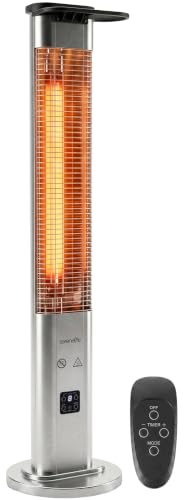
VAGKRI 42″ 1500W Outdoor Infrared Heater Tower
- Power1500W
- Heat Settings9 levels (620W to 1500W)
- Mounting OptionsFree standing tower
- Safety FeaturesETL listed, IPX5 waterproof
- Fast 1-second heating response
- Nine adjustable heat settings
- 24-hour timer for energy saving
- Tower design may not suit all outdoor spaces
- No mounting brackets included
SereneLife 900W Outdoor Electric Patio Heater
- Power900W
- Heat Settings2
- Mounting OptionsStanding
- Safety FeaturesTip-over switch, overheat protection, mesh guard
- Weather RatingIP65
- Quiet operation with remote control
- Safety features for tip-over and overheat
- Weather-resistant IP65 design
- Limited heating range of 15 sq. ft.
- Lower wattage may not suit larger spaces
How to Choose the Right Outdoor Infrared Heater
Outdoor infrared heaters warm objects and people directly by emitting infrared radiation. This differs from fan heaters that blow warm air around and convection heaters that heat the air itself. Infrared heaters work well in winter because their heat is not lost to wind or open spaces as quickly as warmed air.
Heating power is measured in watts or BTUs. More watts mean more heat output. For outdoor use, look for at least 1500 watts to handle open areas. Some heaters reach 3000 watts for larger spaces or commercial settings.
Mounting options vary. Wall-mounted heaters save floor space and direct heat where needed. Freestanding units offer portability for changing setups. Some models include wheels or handles for easy moving.
| Mounting Type | Best For |
|---|---|
| Wall-mounted | Permanent spots like patios or decks |
| Freestanding | Flexible use on patios or events |
| Ceiling-mounted | Overhead coverage in covered spaces |
Safety features matter outdoors too. Look for tip-over shutoff, overheat protection, and weather-resistant housings. Certified models meet UL, ETL, or CSA standards to ensure safety and reliability. Avoid heaters without these certifications.
Sizing and Heat Output for Outdoor Spaces
Heat output is measured in watts or British Thermal Units (BTU). One watt equals about 3.41 BTUs. Knowing this helps compare heaters and calculate coverage.
Calculate the area you want to heat in square feet. For outdoor infrared heaters, plan about 10 watts per square foot in mild conditions. For colder or windier areas, increase this to 15 or 20 watts per square foot.
Halogen infrared heaters produce visible light along with heat. Their light output can be bright, which some find distracting. Choose halogen models if you want added illumination and quick heat but expect some glare.
| Appliance | Watts | Per hour | Per day (4 h) | Per month (30 days) |
|---|---|---|---|---|
| 1,500 W outdoor infrared heater | 1,500 W | 26¢ | $1.02 | $30.60 |
| 3,000 W outdoor infrared heater | 3,000 W | 51¢ | $2.04 | $61.20 |
How many watts do you need? For a 150-square-foot patio, a 1500-watt heater usually suffices in calm weather. Larger spaces or colder, windy conditions require 3000 watts or more. Compare models by their wattage and BTU ratings to match your space.
Running Costs of Outdoor Infrared Heaters
Infrared heaters are generally energy efficient because they warm objects and people directly without heating the air first. This direct heating reduces wasted energy in outdoor spaces where air circulation is constant.
The electricity an infrared heater uses depends on its wattage, typically ranging from 1,000 to 3,000 watts. For example, a 1,500-watt heater running for one hour uses 1.5 kilowatt-hours (kWh) of electricity.
To calculate the cost per hour, multiply the heater’s wattage divided by 1,000 by the electricity rate per kWh. For instance, at $0.17 per kWh, a 1,500-watt heater costs 1.5 × $0.17 = $0.26 per hour to run.
| Heater Wattage | Hourly Energy Use (kWh) | Cost per Hour at $0.17/kWh |
|---|---|---|
| 1,000 W | 1.0 | “at the U.S. average electricity rate” |
| 1,500 W | 1.5 | “at the U.S. average electricity rate” |
| 3,000 W | 3.0 | “at the U.S. average electricity rate” |
Comparing models, look beyond wattage to features like adjustable heat settings and timers. These allow you to reduce power use when full heat isn’t needed, lowering overall costs.
Some infrared heaters use quartz or ceramic elements, which can differ slightly in efficiency. However, wattage remains the main factor in energy consumption, not the heating element type.
Running your heater only when you need it and choosing a model with a thermostat or remote control can help manage energy use precisely. This avoids unnecessary electricity use, especially outdoors where heat loss is faster.
Safety and Certification for Outdoor Infrared Heaters
Outdoor infrared heaters face exposure to weather, so an IP (Ingress Protection) rating is crucial. A rating of IP65 or higher means the heater is dust-tight and protected against water jets, suitable for outdoor use.
Common problems with outdoor heaters include water damage, overheating, and tipping over. Look for features like tip-over shutoff, overheat protection, and weather-resistant housing to reduce these risks.
Certifications such as UL (Underwriters Laboratories), ETL (Intertek), or CSA (Canadian Standards Association) indicate the heater meets safety standards for electrical and fire hazards.
Manufacturer instructions usually specify safe placement, clearance distances, and ventilation requirements. Follow these closely to prevent accidents and ensure the heater operates as designed.
Outdoor heaters should never be left running unattended for long periods. Even with safety features, supervision reduces risks of malfunction or fire.
Check that the heater’s power cord and plug are rated for outdoor use and free of damage. Replace damaged cords instead of attempting repairs to avoid shock or fire hazards.
Some models include remote controls and timers to help manage safe operation. Set timers to shut off the heater automatically if you forget.
Understanding Different Types of Infrared Heaters
Infrared heaters differ from convection heaters by warming objects and people directly through infrared radiation, rather than heating the air first. This makes infrared models more efficient in outdoor or drafty spaces where heated air quickly dissipates.
The two main types of infrared heaters are halogen and carbon. Halogen heaters use quartz tubes filled with halogen gas to produce short-wave infrared radiation. They heat up very fast and deliver intense, focused warmth. Carbon heaters emit long-wave infrared radiation from carbon fiber elements, providing a gentler, more evenly dispersed heat that penetrates deeper into surfaces.
Halogen infrared heaters excel at quick, direct heating over a small area. They are ideal for spot heating on patios or decks where immediate warmth is needed. However, they can create hot spots and may feel harsh if you stay too close. Carbon infrared heaters suit larger spaces or longer use periods. Their softer heat covers a wider area and feels more natural, but they take longer to reach full warmth.
- Halogen heaters heat up and cool down quickly, making them responsive but less even.
- Carbon heaters provide steady, penetrating warmth but require more time to warm up.
- Halogen models usually consume more power during operation.
- Carbon heaters often have longer lifespans due to durable heating elements.
Choose a halogen infrared heater if you want fast, intense heat for short outdoor gatherings or small zones. Opt for a carbon infrared heater for all-night patio comfort or larger outdoor areas where gentle, widespread warmth matters more than instant heat.
For details on sizing and choosing the right heater for your outdoor space, see our buying guide on the best outdoor patio heater.
Frequently Asked Questions
What is the difference between a halogen heater and an infrared heater?
Do infrared heaters work in winter?
How much energy do outdoor infrared heaters use?
What is the average lifespan of an infrared heater?
Can infrared heaters be used indoors?
What safety features should I look for in an outdoor infrared heater?
There is more on best heaters for solar systems in a guide of its own.
Readers in this position usually ask about battery powered heater reviews as well.