
Keeping a small bedroom warm during the cold months can be a challenge. A portable space heater with a thermostat can provide the efficient and reliable warmth you need to stay cozy.
This roundup highlights the top heaters with thermostats, focusing on their features, safety, and performance in small spaces.
Heater Features Comparison
| Product | Best for | Heat Settings | Auto Shut-Off | Size | Weight | Price |
|---|---|---|---|---|---|---|
| VOCRS 1500W PTC Electric Heater with Remote | Best Overall | 700W/1000W/1500W | Overheat and tip-over protection plus timer | — | — | Check price |
| Garvee 1500W/750W Portable Ceramic Heater | Best Budget | 750W/1500W | Tip-over and overheat protection | — | 2.2 lbs | Check price |
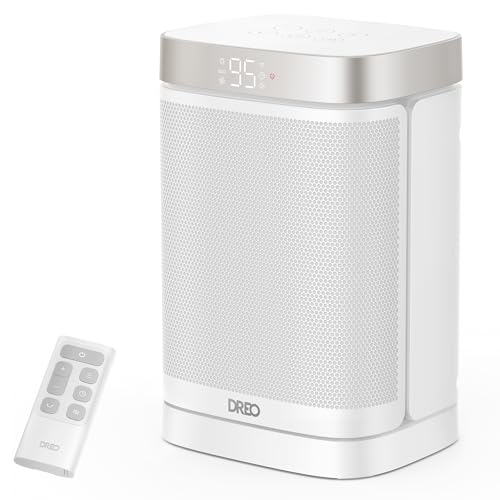
| DREO Portable Electric Heater with Advanced Thermostat | Best Precision Control | Multiple levels including ECO and Power | Tip-over and overheat protection | — | — | Check price |
| DREO Atom One 1500W Oscillating Heater | Best Oscillation | Multiple levels with ECO mode | Tip-over and overheat protection | — | — | Check price |


Top Heaters With Thermostats for Small Bedrooms
VOCRS 1500W PTC Electric Heater with Remote
- Heat Settings700W/1000W/1500W
- Auto Shut-OffOverheat and tip-over protection plus timer
- Size—
- Weight—
- Three adjustable heat settings for tailored warmth
- Remote control with digital display for convenience
- Multiple safety protections including tip-over and overheat shut-off
- 1-12 hour timer for energy savings and safety
- No oscillation feature to spread heat wider
- Slightly heavier than some compact models
Garvee 1500W/750W Portable Ceramic Heater
- Heat Settings750W/1500W
- Auto Shut-OffTip-over and overheat protection
- Size—
- Weight2.2 lbs
- Dual power settings for energy saving or quick heat
- Quiet operation with ceramic heating technology
- Compact and lightweight for portability
- Strong safety features with tip-over and overheat protection
- Manual thermostat lacks precise digital control
- No timer or remote control included
DREO Portable Electric Heater with Advanced Thermostat
- Heat SettingsMultiple levels including ECO and Power
- Auto Shut-OffTip-over and overheat protection
- Size—
- Weight—
- Precise thermostat with 1°F increments
- Quiet operation at 34dB with advanced fan design
- Multiple safety features including tilt sensor and overheat protection
- Remote control and timer for convenience
- No oscillation function to cover wider area
- Slightly larger size than some compact models
DREO Atom One 1500W Oscillating Heater
- Heat SettingsMultiple levels with ECO mode
- Auto Shut-OffTip-over and overheat protection
- Size—
- Weight—
- 70° oscillation for wide heat distribution
- Precise digital thermostat with ECO mode
- Multiple safety protections with ETL certification
- Quiet operation with advanced motor and fan design
- Heavier than non-oscillating models
- No remote control included
How to Choose the Right Heater for Your Small Bedroom
Choose a heater with a precise thermostat to keep your bedroom at a steady temperature. This control helps avoid overheating and saves energy by cycling the heater on and off as needed.
Match the heater’s heat output to your room size. For small bedrooms, look for models with adjustable heat settings up to 1,500 watts. This wattage is usually enough to warm spaces around 150 square feet efficiently.
Safety features are essential. Pick heaters with tip-over protection and automatic shut-off if they overheat. These features prevent fires and injuries, especially in bedrooms.
Portability matters in small rooms. A compact, lightweight design with a handle makes it easy to move the heater to the spot you need. A slim profile helps fit the heater without crowding your space.
Understanding Heat Output and Efficiency
Calculate the wattage you need by multiplying the square footage of your bedroom by 10 watts per square foot. For example, a 150-square-foot room typically needs a 1,500-watt heater.
BTU ratings help compare heat output across types. One watt equals about 3.41 BTUs. A 1,500-watt heater produces roughly 5,115 BTUs, enough to heat a small bedroom comfortably.
Running costs depend on wattage, usage time, and your electricity rate. Use this formula: watts ÷ 1,000 × hours × price per kWh. For instance, running a 1,500-watt heater 8 hours a day at $0.17 per kWh costs about $2.04 daily.
| Appliance | Watts | Per hour | Per day (8 h) | Per month (30 days) |
|---|---|---|---|---|
| 1,500 W space heater | 1,500 W | 26¢ | $2.04 | $61.20 |
| Heated blanket | 100 W | 1.7¢ | 14¢ | $4.08 |
Safety Features to Look for in Space Heaters
The most important safety features in space heaters are overheat protection and tip-over switches. Overheat protection shuts the heater off if it gets too hot, preventing fires. Tip-over switches cut power automatically if the heater falls, a common cause of accidents.
Look for heaters with UL, ETL, or CSA certification. These marks show the heater has passed independent safety tests and meets electrical standards. Certification reduces the risk of electrical faults and unsafe designs.
Some heaters are designed to be safe for overnight use. They have multiple safety features like cool-touch exteriors, automatic shut-off timers, and precise thermostats that maintain steady temperatures without overheating. Always check the manufacturer’s instructions before leaving a heater running while you sleep.
Avoid models without tip-over switches or overheat protection. Portable heaters without these features pose a higher risk, especially in bedrooms where pets or children might knock them over. The VOCRS 1500W PTC Electric Heater, for example, includes both features along with remote control for easy adjustments without leaving the bed.
Common Mistakes When Using Space Heaters
To avoid space heater accidents, never plug a heater into an extension cord or power strip. These can overheat and cause fires. Always plug heaters directly into a wall outlet rated for the heater’s wattage.
Do not leave space heaters unattended or running while you sleep unless the model is explicitly designed for continuous use and has safety features to support that. Many heaters lack automatic shut-off timers or fail-safe mechanisms, making unattended use risky.
Keep at least 3 feet of clearance around the heater. Do not place heaters near curtains, bedding, furniture, or papers. Restricted airflow or flammable materials close by can ignite if the heater overheats or tips over.
Common mistakes include covering the heater, using it in damp locations without proper ratings, and placing it on unstable surfaces. Each of these raises the risk of fire or electric shock. Follow the manual’s placement and usage guidelines carefully.
For a safe start, choose a heater with built-in safety features and follow all instructions. Learn more details on choosing safe models in our best space heaters for small bedrooms guide.
Frequently Asked Questions
What defines the best portable space heater for a small bedroom?
Why is a thermostat crucial in a bedroom space heater?
Which heater types are most effective for small bedrooms?
Can I use a space heater overnight safely?
What safety certifications should I look for in a space heater?
How do I calculate the running costs of my space heater?
If that sounds like your room, read up on best small space heater next.
We cover high-rated electric heaters in its own guide.
