
Cold spots in your home can be uncomfortable and lead to high heating bills. Electric baseboard heaters offer a reliable solution for maintaining warmth in specific areas, especially during the colder months.
Electric Baseboard Heaters Comparison
| Product | Best for | Heat Output | Size | Auto Shut-off | Weight | Price |
|---|---|---|---|---|---|---|
| ROVSUN 32” Electric Baseboard Heater with Remote | Best Overall | — | 32 inches | Timer up to 12 hours | — | Check price |
| Comfort Zone Electric Baseboard Heater 1,500W | Best for Medium Rooms | 1500 W | — | Tip-over switch | — | Check price |
| Cadet Portable Electric Baseboard Heater 1500W 120V | Best Portable | 1500 W | 49 inches | Tip-over and overheat | — | Check price |
| DREO Portable Electric Space Heater with Thermostat | Best Smart Control | 1500 W | — | Overheat protection | — | Check price |
| Dr Infrared Heater DR-968 Portable Space Heater 1500W | Best Dual Heat | 1500 W | — | 12-hour timer | 19 lbs | Check price |
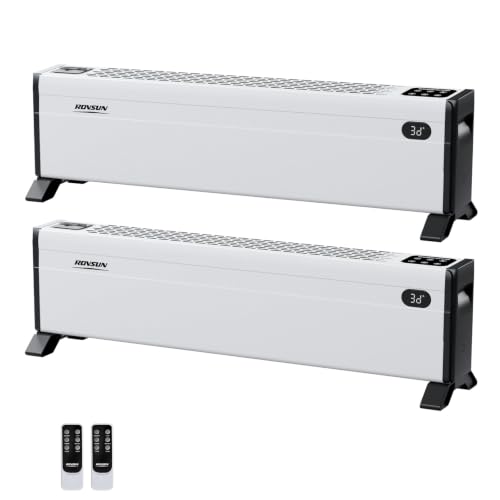



Top Picks for Electric Baseboard Heaters
ROVSUN 32” Electric Baseboard Heater with Remote
- Heat Output—
- Size32 inches
- Auto Shut-offTimer up to 12 hours
- Weight—
- Heats large area quickly
- Built-in humidifier prevents dry air
- Remote and touch panel controls
- Multiple safety features
- Only plug-in, no hardwiring option
- Humidifier adds complexity
Comfort Zone Electric Baseboard Heater 1,500W
- Heat Output1500 W
- Size—
- Auto Shut-offTip-over switch
- Weight—
- Adjustable thermostat and two heat settings
- Durable dent-proof panels
- Tip-over and overheat safety features
- Quiet operation
- No remote control
- Limited to medium room size
Cadet Portable Electric Baseboard Heater 1500W 120V
- Heat Output1500 W
- Size49 inches
- Auto Shut-offTip-over and overheat
- Weight—
- Plug-in design, no wiring required
- Built-in dial thermostat
- Tip-over and overheat protection
- Lightweight with handles
- No remote control or timer
- Longer length may limit placement
DREO Portable Electric Space Heater with Thermostat
- Heat Output1500 W
- Size—
- Auto Shut-offOverheat protection
- Weight—
- Precise temperature control with wide range
- Very quiet operation
- Tilt detection and overheat protection
- Remote control and multiple modes
- Smaller coverage area
- Requires plug-in
Dr Infrared Heater DR-968 Portable Space Heater 1500W
- Heat Output1500 W
- Size—
- Auto Shut-off12-hour timer
- Weight19 lbs
- Dual infrared and convection heating
- 12-hour auto shut-off timer
- Tip-over and overheat protection
- Quiet operation and caster wheels
- Heavier at 19 lbs
- Requires plug-in outlet
How to Choose the Right Electric Baseboard Heater
Pick a heater sized for your room. Baseboard heaters list wattage and approximate square footage coverage. A 1,500-watt model typically heats about 150 square feet. Measure your room and choose a wattage that matches or slightly exceeds that area.
Safety features matter. Look for tip-over protection and overheat shut-off. Electric baseboard heaters usually mount low on walls, so tip-over isn’t common, but models with these features add peace of mind. Make sure the heater has a UL or ETL safety listing.
Energy efficiency affects your monthly bill. Electric baseboard heaters convert nearly all electricity into heat, so efficiency differences come down to controls and insulation of your room. Models with adjustable thermostats and multiple heat settings let you avoid overheating and save energy.
Adjustable settings improve comfort and cost control. A heater with a built-in thermostat or remote control lets you set the exact temperature. This avoids running the heater at full power unnecessarily.
Ceramic heaters and electric panel heaters differ in heat delivery. Ceramic heaters warm the air quickly with a fan, good for short bursts in small spaces. Electric panel heaters heat surfaces and radiate warmth slowly, better for steady background heat. For most rooms, a convection baseboard heater is more efficient and comfortable.
Use an electric unit heater for stairwells or garages. These heaters blow warm air into open spaces and can handle drafts better than baseboard units.
Convector heaters use about the same electricity as oil-filled radiators at the same wattage. The difference is in heat distribution and how long the heater stays warm after turning off. Oil-filled radiators keep radiating heat longer, which can save energy overnight.
Understanding Heating Capacity and Running Costs
Calculate your heating needs in BTUs. One watt equals about 3.41 BTUs per hour. So, a 1,500-watt heater produces roughly 5,115 BTUs. To heat a room, you need about 20 BTUs per square foot, depending on insulation and climate.
Running costs depend on wattage, hours used, and your electricity rate. The formula is watts divided by 1,000, times hours, times price per kilowatt-hour (kWh). For example, a 1,500-watt heater running 8 hours a day at 17 cents per kWh costs 1.5 × 8 × 0.17 = $2.04 per day.
| Appliance | Watts | Per hour | Per day (8 h) | Per month (30 days) |
|---|---|---|---|---|
| 1,500 W baseboard heater | 1,500 W | 26¢ | $2.04 | $61.20 |
| Heated blanket | 100 W | 1.7¢ | 14¢ | $4.08 |
Electric baseboard heaters use electricity continuously when on. Unlike some heaters that cycle on and off, baseboards run steadily to maintain temperature. This means your bill depends heavily on how long you run the heater and your thermostat setting.
Knowing your heater’s wattage helps you estimate monthly costs. If you reduce usage by an hour or lower the thermostat a few degrees, it can cut your bill noticeably.
Safety Features in Electric Baseboard Heaters
Electric baseboard heaters are safe when they include key safety features that prevent accidents and overheating. Look for heaters with tip-over protection and automatic shut-off. These features cut power if the heater falls or reaches a dangerous temperature.
A cool-touch body is essential. It prevents burns if you or pets accidentally touch the heater while it runs. Even when heating, the exterior should stay safe to handle or brush against briefly.
Certification from UL or ETL shows the heater meets strict safety standards. These marks mean the product has passed independent electrical and fire hazard tests.
Electric baseboard heaters are safe for home use when you follow the manufacturer’s instructions and use models with these safety features. Never leave a heater running unattended in an empty room unless the manual specifically allows it.
The Benefits of Convection Heating
Convection heating works by warming the air near the heater, which then circulates throughout the room. This creates a smooth, even heat that spreads without hot or cold spots.
Convection heaters are often quieter than fan-forced models because they rely on natural air movement. This makes them ideal for bedrooms and living spaces where noise matters.
They also tend to be more energy-efficient. By steadily warming the air, convection heaters maintain a consistent temperature without cycling on and off as frequently as some other types.
Convection heaters suit larger rooms best. They fill the space with warm air that rises and moves, providing uniform heat across the area.
| Heater Type | Noise Level | Energy Efficiency | Best Use |
|---|---|---|---|
| Convection | Low | High | Larger rooms, quiet environments |
| Fan-forced | Moderate to high | Moderate | Small rooms, quick heat |
| Radiant | Silent | Variable | Spot heating, close proximity |
Frequently Asked Questions
What is the average lifespan of an electric baseboard heater?
Can electric baseboard heaters be used as the primary heat source?
How do I maintain my electric baseboard heater?
What is the difference between convection and radiant heating?
Are electric baseboard heaters energy-efficient?
Can I install electric baseboard heaters myself?
If that sounds like your room, read up on best small space heater next.
We go through heaters for power outages step by step in a separate article. For the detail, see our notes on effective heating for timber structures.
Before you buy anything, it is worth looking at how to choose electric heaters. The other half of this decision is electric heaters for silent heating.
It helps to understand best heater for 400 square feet before spending anything.
