
EcoSmart tankless water heaters provide efficient, on-demand hot water without the bulk of traditional tank models. With various options available, selecting the right model can significantly impact your energy savings and comfort.
EcoSmart Tankless Water Heater Comparison
| Product | Best for | Power (kW) | GPM | Dimensions | Energy Efficiency | Price |
|---|---|---|---|---|---|---|
| EcoSmart ECOS 27 Tankless Electric Water Heater | Best Overall | 27 | 2.7 to 6.6 | 19 x 4.25 x 9.25 inches | 96% | Check price |
| EcoSmart ECOS 18 Tankless Electric Water Heater | Best for Small Homes | 18 | 1.8 to 4.3 | 19 x 4.25 x 9.25 inches | 96% | Check price |
| Ecosmart ECO 36 36kw Electric Tankless Water Heater | Best for Large Homes | 36 | — | — | 99.8% | Check price |
| EcoSmart ECO 8 Tankless Water Heater, Electric, 8-kW | Most Durable | 8 | — | 12 x 8 x 4 inches | — | Check price |
| EcoSmart POU 4T 3.5kW 120v Thermostatic Point of Use Tankless Water Heater | Best Point of Use | 3.5 | — | — | — | Check price |

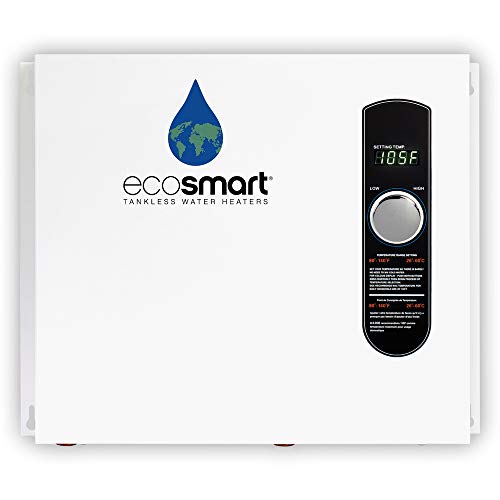
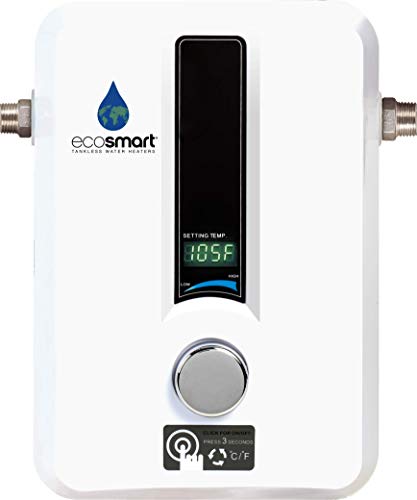

Our Top EcoSmart Tankless Water Heater Picks
EcoSmart ECOS 27 Tankless Electric Water Heater
- Power (kW)27
- GPM2.7 to 6.6
- Dimensions19 x 4.25 x 9.25 inches
- Energy Efficiency96%
- Consistent hot water without running out
- 96% thermal energy efficiency
- Compact wall-mount design
- Requires 112.5 amps breaker, so professional installation likely
EcoSmart ECOS 18 Tankless Electric Water Heater
- Power (kW)18
- GPM1.8 to 4.3
- Dimensions19 x 4.25 x 9.25 inches
- Energy Efficiency96%
- Endless on-demand hot water
- Up to 96% thermal efficiency
- Small footprint for wall or point-of-use installation
- Limited to lower flow rates than larger models
Ecosmart ECO 36 36kw Electric Tankless Water Heater
- Power (kW)36
- GPM—
- Dimensions—
- Energy Efficiency99.8%
- Highest power and efficiency
- Digital temperature display
- Compact and sleek design
- High power needs require substantial electrical upgrade
EcoSmart ECO 8 Tankless Water Heater, Electric, 8-kW
- Power (kW)8
- GPM—
- Dimensions12 x 8 x 4 inches
- Energy Efficiency—
- Highly durable construction
- Simple operation
- Compact size
- Lower power limits flow rate and simultaneous use
EcoSmart POU 4T 3.5kW 120v Thermostatic Point of Use Tankless Water Heater
- Power (kW)3.5
- GPM—
- Dimensions—
- Energy Efficiency—
- Compact size for point-of-use
- Energy efficient on-demand heating
- Consistent hot water supply
- Low power limits use to single fixtures
How to Choose the Right EcoSmart Tankless Water Heater
Choose an EcoSmart tankless water heater by matching its power output and flow rate to your household’s hot water demand. The key is to find a model that delivers enough gallons per minute (GPM) for your simultaneous fixtures without wasting energy.
Start by estimating your peak hot water use in GPM. For example, a shower typically uses 1.5 to 2.5 GPM, while a dishwasher uses about 1.5 GPM. Add up the flow rates of fixtures you expect to run at the same time to get a target GPM.
Next, check the EcoSmart models’ power ratings in kilowatts (kW). Higher kW means more heating capacity and higher flow rates at a set temperature rise. For most homes, the EcoSmart ECO 27 with 27 kW suits multiple simultaneous uses. Smaller models like the ECO 8 or ECOS 18 fit smaller households or point-of-use needs.
| Model | Power (kW) | Max Flow Rate (GPM) | Voltage |
|---|---|---|---|
| ECO 8 | 8 | 1.3 | 120 V |
| ECOS 18 | 18 | 2.5 | 240 V |
| ECOS 27 | 27 | 3.0 | 240 V |
| ECO 36 | 36 | 4.4 | 240 V |
| POU 4T | 3.5 | 0.5 | 120 V |
Energy efficiency ratings matter for cost savings. EcoSmart models typically exceed 99% energy factor, so choose based on size and flow rather than efficiency differences. All electric models avoid standby heat loss common in tank heaters.
- 1. Calculate your peak GPMList fixtures used simultaneously and add their flow rates.
- 2. Choose a model with a power rating that meets or exceeds your GPM need at your inlet wa
- 3. Confirm voltage compatibility with your home’s electrical system.
Sizing and Heat Output for Your Home
Sizing a tankless water heater depends on your household’s gallons per minute (GPM) demand and the temperature rise needed. The temperature rise is how much the heater must raise the incoming water to reach your desired hot water temperature.
To find your GPM, add the flow rates of fixtures you expect to use at the same time. For example, a shower at 2.0 GPM plus a kitchen faucet at 1.0 GPM equals 3.0 GPM total.
Know your inlet water temperature, which varies by region and season. Cold water entering the heater in winter can be as low as 40°F. If you want your hot water at 120°F, the heater must provide an 80°F rise. Higher temperature rises reduce the flow rate a given heater can supply.
- 1. Measure your peak simultaneous GPM need by adding fixture flow rates.
- 2. Determine your inlet water temperature for accurate temperature rise calculation.
- 3. Select a heater model rated for that GPM at your calculated temperature rise.
- 4. For large households, consider installing multiple units to meet high demand without ov
For example, the EcoSmart ECO 27 can deliver about 3.0 GPM with an 80°F rise, enough for a shower and a faucet running together. Larger models like the ECO 36 support higher flow rates for bigger households.
Proper sizing ensures efficient operation and steady hot water supply. Oversizing wastes electricity and costs more upfront; undersizing reduces comfort and can shorten heater lifespan.
For detailed recommendations on electric tankless water heaters, see our best electric tankless water heater buying guide.
Understanding Running Costs of EcoSmart Tankless Water Heaters
Running costs for EcoSmart tankless water heaters depend on their power rating, usage time, and your electricity rate. The formula to calculate operating cost is watts divided by 1,000, multiplied by hours used, then multiplied by your cost per kWh. For example, a 27-kW heater running for one hour at $0.17 per kWh costs 27 × 1 × 0.17 = $4.59.
| Model | Power (kW) | Estimated Monthly Cost (8 hrs/day, 30 days) |
|---|---|---|
| ECO 8 | 8 | Based on typical power use, this model costs less to run than larger units. |
| ECOS 18 | 18 | Its higher power means higher running costs than smaller models, but still efficient. |
| ECOS 27 | 27 | This mid-range model has moderate running costs compared to others in the line. |
| ECO 36 | 36 | The largest model uses the most power, so expect the highest operating cost. |
Energy consumption varies with how much hot water you use and the temperature rise needed. Higher flow rates or colder incoming water increase power use. Tankless heaters only heat water on demand, so standby losses are minimal compared to tank heaters.
EcoSmart models have digital controls to adjust temperature precisely, reducing wasted energy. Using a lower temperature setting saves power. Also, the electric resistance elements operate only when hot water is needed, so running costs reflect actual usage rather than continuous heating.
Safety and Certification of EcoSmart Tankless Water Heaters
EcoSmart tankless water heaters meet UL and ETL safety certification standards, ensuring they comply with electrical safety requirements. These certifications confirm the heaters have been tested for risks like electric shock and fire hazards.
Safety features include automatic shut-off mechanisms that activate if the heater detects overheating or a fault. This protects the unit and prevents damage to your home’s electrical system.
- Hire a licensed electricianEnsure the heater is connected to a dedicated circuit rated for its power draw, typically 240 V and up to 150 amps for larger models.
- Verify proper groundingA secure ground connection prevents electric shock and allows safety devices to operate correctly.
- Install according to local codesCheck local electrical and plumbing codes to comply with all safety regulations.
Are EcoSmart tankless water heaters safe? Yes, when installed properly and used as directed. Their built-in safety features combined with certification provide reliable protection.
EcoSmart Tankless Water Heaters: What Competitors Leave Out
EcoSmart tankless water heaters stand out primarily for their self-modulating technology. This system adjusts the energy use in real time, matching the water temperature and flow demand. It reduces electricity consumption without sacrificing performance.
The compact design of EcoSmart models is another unique advantage. Their small footprint makes them ideal for tight spaces, including closets or utility rooms where larger units would not fit. This space-saving feature often makes installation simpler and more flexible.
Warranty coverage on EcoSmart units is competitive. Most models come with a lifetime warranty on the heating element and a 5-year warranty on parts. This surpasses many competitors, which typically offer shorter warranties or limit coverage to specific components.
| Feature | EcoSmart | Typical Competitor |
|---|---|---|
| Self-Modulating Technology | Yes, adjusts power based on demand | Usually fixed power settings |
| Compact Size | Small and slim design for tight spaces | Often bulkier units |
| Warranty | Lifetime on heating element, 5 years on parts | Shorter coverage, often 1-3 years |
The self-modulating feature delivers energy savings by preventing unnecessary power use during low-demand periods. This keeps your electric bills lower over time compared to models that run at full power regardless of need.
EcoSmart’s compact size also means less installation hassle and more options for placement. If your home has limited mechanical space, these units fit where others cannot without custom modifications.
- Energy-efficient self-modulating technology reduces electricity use
- Compact size fits small or awkward spaces
- Strong warranty on heating element and parts
- Electric models require adequate electrical capacity, which might need panel upgrades
- Not designed for outdoor use without specific outdoor-rated models
- Higher initial cost than basic fixed-power tankless heaters
Frequently Asked Questions
What is the best EcoSmart tankless water heater for a large family?
How do I install an EcoSmart tankless water heater?
What is the average lifespan of an EcoSmart tankless water heater?
Can EcoSmart tankless water heaters be used for outdoor applications?
What maintenance is required for EcoSmart tankless water heaters?
Are EcoSmart tankless water heaters energy-efficient?
We cover 50-gallon options for households in its own guide.
Readers in this position usually ask about how to choose a hot water heater as well.