
As temperatures drop, maintaining a warm workspace in your garage becomes essential. Diesel heaters provide an effective solution for rapid heating, especially in uninsulated areas.
With various options available, it’s crucial to choose a heater that meets your specific needs for efficiency, output, and safety.
Diesel Garage Heater Comparison
| Product | Best for | Heating Power | Fuel Consumption | Control Options | Price |
|---|---|---|---|---|---|
| VEVOR 8KW Diesel Heater with Bluetooth Control | Best Overall | 8 KW | 0.16-0.62 L/h | Bluetooth app, remote control | Check price |
| VEVOR 8KW Diesel Heater with 10L Tank and Bluetooth | Best for Large Spaces | 8 KW | 0.16-0.62 L/h | Bluetooth app, remote control | Check price |
| VEVOR 8KW Diesel Heater with CO Alarm and App Control | Best Safety Features | 8 KW | 0.18-0.4 L/h | Bluetooth app, remote control, display panel | Check price |
| VEVOR 8KW Diesel Heater with CO Alarm and Multi-Voltage | Best for Versatility | 8 KW | 0.18-0.35 L/h | Bluetooth app, remote control, display panel | Check price |
| LF Bros 5KW Diesel Heater with 110V Plug | Best Budget 5KW Option | 5 KW | 0.18-0.53 L/h | Remote control, LCD switch | Check price |
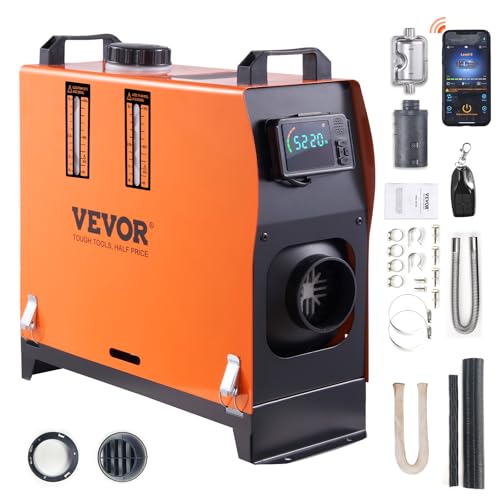


Top Picks for Diesel Garage Heaters
VEVOR 8KW Diesel Heater with Bluetooth Control
- Heating Power8 KW
- Fuel Consumption0.16-0.62 L/h
- Control OptionsBluetooth app, remote control
- Fuel Tank Capacity5 L
- Rated Voltage12 V
- Powerful 8KW output covers up to 269 sq ft
- Bluetooth and remote control for easy operation
- Large 5L fuel tank with low consumption
- Automatic altitude compensation
- Fuel tank capacity could limit very long unattended use
- Bluetooth range may be shorter in obstructed spaces
VEVOR 8KW Diesel Heater with 10L Tank and Bluetooth
- Heating Power8 KW
- Fuel Consumption0.16-0.62 L/h
- Control OptionsBluetooth app, remote control
- Fuel Tank Capacity10 L
- Rated Voltage12 V
- Large 10L tank allows extended heating
- Bluetooth and remote control options
- Fast heat transfer with aluminum exchanger
- Automatic altitude compensation
- Heavier and larger size may limit portability
- Higher fuel capacity adds weight
VEVOR 8KW Diesel Heater with CO Alarm and App Control
- Heating Power8 KW
- Fuel Consumption0.18-0.4 L/h
- Control OptionsBluetooth app, remote control, display panel
- Rated Voltage12-24 V
- Built-in CO alarm for continuous safety monitoring
- Quiet operation at ≤75dB
- Multiple control methods including app and display
- Leak-proof fuel tank cap and fuel level indicator
- Slightly higher fuel consumption range
- CO alarm adds complexity and cost
VEVOR 8KW Diesel Heater with CO Alarm and Multi-Voltage
- Heating Power8 KW
- Fuel Consumption0.18-0.35 L/h
- Control OptionsBluetooth app, remote control, display panel
- Rated Voltage12-24 V
- Wide compatibility with 12-24V power sources
- CO alarm for safety
- Quiet operation
- Multiple control methods
- Slightly lower combustion efficiency than some models
- No large fuel tank option
LF Bros 5KW Diesel Heater with 110V Plug
- Heating Power5 KW
- Fuel Consumption0.18-0.53 L/h
- Control OptionsRemote control, LCD switch
- Voltage Compatibility12V/24V/110V
- Supports 12V, 24V, and 110V plug-in
- Oil leak-proof fuel tank cap
- Clear LCD display and remote control
- Compact and easy to install
- Lower heating power than 8KW models
- No Bluetooth or app control
How to Choose a Diesel Garage Heater
Start by matching the heater’s power to the size and insulation of your garage. A 16-foot by 10-foot garage needs about 20,000 to 25,000 BTUs for effective heating if it’s uninsulated. For garages with no ceiling insulation, choose a model with at least 30,000 BTUs to compensate for heat loss.
| Feature | What to Look For |
|---|---|
| Heating Power | 20,000+ BTUs for small garages, 30,000+ BTUs for uninsulated spaces |
| Fuel Efficiency | Low diesel consumption rate, typically under 0.3 gallons per hour |
| Portability | Lightweight with handles or wheels for easy movement |
| Control Features | Thermostat, timer, remote or app control for precise heating |
| Safety Certifications | UL, ETL, or CSA listings; tip-over and overheat protection |
Fuel efficiency matters because diesel heaters run for hours. Check the consumption rate in gallons per hour and compare it to the heat output. A heater that uses 0.2 gallons per hour at 25,000 BTUs is more efficient than one using 0.3 gallons at the same output.
Portability and installation ease vary by model. Some heaters plug into standard outlets and need no venting, while others require exhaust pipes. Choose based on your garage setup and if you plan to move the heater between locations.
Control features improve convenience and efficiency. Bluetooth or app control lets you adjust settings remotely. A built-in thermostat maintains a steady temperature, reducing fuel use.
Sizing and Heat Output Considerations
Calculate required BTUs by multiplying your garage’s square footage by 30 to 50 BTUs per square foot, adjusting for insulation quality. A 160-square-foot garage with moderate insulation needs about 5,000 to 8,000 watts (17,000 to 27,000 BTUs). Larger or poorly insulated spaces need more power.
Heat distribution depends on the heater’s placement and airflow. Diesel heaters with built-in fans spread warmth more evenly. In large garages, consider multiple units or heaters with oscillation to avoid cold spots.
Insulation plays a major role. A well-insulated garage retains heat longer, reducing fuel consumption. If your garage floor over an unheated space feels cold, add insulation beneath the floor or use a heater with a fan to circulate warm air upwards.
| Appliance | Watts | Per hour | Per day (8 h) | Per month (30 days) |
|---|---|---|---|---|
| Diesel heater, 25,000 BTU (7.3 kW) | 7,300 W | $1.24 | $9.93 | $297.84 |
| Electric heater, 1,500 W | 1,500 W | 26¢ | $2.04 | $61.20 |
For campervans, select compact diesel heaters designed for small spaces and low power consumption. These often run on 12V systems and provide enough heat without draining the vehicle’s battery. Look for models with adjustable thermostats and safety shut-offs.
Safety Features and Certifications
Diesel garage heaters can be safe indoors if installed correctly with proper ventilation. They burn fuel to create heat, which produces exhaust gases including carbon monoxide (CO). Without ventilation, these gases build up and pose a serious health risk. Make sure your garage has vents or windows open to allow fresh air in and exhaust out.
A carbon monoxide alarm is essential near any diesel heater used indoors. This sensor alerts you if CO levels rise dangerously. Many modern diesel heaters include automatic shut-off features that stop the heater if overheating or flame failure occurs, preventing fire hazards and fuel leaks.
Diesel heaters designed for indoor use specify the type of fuel they accept. Using the wrong fuel or contaminated fuel can cause incomplete combustion and increase emissions of harmful gases. Stick to the recommended diesel grade and keep fuel clean to maintain safe operation.
A cold air inlet can improve combustion efficiency by supplying fresh air directly to the heater’s burner. This reduces the risk of drawing in contaminated or oxygen-depleted air from the garage. It also helps the heater run cleaner and safer, with more consistent heat output.
Understanding Fuel Consumption and Running Costs
Fuel consumption is a key factor in the cost of running a diesel garage heater. Most 5 to 8 kW models consume between 0.1 and 0.3 gallons of diesel per hour depending on heat setting and insulation. A higher heat output or poor insulation increases fuel use.
To calculate running costs, multiply the fuel consumption (gallons per hour) by the price per gallon of diesel and the hours you use the heater. For example, a heater using 0.2 gallons per hour running 8 hours daily at $4 per gallon costs about $6.40 per day.
| Model | Fuel Consumption (gal/hr) | Heat Output (kW) |
|---|---|---|
| LF Bros 5KW Diesel Heater | 0.1–0.15 | 5 |
| VEVOR 8KW Diesel Heater | 0.18–0.25 | 8 |
Higher efficiency heaters burn fuel more completely and convert more of it to heat, lowering running costs over time. Bluetooth controls on some models allow precise temperature management, saving fuel by avoiding overheating.
Long-term savings come from choosing a heater that matches your garage size and insulation. Oversized models waste fuel cycling on and off. Consider also the fuel price volatility in your area when budgeting for running costs.
| Appliance | Watts | Per hour | Per day (8 h) | Per month (30 days) |
|---|---|---|---|---|
| 8 kW diesel heater | 8,000 W | 96¢ | $7.68 | $230.40 |
Innovative Features in Modern Diesel Heaters
Modern diesel garage heaters include features that improve efficiency, safety and convenience. Some models are self-powering, meaning they generate their own electricity from the engine’s operation and do not need an external power source. This is ideal for garages without easy access to outlets or for backup heating during power outages.
The best 12 volt diesel heaters combine compact size with robust performance, making them suitable for smaller garages or mobile workshops. They run directly from a 12 V battery system, which is common in vehicles and off-grid setups, reducing installation complexity.
Bluetooth and app control are becoming standard in higher-end diesel heaters. These features let you monitor and adjust temperature settings remotely, schedule heating times, and receive maintenance alerts on your smartphone. This convenience saves fuel by allowing precise control over operation times and heat output.
Automatic altitude compensation adjusts the fuel and air mix based on elevation. This ensures efficient combustion and stable heat output in high-altitude garages where air pressure is lower. Without this feature, heaters can run inefficiently or fail to start properly.
Integrated safety systems include flame failure detection, overheating protection, and alarms for low fuel or system faults. These features shut down the heater or alert you to problems before they become hazards. Look for models with UL or ETL certification to ensure they meet safety standards.
Choosing a diesel heater with these innovations improves reliability and ease of use in cold garages. For more options on heating technology suited to workshops and garages, see our guides on best electric shop heaters for garages workspaces and best workshop heaters for cold workspaces.
Frequently Asked Questions
What is the optimal BTU rating for a garage diesel heater?
Are diesel garage heaters safe for interior use?
How significant is fuel consumption for these heaters?
What features should I look for in a diesel heater?
Can I use a diesel heater in an enclosed garage?
What is the best diesel heater for a 16′ x 10′ garage?
It helps to understand vented propane heater safety before spending anything.
We cover solutions for cold starts in its own guide.