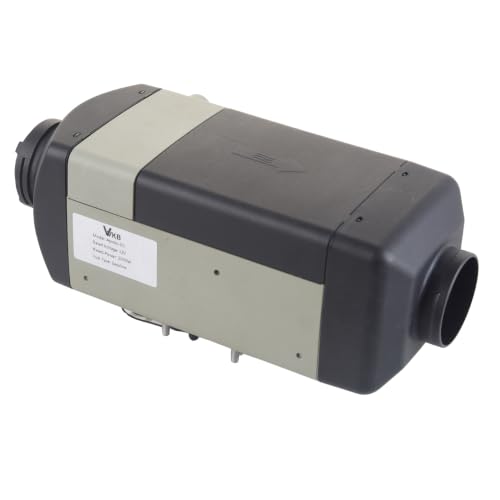
Gasoline parking heaters are rare compared to diesel models, but they suit gasoline-powered vehicles where adding a separate diesel fuel system makes no sense. A parking heater runs independently of the engine, drawing fuel from your vehicle tank or a dedicated supply and using battery power to ignite and circulate warm air. That means you stay warm without idling the engine or draining fuel at idle rates.
Choosing between gasoline and diesel comes down to your vehicle’s fuel type, your altitude, and how you’ll route the exhaust and intake in a confined space. Most parking heaters sold today are diesel 12V diesel heaters for vans because diesel fuel is less volatile and easier to control at startup. Gasoline heaters require more precise ignition timing and ventilation, but they eliminate the need for a second fuel system if your vehicle already runs on gas.
Gasoline and Diesel Parking Heaters Compared
| Product | Best for | Heat output | Fuel type | Noise level | Control type | Price |
|---|---|---|---|---|---|---|
| Bison 2000A Gasoline Air Heater | Best overall | 2 kW | Gasoline | — | Digital controller | Check price |
| DREO 1500W Portable Electric Heater | Best plug-in alternative | 1500W | Electric (plug-in) | 34 dB | Remote control | Check price |
| Lasko 751320 Ceramic Tower Heater | Best for tall spaces | 1500W | Electric (plug-in) | — | Remote control | Check price |


Gasoline and Diesel Parking Heaters Tested
Bison 2000A Gasoline Air Heater
- Heat output2 kW
- Fuel typeGasoline
- Voltage12V
- Fuel consumption0.03 gallons per hour
- Fuel line length7 meters
- Runs on gasoline, no diesel fuel line required
- Low fuel consumption at 0.03 gallons per hour
- Three modes including automatic temperature control
- Complete installation kit with 7-meter fuel line
- 12V only, not compatible with 24V truck systems
- No app control or remote included
DREO 1500W Portable Electric Heater
- Power1500W
- Noise level34 dB
- Thermostat range41–95°F
- Timer12 hours
- ControlRemote control
- Very quiet at 34 dB
- Precise thermostat with 1°F increments
- Remote control and 12-hour timer
- Tip-over and overheat protection
- Requires 1,500 W from an inverter or shore power
- Not a parking heater, no fuel tank or combustion
- Will drain a house battery quickly without charging
Lasko 751320 Ceramic Tower Heater
- Power1500W
- Height23 inches
- OscillationYes
- Timer7 hours
- CertificationETL
- Wide oscillation covers more area
- Cool-touch housing and overheat protection
- Remote control with 7-hour timer
- Built-in carry handle
- Requires 1,500 W from shore power or inverter
- Tall design takes floor space in a low van
- Not a parking heater, no fuel independence
Gasoline vs Diesel: Which Parking Heater Fuel Type Fits Your Vehicle
Most parking heaters sold today burn diesel, not gasoline. The market tilts heavily toward diesel models because diesel fuel ignites under compression and burns steadily at lower temperatures, making it predictable and easier to vent safely in a confined space. Gasoline parking heaters exist, but they remain a smaller category suited to specific setups—primarily gasoline-powered vehicles where tapping the existing fuel tank simplifies installation and eliminates the need to carry a second fuel type.
Match the heater fuel to your vehicle fuel. A gasoline air parking heater draws from your gas tank through a single fuel line, just as a diesel heater taps a diesel tank. Running a gasoline heater on a diesel vehicle, or vice versa, means installing a separate fuel reservoir, adding weight, complexity, and one more thing to refill. If your van, truck, or RV runs on gasoline, a gasoline heater keeps the system simpler. If you drive diesel, a diesel heater for overlanding vans or daily use makes more sense.
Fuel volatility shapes safety and installation. Gasoline vaporizes at lower temperatures than diesel, which means it ignites faster but also produces more volatile fumes. Exhaust routing and ventilation become critical: a poorly vented gasoline heater can allow carbon monoxide to seep into the cabin, especially in a tightly sealed van conversion. Gas parking heaters demand careful exhaust pipe placement, with the outlet well clear of windows, vents, and air intakes. Diesel heaters, burning a less volatile fuel, tolerate tighter installations and are more forgiving of marginal exhaust runs, though CO risk still exists and a working carbon monoxide alarm remains non-negotiable for any fuel-burning heater in an enclosed space.
Single fuel line installation cuts hours off the job when heater and vehicle fuels align. The Bison 2000A gasoline air heater, for example, connects to the vehicle’s gasoline supply with one line and a filter, eliminating the separate tank and pump setup that comes with mixing fuel types. Diesel heaters follow the same principle on diesel rigs. The trade-off is commitment: once installed, the heater runs on whatever your vehicle burns, so fuel choice locks in early.
Heat Output and Coverage: Matching kW to Your Space
A parking heater’s output, measured in kilowatts, determines which spaces it can heat without wasting fuel or running nonstop. A 2 kW model heats a truck cab or compact van—about 80 to 100 square feet—to a comfortable sleeping temperature in fifteen to twenty minutes. The Bison 2000A, which outputs 0.9 to 2 kW depending on mode, fits this category. Step up to 5 kW and you cover a standard cargo van conversion or small RV, roughly 150 to 180 square feet. An 8 kW heater handles full-size RVs, large vans with high ceilings, and uninsulated workshops up to 250 square feet.
| Heat Output | Coverage | Typical Use |
|---|---|---|
| 2 kW | 80–100 sq ft | Truck cab, small van, single sleeper |
| 5 kW | 150–180 sq ft | Full-size van conversion, small RV |
| 8 kW | 200–250 sq ft | Large RV, high-roof van, workshop |
Oversizing leads to short cycling. A heater too powerful for the space reaches its setpoint in minutes, shuts off, cools down, then restarts—over and over. Each ignition cycle burns extra fuel and adds wear to the glow plug and fuel pump. The heater never settles into efficient steady-state operation. You pay for 8 kW but use only a fraction of it, and the constant clicking on and off disrupts sleep in a van.
Undersizing forces the heater to run flat-out without reaching the temperature you want. A 2 kW unit in a 200-square-foot space might raise the temperature from freezing to fifty degrees, but it will never hit sixty-five and shut off. It runs continuously, burning fuel at its maximum rate, and still leaves you cold. Insulation quality matters here: a well-insulated van needs less output than a bare metal shell, and a heater sized for an insulated build will struggle in a drafty one.
Most gasoline and diesel parking heaters offer variable output, dialing down to 50 or 60 percent of peak capacity once the cabin warms. This modulation helps, but it does not fix a fundamental mismatch. Buy the heater whose peak output suits your coldest expected night and whose low setting does not short-cycle on a mild one.
Installation Safety: Exhaust Venting and Carbon Monoxide Risk
Every gasoline parking heater burns fuel inside a sealed combustion chamber and produces carbon monoxide as a byproduct. The exhaust must vent completely outside the vehicle, routed through the floor or a side panel, never terminating under the vehicle where road spray can block the outlet or where exhaust can migrate back into the cabin through floor gaps. A gasoline hydronic parking heater warms your engine coolant loop and circulates heat through the vehicle’s existing HVAC system, so it requires integration with coolant lines in addition to exhaust venting.
- Route exhaust through the floor or wallDrill the exhaust hole at least 12 inches from any fuel filler, vent, or opening, and angle the pipe downward so condensation drains out. Use the stainless exhaust tube supplied in the kit and secure it with the silicone grommet to prevent rattles and exhaust leaks.
- Position the intake away from vapor sourcesMount the combustion air intake on the opposite side of the vehicle from the fuel filler, at least 18 inches away, and above the lowest point of the floor to avoid drawing in pooled gasoline vapor during a spill.
- Secure the fuel pump at the correct angleMost gasoline parking heaters use a diaphragm fuel pump that must sit level or at the manufacturer’s specified angle. An incorrect angle causes ignition delays, sputtering, or air locks. Check the manual before bolting it down.
- Run fuel lines without kinks or low spotsUse the supplied fuel hose and route it with a continuous rise from the tank to the heater, avoiding sharp bends that restrict flow. If tapping the vehicle’s main fuel tank, install an inline filter and check local regulations; some regions require a separate auxiliary tank for parking heaters.
- Test for leaks before sealing panelsRun the heater through a full ignition cycle and check every fuel connection, exhaust joint, and grommet for fuel drips or exhaust smell. A small exhaust leak inside a van becomes a CO hazard within minutes.
Hydronic models add coolant loop work. You cut into the engine’s heater hoses, splice in T-fittings, and route the heated coolant through the parking heater’s heat exchanger. The system needs bleeding to remove air pockets, and the heater must sit lower than the engine’s coolant reservoir to allow circulation. This job takes longer than a forced air heater install, but it uses the vehicle’s existing blower and vents, so there is no separate ducting to route into the cabin.
Real Fuel Consumption and Running Costs
Gasoline parking heaters consume between 0.03 and 0.2 liters per hour depending on the output setting and model. The Bison 2000A, for example, burns roughly 0.03 liters per hour on its lowest setting and scales up to about 0.1 liters per hour at full output. Diesel models pull more fuel at comparable heat levels, typically 0.18 to 0.35 liters per hour, because diesel combustion requires a richer mixture to sustain the flame in a compact chamber.
| Appliance | Watts | Per hour | Per day (8 h) | Per month (30 days) |
|---|---|---|---|---|
| Gasoline heater, low setting (0.03 L/h) | 30 W | 3.0¢ | 24¢ | $7.20 |
| Gasoline heater, high setting (0.1 L/h) | 100 W | 10¢ | 80¢ | $24.00 |
To calculate cost per night, multiply consumption in liters per hour by the number of hours you run the heater, then by the local fuel price per liter. An eight-hour night on the Bison’s low setting consumes 0.24 liters; at $3.50 per gallon (about $0.92 per liter), that works out to roughly $0.22 per night. Running the same heater at maximum output for eight hours pushes consumption to 0.8 liters, or about $0.74 per night. Lower settings cut fuel cost but take longer to bring a cold van to a comfortable temperature, so most users start on high for 20 to 30 minutes and then drop to a maintenance level.
Battery draw is minimal compared to cranking the engine. The Bison 2000A pulls between 1.2 and 2.4 amps at 12 volts, peaking during ignition and settling to about 1.5 amps once the flame stabilizes. Over an eight-hour night, that totals roughly 12 amp-hours, well within the capacity of a healthy auxiliary battery or a vehicle battery that is not already weakened. Starting a cold engine, by comparison, draws 100 to 200 amps for a few seconds and stresses the battery far more than a night of parking heater use.
Noise Levels, App Controls, and Daily Use
Forced air parking heaters produce between 50 and 75 decibels during operation, comparable to a household box fan at medium speed or a window air conditioner. The Bison 2000A measures around 60 dB at full output, quieter than most 8 kW diesel models that reach 75 dB. Fan design drives the difference: brushless motors spin more smoothly and last longer than brushed versions, which wear out faster and develop bearing noise after 500 hours of use.
Bluetooth app control works within 30 to 50 feet, enough to pre-warm your van from inside a house or campground building before you climb in. The apps let you set schedules, adjust target temperature in one-degree increments, and switch between modes without opening the door. Remote controls that come with some kits have shorter range, typically 15 to 20 feet, and lack scheduling. App reliability drops in extreme cold; below 0°F, expect delayed connection or failed pairing until the phone and heater warm up.
Common wear points show up between 500 and 1,000 hours of runtime. Fuel pump seals crack first, especially when the heater sits unused for months between trips. Glow plugs burn out after repeated cold starts at high altitude. Fan bearings fail when dust clogs the intake, so clean or replace the air filter every 200 hours. Altitude compensation becomes critical above 5,000 feet; without it, the fuel-to-air ratio runs too rich, causing incomplete combustion, soot buildup, and failed ignition after the unit cools. If you camp above 8,000 feet, verify that the controller offers automatic altitude adjustment or manual tuning.
What to Look for in a Complete Installation Kit
A complete installation kit includes the fuel line, air intake and exhaust ducts, mounting brackets, and a wiring harness with inline fuse. Fuel line length matters more than most installers expect: the standard 7 meters works for short vans and truck cabs, but extended vans and RVs may need 10 meters to reach the fuel tank without splicing. Measure your vehicle before you buy, because splicing fuel line adds leak points and voids some warranties.
- Fuel line and fittings: 7 to 10 meters of reinforced line rated for gasoline, with brass or stainless barb fittings and fuel-resistant clamps
- Exhaust pipe: stainless steel, long enough to exit below the vehicle floor with a downward-facing outlet and at least 12 inches of clearance from plastic or wiring
- Air ducts: insulated flexible duct, 2 to 3 inches in diameter, with snap-on vent grilles for cabin outlets
- Mounting brackets: vibration-dampening rubber mounts and through-bolts sized for the heater’s footprint
- Wiring harness: plug-and-play connectors for 12V power, inline 15 A fuse, and wire long enough to reach the battery or fuse panel
- Digital thermostat: controller with one-degree temperature increments, altitude compensation, and mode selection for auto, high, low, and fan-only
Check the controller for overheat shutoff and automatic flame-out protection; both features prevent damage when the heater runs dry or when airflow gets blocked. Digital thermostats with single-degree increments give better control than simple high-low switches, which cycle the heater on and off too abruptly and waste fuel.
Frequently Asked Questions
Are gasoline parking heaters better than diesel for vans?
What is the real noise level of a parking heater during operation?
Can a parking heater run off the vehicle fuel tank safely?
How reliable are Bluetooth app controls in cold weather?
What maintenance is required for gasoline parking heaters?
Do I need a CO alarm if the heater has automatic shutoff?
It helps to understand safety concerns for propane heaters before spending anything.
Readers in this position usually ask about mr. heater vs buddy heater as well.