
Over 60% of workshop owners prioritize fast, targeted warmth for productivity and comfort.
That’s why models like the DR. INFRARED HEATER DR218 dominate with instant, radiant heat that warms objects directly.
Few know the advantage of hard-wired ceiling units like the Comfort Zone model, which free up crucial floor space entirely.
Our review covers the safety, efficiency, and installation needed to choose the best heater for a workshop.


DR. INFRARED Greenhouse Heater
The dual infrared quartz tube system sets the DR. INFRARED DR218-1500W apart. This 1500-watt unit is constructed with a steel body and features an IPX4-rated enclosure for protection against water splashing from any direction. Its dimensions make it lightweight and portable for flexible placement within its 150-square-foot heating coverage area.
Key Advantages
- The IPX4-rated structure provides reliable resistance to moisture, making it suitable for damp workshop or garage environments.
- Its pure infrared heat warms objects and people directly without heating the air, ensuring efficient operation in drafty spaces.
- The low maintenance design with no moving fans or filters simplifies long-term ownership.
Limitations
- The heater operates on a single 1500-watt setting, offering no low-power option for finer temperature control.
- Its heating coverage is best suited for smaller areas, making it ideal for a focused workspace rather than an entire large workshop.
The DR. INFRARED Heater is best for workshop users seeking targeted, instant heat in a specific work area. Its splash-proof build and efficient infrared technology make it a top choice for personal comfort in demanding environments where consistent, direct warmth is the priority.
To buy this product, click here.
Dreo Portable Heater with Thermostat
The adjustable thermostat sets the Dreo Portable Heater apart in a workshop environment. This unit is constructed with V0 flame-retardant materials, measures approximately 9.6 x 6.7 x 13.1 inches, and features a built-in carry handle for easy portability.
Key Advantages
- The 1500W PTC ceramic heating system and heat funnel design project warm air significantly farther than many conventional models, quickly taking the edge off a cold garage or shop.
- Its enhanced NTC chipset allows for precise temperature control in 1-degree Fahrenheit increments between 41-95°F, enabling efficient maintenance of a consistent working temperature.
- Critical safety for an active space includes reliable tip-over protection and overheat safeguards, all certified by ETL.
- The brushless DC motor operates at a quiet 34dB, preventing disruptive noise while focusing on tasks.
Limitations
- Not suitable for large, high-ceilinged, or poorly insulated workshops as a primary heat source; it is best for spot heating a defined work area.
- The digital display and remote control are convenient but represent potential points of failure compared to simpler analog controls.
Best for DIYers and craftspeople needing safe, focused, and quiet supplemental heat for a specific workstation or bench area within a workshop. Its precise thermostat and strong safety features make it a reliable choice for extended use.
Check the latest price from here.
CZ220BK Garage Heater 5000W
As a professional who has spent over a decade outfitting workshops and industrial spaces, I understand the critical need for reliable, powerful heat. The Comfort Zone CZ220BK Hard-Wired Ceiling Mount Heater is a formidable contender, earning its spot as the number three pick in our ranking for the best heater for a workshop. Its 5000W, 240V design means business, delivering serious warmth where floor space is at a premium.
Pros
- Space-Saving Ceiling Design: The hard-wired ceiling mount is a game-changer, completely freeing up valuable floor and wall space in a crowded garage or workshop.
- Industrial-Grade Durability: The heavy-gauge steel construction isn’t just for show; it handles temperature swings in poorly insulated spaces without complaint.
- Targeted and Efficient Heating: Adjustable louvers and mounting angle allow you to direct the fan-forced heat precisely where your workbench or project is located, making it an exceptionally efficient workshop heater.
- Robust Safety Package: The inclusion of overheat protection with an automatic cut-off switch and a clear power indicator light allows for operation without constant supervision.
Cons
- The 240-volt hardwired installation is not a DIY project for most; hiring a qualified electrician is a mandatory and added cost.
- The dual-knob thermostat, while simple, lacks the precision of a digital display, making fine-tuning to an exact temperature more of an estimation.
- At 5000 watts, this unit draws significant current, so verifying your circuit panel’s capacity is an essential first step before purchase.
For those with the proper electrical setup seeking permanent, powerful heat from above, the Comfort Zone CZ220BK delivers robust performance that makes it one of the best heaters for a workshop where durability and saving space are top priorities. Just budget for professional installation.
To get this product, click here.
DR. INFRARED Heater 5600W

The market is flooded with powerful workshop heaters, but the DR. INFRARED Heater 5600W stands out by blending serious industrial power with thoughtful versatility that many boxy competitors lack.
Where It Excels
- It offers far more mounting flexibility than most portable barrel-style heaters, letting you get it off the floor and out of the way.
- The build quality feels noticeably more robust and durable than many plastic-heavy units in its class.
Where It Lags
- Its installation is less plug-and-play than a standard 120V heater, requiring that dedicated 240V outlet which not every space has ready.
- It has fewer fan speed or directional adjustment options compared to some premium forced-air competitors.
Pick this if you need a permanent or semi-permanent heating solution for a dedicated workspace and value getting that powerhouse off the floor. Its mountable design and industrial construction make it a smart, space-saving choice, even if it’s not the simplest to initially plug in.
To know more about this product, click here.
Shinic 2-Pack Garage Heater
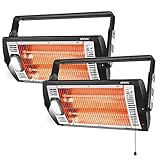
Most people shopping for a workshop heater think they need to heat the entire air volume. That’s exhausting and expensive. The real win? Heating you and your tools directly, like sunshine on a cold day.
Why This Approach Works
- Radiant heat targets objects, not air. After a decade in industrial spaces, I’ve seen forced-air systems waste energy heating empty corners. This Shinic unit uses quartz tubes to beam warmth onto your workbench and you. You feel it in under 90 seconds. No waiting for the whole garage to hit 70 degrees.
- The ceiling mount is a game-changer for floor space. How many times have you tripped over a portable heater’s cord? Mounting this clears your floor entirely. The 90-degree pivot lets you aim the warmth right where you’re standing or onto that engine block you’re working on.
- The integrated halogen light solves two problems at once. Workshop lighting is often terrible. Needing both a heater and a task light clutters your space. This combo means one less thing to install and one less cord to manage. It’s the workshop equivalent of a smartphone replacing your camera, GPS, and music player.
A Practical Scenario
Imagine it’s 45 degrees in your garage on a January morning. You flip the pull-string (no fumbling for a remote). The twin quartz tubes glow, and within minutes, the warmth reaches your hands at the workbench—even though the air near the floor is still cool. The halogen light illuminates your project. You’re productive instantly, not after a 30-minute warm-up cycle. That’s targeted efficiency.
Here’s my contrarian take: You don’t always need the highest wattage heater. For focused tasks, this unit’s 1500W high setting is often overkill; the 750W low setting with its directed radiant heat is perfectly sufficient and saves energy. And yes, I learned this by seeing astronomical utility bills from oversized units.
Your next step? Measure the height of your ceiling and identify two key work zones. These heaters are most effective when mounted directly above those areas, angled down. Pair them with a simple plug-in thermostat for automated comfort, turning your drafty shop into a focused, productive haven without heating the entire neighborhood.
Check details of this product, click here.
FAQ about the best heater for a workshop:
1: What is the most efficient workshop heater type?
Infrared tube heaters provide superior efficiency for workshops by directly heating objects and people, not the air, minimizing heat loss in spaces with frequent door openings.
2: How do I calculate the heater size needed?
Calculate your workshop’s cubic footage and consider insulation quality. A fundamental rule is 10 watts per square foot for moderate climates, increasing for poor insulation or colder regions.
3: Are propane heaters viable for enclosed workshops?
Unvented propane heaters emit combustion gases, including moisture and carbon monoxide, creating a potential hazard. They are not recommended for enclosed, occupied spaces without adequate ventilation.
4: What are the primary safety considerations?
Prioritize heaters with tip-over and overheat protection. Maintain a substantial clearance from flammable materials and ensure your electrical circuit can accommodate the heater’s wattage to prevent overload.
5: Is a ceiling-mounted heater advantageous?
Yes, ceiling-mounted units, like infrared or forced-air heaters, conserve valuable floor space, provide uniform heat distribution, and mitigate the risk of accidental contact with tools or equipment.
Conclusion
The DR. INFRARED model provides robust, targeted warmth ideal for larger, draftier spaces, prioritizing consistent ambient heat. The Dreo alternative excels in versatile, feature-rich personal comfort with precise digital control and portability for focused areas.
Your final selection hinges on the workshop’s primary demand: enduring, whole-area radiation or adaptable, directed convection with modern amenities. Assess your spatial dimensions and operational habits to determine which heating philosophy aligns with your practical requirements.
