
The skinny metal rod buried in your water heater isn’t dead weight. It’s a sacrificial bodyguard, quietly rusting itself to pieces so your tank doesn’t. Pick the wrong metal and you get one of two miserable outcomes: hot water that reeks of rotten eggs, or a tank that rusts through years early. The magnesium vs aluminum anode rod question has a real answer, and it depends entirely on the water coming out of your taps. Here’s how to choose without guessing.
The 10-second answer: Choose magnesium for soft or neutral water and maximum tank protection. Choose an aluminum/zinc rod for hard water, well water, or to kill a rotten-egg smell. Want to stop replacing rods forever and never smell sulfur again? A powered titanium anode ends the debate completely.
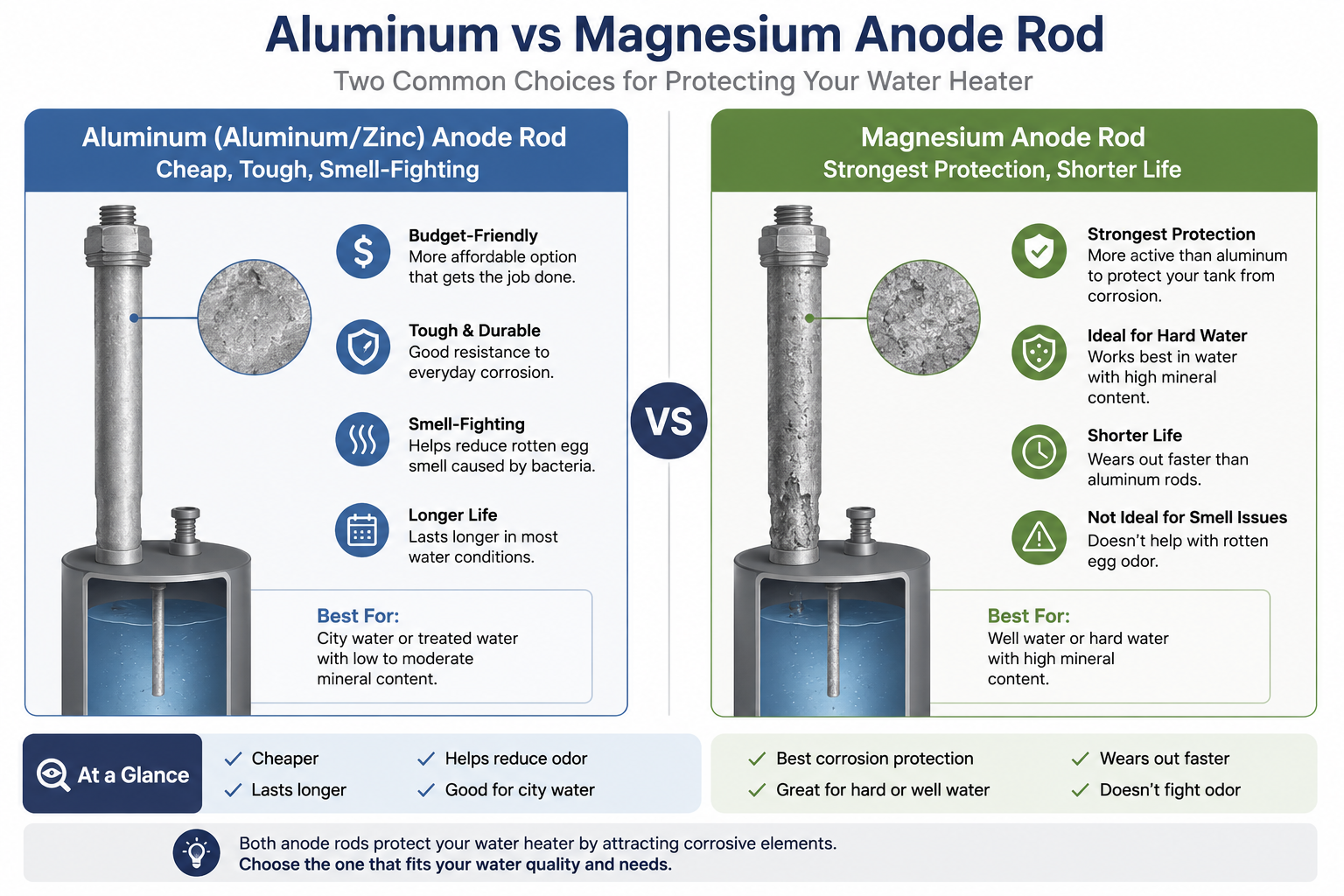
How a Sacrificial Anode Rod Actually Protects Your Tank
Your steel tank is lined with glass-like enamel, but that lining always has microscopic cracks. Bare steel plus hot, mineral-rich water equals rust. The anode rod solves this with simple electrochemistry: it’s made from a metal more reactive than steel, so corrosion attacks it instead of your tank walls. The rod dissolves over a few years; the tank survives. Once the rod is gone, your tank is next in line. If you want the full mechanism, here’s what your anode rod actually does inside the tank.
All three common materials — magnesium, aluminum (usually alloyed with zinc), and titanium in powered rods — do this same job. They just do it at very different speeds, costs, and side effects.
Aluminum (Aluminum/Zinc) Anode Rods: Cheap, Tough, Smell-Fighting
Where it wins
- Hard water: corrodes slowly, so it lasts longer where minerals are aggressive.
- Well water: handles high iron and dissolved solids better.
- Kills the rotten-egg smell: the zinc alloy disrupts the bacteria reaction that magnesium tends to feed.
- Cheapest upfront and widely available.
Where it falls short
- Weaker protection: less reactive, so it shields the tank less aggressively than magnesium.
- Aluminum sediment: byproducts can settle as a gel-like sludge at the tank bottom.
- Drinking-water hesitation: some homeowners simply prefer not to add aluminum to water they cook with.
Best for: homes on hard municipal water or a private well, and anyone fighting a sulfur smell. An aluminum/zinc rod is the practical, budget-friendly default — especially the pick we cover in our best anode rod for hard water review.
Magnesium Anode Rods: Strongest Protection, Shorter Life
Where it wins
- Best-in-class protection: the most reactive metal, so it defends the tank hardest.
- Cleaner byproduct: magnesium hydroxide is mild and considered benign.
- Ideal for soft water and new tanks where you want maximum coverage.
Where it falls short
- Burns out faster: high reactivity means more frequent replacement.
- The smell culprit: in well/bacteria-prone water, magnesium most often triggers hydrogen-sulfide (rotten egg) odor.
- Self-destructs in very soft, acidic water, sometimes too fast to be efficient.
Best for: soft or neutral-pH water and owners who prioritize protecting the tank over rod longevity. If that’s you, see our breakdown of the best magnesium anode rod for residential tanks.
Rotten egg smell? Read this first.
That sulfur stench comes from sulfate-reducing bacteria producing hydrogen sulfide gas. Because magnesium is the most reactive metal, it usually feeds that reaction the hardest — which is why the classic fix is swapping a magnesium rod for an aluminum/zinc rod, or installing a powered anode that removes the reaction entirely. If your hot water smells and your cold water doesn’t, your anode is almost certainly the cause.
Aluminum vs Magnesium vs Powered: Side-by-Side
| Factor | Aluminum / Zinc | Magnesium | Powered Titanium |
|---|---|---|---|
| Tank protection | Good | Excellent | Excellent (constant) |
| Lifespan | 4–7 yrs | 3–5 yrs | 20+ yrs (no wear) |
| Upfront cost | $ (lowest) | $$ | $$$ |
| Hard water | Best | Fair | Best |
| Soft water | Good | Best | Best |
| Rotten egg smell | Reduces it | Often causes it | Eliminates it |
| Maintenance | Replace periodically | Replace often | None |
Protection Strength vs. Years Between Replacements
Tank protection strength
Years before replacement
The 2 Anode Rods Worth Buying in 2026
As an Amazon Associate, HeaterSphere earns from qualifying purchases. Prices shown are approximate and change often — tap through for the live price.
Water Connection Aluminum/Zinc Anode Rod
A thick 3/4″ solid rod built specifically to end the rotten-egg smell that magnesium leaves behind. The extra zinc disrupts the sulfur reaction, and the heavier diameter means more metal to sacrifice — so it protects longer in hard and well water. The honest budget pick for most homes, usually around $30–$40.
Check Today's Price on Amazon →Corro-Protec Powered Titanium Anode Rod (20-Yr Warranty)
This is the one that ends the cycle. A titanium powered anode doesn’t dissolve, so it protects your tank for 20+ years with zero replacements — and it kills sulfur smell within 24 hours by neutralizing the bacteria outright. Lead-free and WQA-certified, it fits 40–89 gallon electric, gas, solar, and hybrid tanks. Around $150, but spread over two decades it’s cheaper than buying a sacrificial rod every few years — and far cheaper than a new tank.
Which Anode Rod Is Better for You?
Hard or well water: Aluminum/zinc. It outlasts magnesium and handles iron and minerals better.
Soft or neutral water, brand-new tank: Magnesium, for the strongest protection.
Hot water smells like rotten eggs: Move off magnesium to aluminum/zinc, or go powered for a permanent fix.
Tired of replacing rods / on a softener: Powered titanium, every time.
Not sure what’s in your pipes? A $15 water-hardness test strip removes all the guesswork. And once your rod is in, learn how often you should be checking it so you catch a spent rod before your tank pays the price. When it’s time, swapping the rod yourself takes about 20 minutes with a 1-1/16″ socket.
Frequently Asked Questions
Does an aluminum anode rod last longer than magnesium?
Yes. Aluminum corrodes more slowly, so it typically lasts 4–7 years versus 3–5 for magnesium. The trade-off is slightly weaker tank protection.
Which anode rod is better for well water?
Aluminum/zinc. It resists the high iron, minerals, and bacteria common in well water better than magnesium, which corrodes too fast and can worsen odor.
How can I tell a magnesium rod from an aluminum one by looking at it?
You usually can’t by sight — both look like a dull gray metal rod. Check the packaging or the stamped label. A spent magnesium rod tends to be pitted and chunky; aluminum often goes mushy and gel-like as it corrodes.
Can I use aluminum and magnesium anode rods together?
A tank uses one anode at a time. You can switch materials between replacements, but don’t try to run both — match the metal to your water instead.
Is the aluminum from the rod safe in my drinking water?
Levels are considered safe by industry standards, but some homeowners prefer magnesium or a powered titanium anode to avoid adding any aluminum to water they drink or cook with.
What about RV water heaters?
Same rules, smaller rods. Suburban and Mor-Flo tanks usually take a magnesium or aluminum rod; Atwood-style aluminum tanks shouldn’t use magnesium. Check your manual for thread size before buying.
Stop guessing. Protect the tank today.
Match the rod to your water and you’ll get years more from a $800 tank. If you never want to think about it again, the powered titanium anode is the last rod you’ll ever buy.
View the Corro-Protec Powered Anode →