
A damp room feels cold even when the radiator runs. You turn up the thermostat, the meter spins faster, but the chill and mustiness persist. The problem isn’t your heater—it’s the moisture turning your walls and air into thermal drains.
Most UK homes battle condensation from cooking, showers and breathing, producing up to 100 litres of water vapor weekly. That moisture settles on cold surfaces, cools the room, and makes every heating attempt less effective. The solution follows a sequence: dry the air, insulate strategically, then heat with the right equipment.
Why Some Houses Feel Warmer in Winter: Heat Retention and Moisture
Houses that feel warmer in winter keep moisture under control, maintain continuous insulation layers, and avoid thermal bridging—cold spots where heat escapes through the structure. Damp homes feel colder because water inside walls and humid air conduct heat away from you and the room far more efficiently than dry materials do, so you’re losing warmth constantly even when the heater runs.
Water conducts heat roughly 20 to 25 times better than air. A damp wall pulls warmth out of a room faster than a dry one, and humid air holds more energy but delivers less comfort because much of that energy goes into evaporating moisture rather than raising the temperature you feel. When you heat a damp room, you’re fighting a continuous cycle: warm air meets cold surfaces, condensation forms at the dew point, and the evaporation process draws heat away. The air feels clammy, surfaces stay cold, and the heater works harder for less warmth.
Thermal mass and insulation play different roles, and moisture disrupts both. Thermal mass—dense materials like brick or concrete—absorbs heat and releases it slowly, smoothing out temperature swings. Insulation slows heat transfer through walls, floors and ceilings. Damp degrades insulation by filling air pockets with water, turning a barrier into a conductor. It also prevents thermal mass from storing useful warmth because the material stays cold and wet. Rooms without insulation lose heat rapidly through walls and windows, but adding insulation to damp fabric traps moisture and can make the problem worse unless ventilation improves first.
| Condition | Relative heat loss | Why it matters |
|---|---|---|
| Dry wall with insulation | Baseline | Heat moves slowly through trapped air |
| Dry wall, no insulation | 3× faster | No barrier; heat conducts straight through brick or block |
| Damp wall, no insulation | 20–25× faster | Water fills gaps and conducts heat rapidly |
| Damp insulation | 10–15× faster | Wet insulation loses its air pockets and becomes a conductor |
Heating Damp Rooms: Ventilation and Moisture Control First
You cannot insulate or heat your way out of a moisture problem. Adding insulation to damp walls traps water inside the fabric, accelerating rot and mould. Running the heater harder in a humid room wastes energy evaporating moisture without making the space feel warmer. Ventilation and dehumidification must come first because they remove the water that conducts heat away. Only then can insulation and steady heating retain warmth effectively.
A typical UK household produces around 100 litres of moisture a week from cooking, showering, breathing and drying clothes indoors. That water has to go somewhere. Without ventilation, it condenses on cold surfaces—windows, outside-wall corners, and the areas behind furniture—and creates the damp, cold feeling that no heater can overcome. Strategic ventilation replaces humid indoor air with drier outdoor air, even in winter, because cold outdoor air holds less absolute moisture than warm indoor air saturated with steam.
- Run extractor fans during and after steamTurn on the bathroom fan before you shower and leave it running for 20 minutes afterward. Do the same in the kitchen when boiling, frying or using the kettle. The fan removes moisture before it spreads through the house and condenses elsewhere.
- Open windows strategicallyOpen windows for 10 to 15 minutes two or three times a day, especially after cooking or bathing. A short burst of ventilation clears humid air without cooling the fabric of the building significantly. Trickle vents in window frames should stay open all the time unless wind-driven rain is an issue.
- Use a refrigerant dehumidifierRefrigerant models work better than desiccant types in the warmer indoor temperatures typical of UK homes. They cool air to condense moisture out, then reheat it slightly before releasing it back into the room. Run the dehumidifier in the dampest room or move it between rooms, aiming to keep indoor relative humidity between 40 and 60 percent.
- Consider a positive input ventilation systemPIV units installed in the loft draw in filtered outdoor air and gently pressurise the house, pushing out stale, humid air through natural gaps and vents. They provide whole-house humidity control without opening windows, and some models include a heater element to temper incoming air in winter.
Daily habits make the difference. Use pan lids when cooking to trap steam, close the bathroom door and run the fan, wipe down wet windows in the morning, and keep furniture a few centimetres away from external walls to allow air circulation. These steps cost nothing and stop moisture from building up faster than ventilation can remove it. Once indoor humidity drops and surfaces stay dry, heat retention tips for portable heater efficiency and insulation improvements can do their job without fighting constant evaporation.
Insulation Materials That Work in Damp Environments
Standard fiberglass insulation traps moisture like a sponge. Once wet, it loses up to 50% of its insulating value and stays damp for weeks, creating the cold spots where condensation forms. Damp-prone UK homes need insulation that either resists moisture or allows water vapor to pass through without losing performance.
Single-glazed windows lose heat so fast that even thick curtains fight an uphill battle. Before insulating walls, address the windows: secondary glazing creates an air gap that cuts heat loss by 60% and raises the inner pane temperature above the dew point, stopping condensation at the source. Full cupboards against external walls trap still air and slow heat escape, but only if the wall behind them stays dry—check yearly for hidden mould.
| Material | Moisture Tolerance | Where It Works |
|---|---|---|
| Fiberglass batts | Poor—loses R-value when wet | Avoid in damp rooms |
| PIR/PUR rigid foam boards | Excellent—closed-cell, vapor-resistant | Internal walls, ceilings |
| Multi-foil reflective | Good—needs 25 mm air gap each side | Lofts, under floors |
| Sheep’s wool, hemp | Excellent—breathable, regulates humidity | Breathable wall systems |
| Expanded polystyrene | Good—water-resistant but vapor-permeable | External wall insulation |
PIR and PUR rigid boards deliver high R-value per inch and shrug off moisture, making them the practical choice for internal wall insulation in flats and terraced houses where external work isn’t an option. Multi-foil insulation reflects radiant heat but only works with an air gap on both sides; installed flat against a surface, it does almost nothing. Natural materials like sheep’s wool and hemp fiber absorb and release moisture without losing insulating power, ideal for breathable lime-plastered walls in older homes.
External wall insulation wraps the house in a continuous layer, eliminates thermal bridging, and keeps the structure warm and dry. Internal insulation is cheaper and faster but reduces room size and creates new cold bridges at every floor and partition. In a home with persistent penetrating damp, fix the water ingress before you insulate—sealing moisture inside the wall accelerates rot.
How to Maximize Heat Retention with Curtains and Blinds
Thermal-backed curtains cut heat loss through single glazing by 25 to 30%, but only if they seal the window recess. Cold glass chills the air in front of it; that air sinks and flows into the room as a draft unless a pelmet across the top and side seals along the wall block the convection loop. A curtain hanging in open space slows heat loss but doesn’t stop the cold downdraft that makes a room feel chilly no matter how warm the air.

Close curtains at dusk, before the glass cools fully and condensation starts. Once the pane is cold, a drawn curtain traps humid room air against it and makes condensation worse. Open curtains on sunny winter days to capture solar gain—a south-facing window can add 500 watts of free heat on a clear afternoon. Cellular blinds with honeycomb pockets trap still air and work well where curtains would block a radiator, but they need side channels to stop air flowing around the edges.
An open staircase hemorrhages heat. Warm air rises to the upper floor and cold air flows down, creating a draft you feel in every downstairs room. A thick curtain at the bottom of the stairs, closed in the evening, breaks the convection current. Draft excluders at the top and bottom of the staircase door make an even bigger difference. In open-plan layouts, zone the space: draw a curtain or close a folding screen to isolate the area you’re heating, rather than warming the entire volume.
Best Heating Devices for Damp Rooms and High Humidity
Oil-filled radiators hold heat longer than ceramic heaters. Oil radiators continue warming the room for 20 to 30 minutes after they switch off because the heated oil inside the sealed fins releases stored thermal energy. Ceramic heaters stop warming the moment the element cuts out. For damp rooms that need steady background warmth, oil-filled models reduce the on-off cycling that causes temperature swings and condensation on cold surfaces.
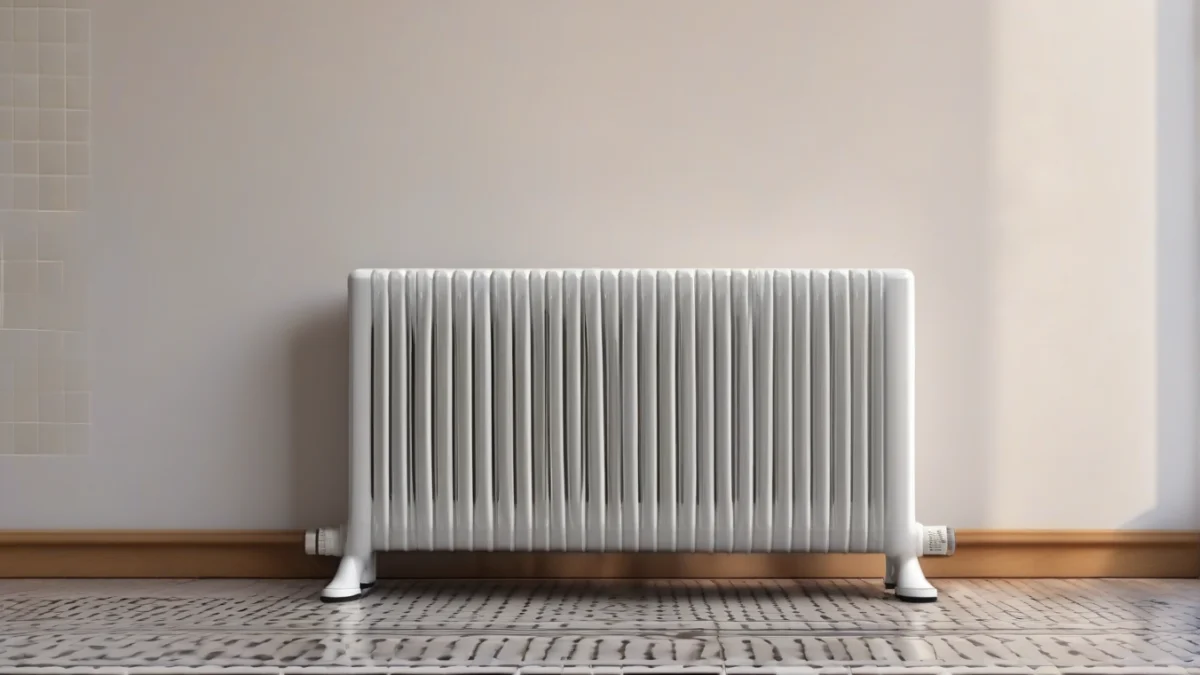
- Retain heat 20 to 30 minutes after shutdown
- Silent operation—no fan noise
- Steady warmth reduces condensation risk
- Heat output stops immediately when off
- Fan noise in most models
- Rapid heating can stir up dust and moisture
Never use portable gas or paraffin heaters in damp rooms. Combustion produces water vapor as a byproduct—burning one liter of paraffin releases roughly one liter of water into the air, worsening condensation and mold risk.
Electric panel heaters with accurate thermostats deliver the low, steady warmth that prevents surface temperatures from dropping below the dew point. They mount flat to the wall, heat silently, and many include adaptive start programming that learns how long the room takes to warm. Heaters for damp areas should carry an IP rating of at least IP24 for bathrooms and kitchens, meaning they resist water splashes.
Infrared heaters warm walls, floors and furniture directly rather than heating the air. This reduces the energy wasted on warming humid air and keeps surfaces dry. They suit basements and poorly insulated rooms where air heating alone loses warmth to cold walls. Mount them high on the wall, aimed at the zone you occupy.
Central heating radiators work best when sized correctly and controlled with thermostatic radiator valves (TRVs) for each room. An undersized radiator in a damp room runs constantly at full output, never reaching the setpoint, while a correctly sized unit cycles gently and maintains even warmth. For a basement or ground-floor room prone to damp, size the radiator 20% larger than the standard calculation to account for heat lost to cold floors and walls.
Heating Large Rooms and High Ceilings Without Losing Warmth
Warm air rises, and in a room with a high ceiling it stratifies in layers—hot air gathers near the ceiling while the floor stays cold. A ceiling fan on low speed in reverse mode pushes warm air back down without creating a draft. Run it clockwise when looking up at the blades. The difference in floor-level temperature can reach 3 to 4°C in a room with ceilings above 3 meters.
Heat the zone you occupy, not the entire volume. Place the heater low and central rather than tucked in a corner, so warmth spreads evenly across the floor before rising. If the room has distinct seating or working areas, position a heater in each zone rather than trying to heat the whole space from one corner. A large-room heater still outputs a maximum of 1,500 W from a standard plug—enough for about 150 square feet in a well-insulated room, less in a drafty one.
Insulated floors and thick rugs stop heat draining through the ground. Solid floors—concrete, tile, stone—conduct heat away rapidly. A rug with a thermal underlay or cork tiles adds an insulating layer that keeps your feet warm and reduces the watts needed to maintain comfort.
Expectations matter. A 1,500 W plug-in heater cannot warm a large, high-ceilinged room to 21°C if the walls are cold and the insulation is poor. It will take the chill off and warm a corner, but whole-room comfort in a big space needs central heating or multiple circuits. Trying to heat 400 square feet with a single space heater leaves you running it constantly and still feeling cold.
When to Call a Professional for Damp and Heat Loss
You can handle ventilation improvements, dehumidifiers, thermal curtains, and draft excluders yourself. Adding an electric radiator to an upstairs bedroom is straightforward if you have a spare outlet on a circuit that can spare the load—most 1,500 W heaters draw 12.5 amps, close to the 13-amp limit of a UK plug. Basement radiators follow the same rule, but heaters for damp areas need tip-over and overheat protection because basements trap moisture and limit airflow.
Call a professional when you see a tide mark—a horizontal stain line creeping up from the floor—or when damp patches appear after rain and worsen over time. The first suggests rising damp from a failed damp-proof course; the second points to penetrating damp from structural defects like cracked rendering, blocked gutters, or leaking pipes. Both need diagnosis and repair by someone who can trace the water’s path and fix the building fabric, not just the symptom.
A damp survey distinguishes condensation from rising damp and penetrating damp using moisture meters, thermal imaging, and inspection of the damp-proof course. Condensation shows up on cold spots—windows, corners, the back of wardrobes on external walls—and usually brings black mould. Rising damp leaves salt deposits and a tide mark. Penetrating damp follows a defect you can trace: a crack, a missing tile, a gap around a window frame.
Positive input ventilation and mechanical ventilation with heat recovery systems need professional design and installation. Both move large volumes of air through ducts that must be sized, sealed, and balanced to avoid drafts, noise, and wasted heat. An incorrectly designed system either under-ventilates, leaving moisture behind, or over-ventilates and strips the heat you are trying to retain.
Frequently Asked Questions
What temperature should I keep my house to prevent condensation?
Can a dehumidifier help retain heat in a damp room?
Which insulation materials work best in damp conditions?
How do I heat a dorm room that doesn’t allow heating units?
How do I prevent mould regrowth after treating a damp room?
Should I use an oil-filled radiator or ceramic heater in a damp bedroom?
Readers in this position usually ask about how to stop cold air leaking from extractor fan vents as well.
If that sounds like your room, read up on best weatherstripping for uk homes: a practical guide next.
