
Choosing a space heater can be complex. With many options available, understanding the differences between convection and radiant heaters is crucial for comfort, energy efficiency, and safety.
Convection Heater vs Radiant Heater at a Glance
| Feature | Convection Heater | Radiant Heater |
|---|---|---|
| Heat output and room size | Heats whole rooms evenly and steadily | Heats small areas quickly, not whole rooms |
| Running cost | Costs the same as radiant at the same wattage | Costs the same as convection at the same wattage |
| Safety features | No fan, less dust circulation, safe for allergies | Has tip-over and overheat shutoff, fan may circulate dust |
| Noise level | Produces some fan or convection noise | Quieter, especially models without fans |
| Portability and convenience | Heavier, less easy to move frequently | Lightweight, compact, easy to move room-to-room |
| Lifespan and maintenance | Fewer moving parts, longer lifespan | Quartz tubes and fans may need more maintenance |

BLACK+DECKER Infrared Radiant Quartz Tower Heater
- Heat SettingsLow (750 W), High (1500 W)
- Safety FeaturesCool touch housing, power indicator, overheat shutoff, tip-o
- Weight5 lbs
- Fast heat-up with infrared quartz tubes
- Portable design at 5 lbs
- Multiple safety features including overheat and tip-over protection
- Limited to personal or small space heating
- No programmable timer or digital controls
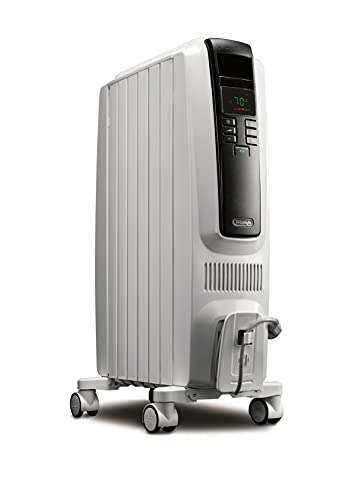
De’Longhi Dragon Digital Oil Filled Radiator Heater
- Power1500 W
- ControlDigital panel with LED display and 24-hour timer
- Energy FeatureECO Plus energy saving mode
- Large radiant surface for effective room heating
- Digital controls with programmable 24-hour timer
- Energy-saving ECO Plus feature and no fan to stir dust
- Heavier and less portable than radiant tower heaters
- Slower to heat up compared to infrared models
Convection vs Radiant Heater
Convection heaters warm the air in a room, while radiant heaters send heat directly to objects and people. Choose convection for steady whole-room warmth and radiant for quick, focused heat.
Convection heating works by warming cool air near the heater. The warm air rises and circulates, pushing cooler air toward the heater to repeat the process. This creates a gentle airflow that heats the entire space evenly over time.
Radiant heating uses infrared rays that travel in straight lines to warm surfaces and skin directly. It does not rely on air movement, so you feel heat instantly when in the rays’ path. The air temperature in the room may stay cooler compared to convection.
Convection heaters include oil-filled radiators and panel heaters. They suit bedrooms, living rooms, and offices where you want the whole room comfortable for long periods. Radiant heaters include infrared quartz models like the BLACK+DECKER Infrared Radiant Quartz Tower Heater, ideal for spot heating near a desk or seating area.
- Choose Based on UsePick convection heaters for steady warmth in enclosed rooms. Pick radiant heaters for quick heat in a specific spot or when you move between rooms.
- Consider Room SizeUse convection for medium to large rooms. Use radiant for small areas or personal heating.
- Check Safety FeaturesLook for tip-over and overheat protection on both types. Never use a radiant heater unattended unless rated for it.
Heat Output and Room Size
Convection heaters steadily warm the air, making them effective for heating entire rooms. An oil-filled radiator like the De’Longhi Dragon Digital Oil Filled Radiator Heater outputs heat that spreads evenly, warming spaces up to 150 square feet or more depending on insulation.
Radiant heaters deliver heat directly to objects and people without warming the air first. This makes them efficient for spot heating but less effective for large or open rooms. They work best in small spaces or when you want immediate warmth in one area.
A hot oil heater is a convection type. It heats oil inside the unit, which retains heat and radiates it slowly to the air. This keeps the room warm even after the heater cycles off, unlike radiant heaters that stop heating immediately when off.
| Heater Type | Heat Distribution | Best Room Size | Heat Persistence |
|---|---|---|---|
| Convection (oil-filled radiator) | Air circulation warms entire room evenly | Medium to large rooms (150+ sq ft) | Continues radiating heat after off cycle |
| Radiant (infrared quartz) | Direct rays warm objects and people instantly | Small rooms or localized spots | Stops heating immediately when off |
Radiant heat vs convection heat burners differ in how they transfer warmth. Convection burners heat air that then circulates, while radiant burners emit infrared heat directed at surfaces. This affects how quickly and where heat is felt in a room.
For whole-room heating, convection models are better. For quick, targeted warmth, radiant models excel. Choose based on your room size and whether you want steady heat or instant comfort.
For more on how radiant and convection heat feel differently, see radiant vs convection heat.
Running Costs
Radiant heaters do not cost more to run than convection heaters if they use the same wattage. Both types convert electrical energy into heat at nearly 100% efficiency. The main factor in running costs is wattage multiplied by hours of use and the electricity rate.
Calculate running costs by multiplying the heater’s wattage by the hours you run it, then dividing by 1,000 to get kilowatt-hours. Multiply by your electricity rate, typically around 17 cents per kWh in the U.S. For example, a 1,500 watt heater running 8 hours daily costs 1.5 × 8 × 0.17 = $2.04 per day.
The difference between convection and radiant heat lies in how warmth reaches you. Convection heaters warm the air, distributing heat evenly across a room. Radiant heaters send infrared rays directly to objects and people, warming them before the air.
Efficiency varies by how you use the heater and the room size. Radiant heaters are more efficient in small spaces or when you want quick, targeted warmth. They heat people and objects directly without warming all the air, so they use less energy when you only need spot heat.
Convection heaters suit larger rooms or continuous heating. They take longer to warm a space but keep the temperature steady. Running these heaters in well-insulated rooms reduces heat loss and lowers overall costs.
| Appliance | Watts | Per hour | Per day (8 h) | Per month (30 days) |
|---|---|---|---|---|
| 1,500 W space heater | 1,500 W | 26¢ | $2.04 | $61.20 |
| Heated blanket | 100 W | 1.7¢ | 14¢ | $4.08 |
Safety Considerations
Radiant heaters are not better than unit heaters for whole-room space heating. Radiant models provide direct heat to people and objects but do not warm the air evenly, which unit heaters do more effectively for larger spaces.
Radiant and convection heaters each have important safety features to look for. Both should have tip-over protection that shuts the unit off if it falls. Overheat protection is also essential to prevent fires.
Radiant heaters pose higher burn risks because their heating elements can reach very high temperatures. Keep at least 3 feet of clearance around them and never touch the heating surface while on. They are best used where children and pets cannot reach.
Convection heaters generally have cooler surfaces, especially oil-filled models like the De’Longhi Dragon. This reduces burn risk and makes them safer for bedrooms and around children.
Read radiant vs convection heater reviews for safety insights. Many users report that convection heaters feel safer for extended use, while radiant heaters excel in quick, direct warmth but require more caution.
Always plug heaters directly into wall outlets, never extension cords. Use heaters with UL, ETL, or CSA safety listings to ensure they meet safety standards. Never leave heaters running unattended unless the manual explicitly allows it.
Noise Levels
Radiant heaters are quieter than convection heaters. Radiant models operate silently because they heat objects directly without moving air. Convection heaters that use fans produce noticeable noise from the motor and airflow.
Fan-assisted convection heaters generate a steady hum or whir that can be distracting in quiet environments like bedrooms or offices. The noise level varies with the fan speed and model quality. Some convection heaters use natural convection without fans, which cuts noise but slows heating.
Ceramic heaters are a type of convection heater that often use fans to spread warm air quickly. They tend to be louder than oil-filled or baseboard convection models but quieter than many metal element fan heaters. Ceramic vs convection heaters noise comparison depends on fan use and design, not the heating element alone.
| Heater Type | Noise Level |
|---|---|
| Radiant heater | Silent operation |
| Fan-assisted convection heater | Moderate noise from fan |
| Natural convection heater | Minimal noise, no fan |
| Ceramic heater | Low to moderate fan noise |
Portability and Convenience
Radiant heaters provide direct spot heat and tend to be lightweight and easy to move. They often have compact designs and handles for quick repositioning. This makes them convenient for targeting cold spots or using in multiple rooms.
Convection heaters warm the whole room by circulating air. Oil-filled radiators and baseboard convectors are heavier and bulkier due to metal and fluid inside. They usually have wheels or handles but require more effort to move between rooms.
Ease of use is similar for both types. Plug-in models need no installation. Radiant heaters are typically ready to use immediately and heat instantly. Convection heaters take longer to warm the room but run quietly when fans are off.
- Check weight and sizeRadiant heaters often weigh under 10 pounds; oil-filled radiators can weigh 15 to 30 pounds.
- Look for handles or wheelsHandles improve carrying; wheels ease moving heavy convection units.
- Consider where you need heatChoose radiant for spot heating; convection for whole-room warmth.
- Plug in and power onBoth types usually run from standard 120 V outlets with no special setup.
Frequently Asked Questions
What is the main difference between convection and radiant heaters?
Can you use a radiant heater in a large room?
How do you calculate the running cost of a heater?
Are convection heaters more energy-efficient?
Which type of heater is better for allergic individuals?
How long do convection and radiant heaters typically last?
Before you buy anything, it is worth looking at electric heaters without hot spots.
If that sounds like your room, read up on oil radiator vs electric next.