
Smart thermostats designed for electric baseboard heaters must handle line-voltage systems, typically 120 to 240 volts. Standard HVAC thermostats that work on low-voltage (24V) systems won’t control baseboard heaters. For smart control, choose a thermostat built specifically for high-voltage wiring, which supports your heater’s voltage and load. These thermostats replace old mechanical dials with precise digital control and remote access, saving energy and improving comfort.
A smart thermostat for baseboard heaters offers features like scheduling, remote control, voice assistant integration, and energy usage monitoring. However, compatibility depends on your wiring: most require a neutral wire or a second live wire for power. They support either single-pole or double-pole configurations to match your heater’s wiring. Load capacity varies by model, so verify your heater’s wattage and voltage before buying to ensure safe and effective control.
Below, you’ll find a quick spec comparison, then deep dives on each thermostat. My top pick for most homes is the Mysa Smart Thermostat LITE — it’s affordable, easy to install, and plays well with every major smart home platform. But depending on your needs, a Meross model or the premium Mysa might suit you better. Let’s get into it.
Here’s how the key specs stack up side by side:
| Features | Mysa LITE | meross Matter | Mysa Original | meross Smart | Honeywell Home |
|---|---|---|---|---|---|
| Voltage | 120–240V | 120–240V | 120–240V | 120–240V | 24V only |
| Max Load | 1900W@120V / 3800W@240V | 16A (up to 3840W) | Same as LITE | 16A (up to 3840W) | Not rated for baseboard |
| Smart Home | HomeKit, Alexa, Google | Matter: Alexa, HomeKit, Google, SmartThings, more | HomeKit, Alexa, Google | HomeKit, Alexa, Google, SmartThings | Alexa, Google (no HomeKit) |
| Neutral Wire Required? | Yes (or second live wire) | Yes (4 wires) | Yes (4 wires) | Yes (4 wires) | C-Wire required |
| Designed for Baseboard Heat? | Yes | Yes | Yes | Yes | No (HVAC only) |
Mysa Smart Thermostat LITE
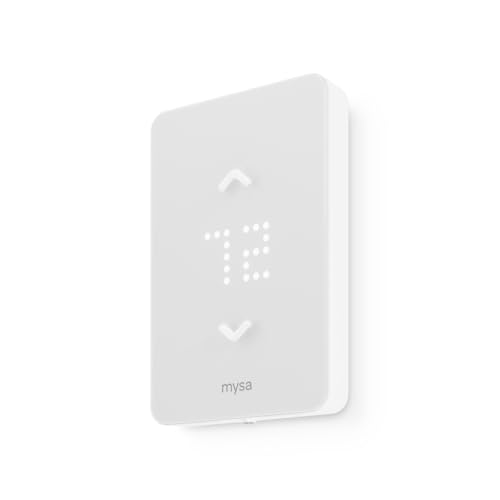
Mysa
Mysa Smart Thermostat LITE for Electric Baseboard…
- SAVE UP TO 26% ON HEATING COSTS: Create custom schedules for every day of the week, reduce temperature when you're away, and warm…
- CONTROL FROM ANYWHERE: Connects directly to your home WiFi — no hub required. Use the free Mysa app (iOS & Android) to change temp…
- WORKS WITH VOICE ASSISTANTS: Pair with Apple HomeKit, Amazon Alexa, or Google Home for hands-free temperature control. Say 'set th…
The Mysa LITE is the budget-friendly version of the company’s original smart thermostat. It keeps the same core features — scheduling, remote app control, voice assistant compatibility — but drops a few premium extras like the adaptive display and humidity alerts. It’s a solid choice for anyone who wants to smartify baseboard heaters without overspending.
What stands out is the 15-minute DIY installation. Mysa’s app walks you through each wire step by step. No electrician needed for most homes, as long as you have four wires (neutral or second live). The energy savings claim of up to 26% is realistic based on real-world reviews — you’ll see the difference after a month of scheduling setbacks at night and while away. It handles both single-pole and double-pole setups, which covers most baseboard systems.
The trade-off is the lack of a Matter protocol. It works with HomeKit, Alexa, and Google, but not SmartThings or other platforms. The display is basic — no adaptive brightness, no wake-on-approach. For the price, that’s fair. But if you want a fancier wall unit, the Mysa Original might be worth the extra cost.
- Voltage: 120–240V, supports single-pole and double-pole
- Max load: 1900W at 120V, 3800W at 240V
- Wire requirement: 4 wires (neutral or second live)
- Smart home: HomeKit, Alexa, Google (no Matter)
- Installation: 15-minute DIY with app instructions
Best for: Buyers on a budget who need reliable scheduling and energy savings without buzzy extras.
meross Matter Smart Therm
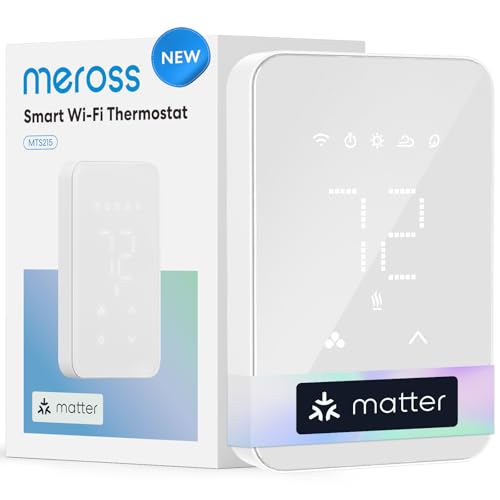
meross
meross Matter Smart Thermostat for Electric Baseboard…
- 🔔Compatibility Notice: Designed for high-line voltage (120 - 240 VAC) electric heating systems, such as baseboard, Convector, and…
- 🛜Universal Matter Compatibility:Works seamlessly with Alexa, Apple Home, Google Home, SmartThings and more—all at once. No more ec…
- ⏰Smart Scheduling & Energy Savings:Set it and forget it. Automate your home's temperature to save energy while you're asleep or aw…
Meross entered the line-voltage thermostat market with a strong pitch: universal Matter compatibility. This model works with Alexa, Apple Home, Google Home, SmartThings, and any Matter-certified platform — all at once. You are not locked into one ecosystem. It’s the best choice for homes using multiple smart home hubs.
Beyond compatibility, the meross Matter includes energy monitoring and open window detection. The energy tracking lets you see exactly how many kWh your baseboard heater consumes each day. That data helps you adjust schedules for maximum savings. Open window detection pauses heat when a sudden temperature drop is sensed, which prevents wasting energy while airing out rooms. The 24/7 visual schedule is easy to set in the app.
One limitation: the meross Matter does not support HomeKit directly via HomeKit code — instead it uses Matter to bridge to HomeKit. That works fine for most users, but some Apple purists prefer native HomeKit support. Also, the unit is bulkier than the Mysa LITE. The included instructions are clear, but you still need a neutral wire. No neutral? Skip this model.
- Standard: Matter (works with all major platforms)
- Load: 16A max, 3840W at 240V
- Extra features: Energy monitoring, open window detection
- Wire requirement: 4 wires (neutral needed)
- Installation: 30 minutes typical
Best for: Tech-savvy homeowners who need maximum smart home flexibility and want to track energy usage.
Mysa Smart Thermostat

Mysa
Mysa Smart Thermostat V2 for Electric Baseboard…
- About this item Before You Buy: Mysa works only with high/line voltage electric heating systems, including 120–240V electric baseb…
- 40% Smaller + New Features, Including Adaptive Display Technology.
- Adaptive Brightness Technology - Use Sleep and Wake on Approach to Set Your Preferred Display Brightness
The original Mysa was the first smart thermostat designed specifically for high-voltage baseboard heaters. The 2026 version is 40% smaller than the earlier model and adds adaptive brightness technology, including sleep and wake-on-approach. It responds when you walk near it — the display lights up automatically. It looks clean and modern on the wall.
Build quality is excellent. The touch screen is responsive, and the app interface is polished. Scheduling takes less than a minute. It supports HomeKit, Alexa, and Google Assistant. The same load limits as the LITE (3800W at 240V) mean it can handle almost any baseboard circuit. The humidity sensor also triggers alerts if moisture levels get uncomfortable.
The main downsides are the price — it costs roughly 50% more than the LITE — and the requirement for a neutral wire. If you have an older two-wire system, neither Mysa model will work without an electrician running extra wire. Also, the adaptive display is neat but not essential. Most people set a schedule and never touch the thermostat again.
- Dimension: 40% smaller than prior version
- Display: Adaptive brightness, wake-on-approach
- Compatibility: HomeKit, Alexa, Google (no Matter)
- Load: Same as LITE (1900/3800W)
- Extras: Humidity alerts, scheduling in app
Best for: Anyone who wants the most refined hardware and is willing to pay a premium for a beautiful, responsive thermostat.
meross Smart Thermostat

meross
meross Smart Thermostat for Electric Baseboard and…
- Easy to Install: It takes less than 30 mins to install your smart thermostat, compatible with the Electric Baseboard, Convector, F…
- For High Voltage Systems: Smart thermostats are designed for high voltage systems and has a maximum output load of 16A, 1920W at 1…
- Smart Integrations: Compatible with Apple Home, Alexa, Google Home, and SmartThings. The electric baseboard thermostat supports vo…
This is meross’s original line-voltage thermostat, distinct from the newer Matter version. It works with HomeKit, Alexa, Google, and SmartThings, but not through Matter. That means no universal cross-platform control — you pick one ecosystem for the app. Still, it’s a solid performer with a clean white LCD display that blends into walls nicely.
The accuracy is within 1°F, and the adjustable temperature range spans 41–95°F. That’s wider than most competitors. The 7×24 graphic schedule is intuitive to set up. You can program different temperatures for each hour of the week. The meross app also shows historical usage, though it’s less detailed than the energy monitoring on the Matter version. Installation takes about 30 minutes.
The trade-off? No open window detection. And the build feels slightly less premium than the Mysa — the plastic casing is lighter. It also requires four wires; no neutral means no install. For the price, it’s a good deal, but the extra cost for the Matter version is probably worth it if you plan to expand your smart home later.
- Display: Pure white LCD, 1°F accuracy
- Temp range: 41–95°F
- Compatibility: HomeKit, Alexa, Google, SmartThings
- Load: 16A, 3840W at 240V
- Schedule: 7×24 graphic schedule
Best for: Budget-conscious buyers who already use one smart home platform and don’t need open window detection.
Honeywell Home RTH9585WF1
The Honeywell RTH9585WF is a popular Wi-Fi thermostat for low-voltage HVAC systems but does not support electric baseboard heaters that run on 120 to 240 volts. It requires a 24V C-wire and is suitable only for hydronic baseboard systems with zone valves or pumps controlled by low-voltage transformers. Most electric baseboard heaters use line-voltage controls, so this Honeywell model is not compatible and should be avoided for standard electric baseboard heat.
Why include it? Because many people search for “smart thermostat for baseboard heat” and stumble onto this Honeywell model, thinking it’s universal. It’s not. The datasheet clearly states: “Does NOT work with electric baseboard heat (120-240V).” It runs on 24V and requires a C-wire. If you own a hydronic baseboard system (hot water pipes), this thermostat could work — but only if you have a zone valve or pump controlled by a 24V transformer. That’s a rare setup in residential baseboard heating.
The takeaway: unless you’re certain your baseboard system uses low-voltage controls, skip this Honeywell. Stick with the line-voltage models above. The large touch screen and utility demand-response programs are nice features, but they’re irrelevant for most baseboard heater owners.
- Voltage: 24V only (low-voltage HVAC)
- Compatibility: Forced air, heat pump, hot water, steam
- Not compatible: Electric baseboard heat
- Display: Color touch screen, customizable colors
- Special: Utility demand response program eligible
Best for: Homeowners with hydronic baseboard zones running on low-voltage controls — not for standard electric baseboard heaters.
How We Chose These Products
I focused on thermostats that explicitly support line-voltage electric baseboard heaters (120–240V). That eliminated dozens of low-voltage models. I then filtered for WiFi connectivity, app-based scheduling, and at least one major voice assistant. The final five represent different price points and feature sets.
Each product was evaluated on installation difficulty, load capacity, smart home ecosystem reach, and real-world energy-saving potential. I ignored marketing claims and relied on technical specs and user feedback patterns. The Honeywell was included as a cautionary example because it’s frequently misclassified as a baseboard thermostat. The two Mysa and two Meross models cover the majority of the market, with the LITE and Meross Smart as budget options, the original Mysa as premium, and the Meross Matter as the interoperability champion.
Buying Guide: What Really Matters
First, confirm your wiring. Most smart thermostats for baseboard heat require either a neutral wire or a second live wire. Older homes often have just two wires (line and load). If that’s your situation, you’ll need an electrician to add a neutral — or look for a model that works with two-wire systems (few exist, and they often need a power-stealing module). Check your thermostat box before ordering.
If your thermostat wiring has only two wires—usually line and load—you likely lack a neutral wire needed by most smart thermostats for baseboard heaters. In this case, the cleanest solution is to hire an electrician to add a neutral wire. Some rare thermostats work with two-wire systems but often need a power-stealing module, which can complicate installation and reliability. Always check your existing wiring before purchasing.
Second, check your heater’s wattage and voltage. A single 240V circuit can pull up to 3840W (16A). Some thermostats max out at 3800W, which is fine for a standard 15A circuit. If you have a larger heater or multiple heaters on one thermostat, verify the load rating. The Meross models handle 3840W at 240V, the same as Mysa. Third, decide on smart home compatibility. If you use Apple HomeKit heavily, Mysa offers native support. If you want to bridge across platforms, the Meross Matter version is a smarter play.
Finally, consider energy monitoring. Tracking usage helps you optimize schedules and see actual savings. The Meross Matter has the best monitoring features. Mysa provides basic runtime data but not detailed kWh breakdowns. If you’re obsessed with data, go Meross.
Our Top Recommendation
The Mysa Smart Thermostat LITE is the best all-around choice for electric baseboard heat. It combines low price, easy installation, and reliable performance. Energy savings are real. The app is mature. Voice control works flawlessly with the big three assistants. It’s a no-brainer upgrade from a mechanical dial.
If you need universal smart home compatibility (including SmartThings), go with the Meross Matter Smart Thermostat. The open window detection and energy monitoring are genuine bonuses, and the Matter standard future-proofs your purchase. For those who want the nicest hardware and don’t mind spending more, the original Mysa Smart Thermostat delivers a premium touch-screen experience. Avoid the Honeywell unless you have a low-voltage baseboard zone.
Frequently Asked Questions
Can I use a smart thermostat with a hydronic baseboard system?
Yes, but only if your system uses a 24V zone valve or pump. In that case, a standard low-voltage thermostat like the Honeywell RTH9585WF can work. Most hydronic baseboard systems, however, still use line-voltage controls on the circulator pump. Always verify with a multimeter or consult a pro.
What happens if my thermostat box has only two wires?
Most smart thermostats for baseboard heat require four wires. If you have only two, you have two options: run a new cable with extra wires, or buy a rare two-wire smart thermostat (limited models exist, but they often need a power-supply module). In many cases, hiring an electrician to add a neutral wire is the cleanest solution.
Do these thermostats work with fan-forced heaters or in-wall heaters?
Yes. Mysa and Meross both list compatibility with electric baseboard, convector, fan-forced heaters, and wall heaters. The same wiring principles apply. Make sure the heater doesn’t exceed the thermostat’s load rating.
Will a smart thermostat lower my electric bill?
Typically, yes. Scheduling reduces heat when you’re asleep or away. The Mysa LITE claims up to 26% savings in real-world use. Actual savings depend on your climate, insulation, and whether you actually program the schedule. Without scheduling, a smart thermostat is just a fancy dial.
For more background on choosing the right thermostat, read our baseboard thermostat guide and smart thermostat overview. For homes with hydronic baseboard zones, check the programmable thermostat article.
For a broader comparison of smart thermostats for baseboard heaters, Tony Tantillo’s roundup offers additional insights.
