
When outdoor temperatures drop below 20°F and your room starts the night at 50°F or colder, you need a heater that delivers 1500 watts, holds a set temperature precisely, and includes tip-over and overheat protection. A poorly insulated room or a garage with no insulation multiplies the challenge: heat escapes as fast as the heater produces it.
The heaters below are ranked by how well they handle prolonged extreme cold, how quickly they recover when a door opens, and whether they can run safely all night. Every one maxes out at 1500 watts—the limit for a standard 120V outlet—so the differences come down to heating method, oscillation, thermostat precision, and build quality.
Specs at a Glance
| Product | Best for | Heat settings | Oscillation | Auto shut-off | Noise level | Price |
|---|---|---|---|---|---|---|
| DREO 1500W Ceramic Space Heater | Best overall | 1000W / 1500W / ECO mode | 70° | 12-hour timer, 24-hour auto off | 34 dB | Check price |
| Dr Infrared DR-968 Portable Space Heater | Best for workshops | High / Low / Auto | — | 12-hour timer | 39 dB | Check price |
| BEYOND HEAT 1500W Milkhouse Heater | Best for basements | Fan / 1300W / 1500W / anti-freeze | — | Tip-over and overheat | — | Check price |
| R.W.FLAME Mini Portable Ceramic Heater | Quietest | Multiple with ECO mode | — | 24-hour timer | — | Check price |
| R.W.FLAME 1500W Ceramic Office Heater | Best budget | 1500W with thermostat | — | Tip-over and overheat | — | Check price |



The Five Heaters That Handle Extreme Cold
DREO 1500W Ceramic Space Heater
- Power1500W
- Oscillation70°
- Noise level34 dB
- Timer12 hours
- SafetyETL-certified, tip-over and overheat protection
- ECO mode maintains precise temperature and saves energy
- 70° oscillation covers large rooms evenly
- 34 dB operation won’t wake light sleepers
- 12-hour timer and 24-hour auto shut-off
- No carrying handle for moving between rooms
- Oscillation mechanism adds bulk compared to fixed heaters
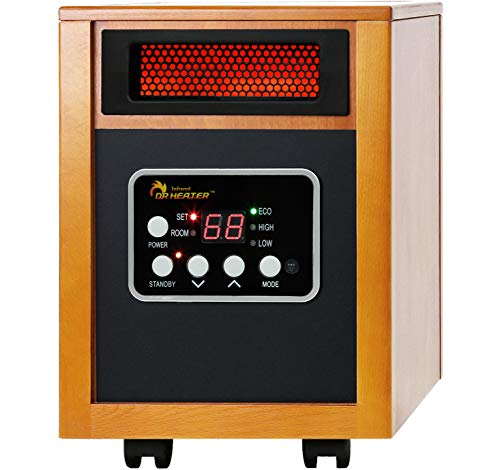
Dr Infrared DR-968 Portable Space Heater
- Power1500W
- Heat output5,200 BTU
- Heating systemInfrared quartz + PTC
- Thermostat range50–85°F
- Noise level39 dB
- Cord length72 inches
- Infrared quartz targets people and objects, not just air
- 5,200 BTU output suits large uninsulated spaces
- Caster wheels and 6-foot cord for easy positioning
- Lifetime filter saves ongoing costs
- 19 lbs makes it heavy to carry upstairs
- 39 dB is louder than ceramic models
- Wood cabinet finish shows dust in workshops
BEYOND HEAT 1500W Milkhouse Heater
- Power1500W / 1300W / fan only
- Anti-freezeYes
- SafetyETL-certified, tip-over and overheat protection
- PortabilityCarry handle
- Anti-freeze mode protects pipes automatically
- Solid carry handle suits frequent moves
- Fan-only mode circulates air in warmer weather
- ETL-certified with tip-over and overheat protection
- No oscillation—you get a fixed heating cone
- No remote control or timer
- Heats up in seconds but doesn’t hold temperature as precisely as models with ECO modes
R.W.FLAME Mini Portable Ceramic Heater
- TypeCeramic
- Timer24 hours
- ControlRemote and thermostat
- SafetyTip-over and overheat protection
- Compact and portable for small spaces
- Remote control and 24-hour timer
- ECO mode adjusts output automatically
- Thermostat maintains set temperature
- Lower output struggles in rooms larger than 100 sq ft
- No oscillation—heats only the area in front of it
R.W.FLAME 1500W Ceramic Office Heater
- Power1500W
- TypeCeramic
- ControlThermostat
- SafetyETL-certified, tip-over and overheat protection
- 1500W ceramic element heats quickly
- Thermostat maintains temperature
- ETL-certified with tip-over and overheat protection
- Portable and lightweight
- No timer or remote control
- No oscillation—fixed heating direction
- No ECO mode to save energy overnight
How to Choose a Heater for Extreme Cold
A heater for a cold room needs three things: a heating method that matches your insulation, a thermostat precise enough to hold steady warmth, and coverage wide enough to heat the whole space instead of one corner. Ceramic heaters with fans heat air fast and work best in insulated rooms where the warm air stays put. Infrared heaters warm objects and people directly, the way sunlight does, and suit drafty or uninsulated spaces where heated air escapes before it can raise the room temperature.
A digital thermostat that holds within 1°F prevents the cold swings that wake you at 3 a.m. and the wasted energy of overheating. Mechanical thermostats can drift 3 to 5 degrees, cycling between too hot and too cold. The DREO ceramic heater uses a digital sensor and ECO mode to maintain your target within a degree, cycling between 1000W and 1500W as needed.
Oscillation or a wide heating angle spreads warmth across the room instead of creating a hot spot in front of the heater. A 70° oscillation covers a 12-by-12-foot bedroom from one corner; a fixed heater aimed at your bed leaves the rest of the room cold. The Dr Infrared DR-968 uses a 60° radiant panel and a blower to distribute heat across 200 square feet in an insulated space.
| Feature | Ceramic with Fan | Infrared Radiant |
|---|---|---|
| Heat method | Warms air, circulates with fan | Warms objects and people directly |
| Best for | Insulated rooms, fast warmth | Drafty or uninsulated spaces |
| Warm-up time | 30 seconds to 2 minutes | 5 to 10 minutes for objects to radiate |
| Coverage pattern | Narrow unless oscillating | Wide radiant panel, 60° to 90° |
Room Size and Insulation: Matching Output to Your Space
A 1500W heater covers 150 to 200 sq ft in a well-insulated room, 100 to 150 sq ft in a poorly insulated room, and 75 to 100 sq ft in an uninsulated garage or workshop. The outdoor temperature matters less than whether your walls, ceiling and windows hold the heat in. A room with an attic above and poor insulation loses heat through the ceiling faster than the heater can replace it, especially when the attic temperature drops below freezing.
Sealing drafts around windows and doors cuts heat loss by a third in most rooms. Adding a rug or foam board under the heater helps in uninsulated garages where concrete pulls warmth straight into the ground. Bathrooms with tile floors and exterior walls need a heater with a high CFM fan to push warm air down to floor level; the best portable heaters for cold winter nights with oscillation work better than a fixed unit aimed at the mirror.
- Well-insulated room (new windows, insulated walls and ceiling): 150 to 200 sq ft per 1500W heater
- Poorly insulated room (older home, single-pane windows, insulation in walls only): 100 to 150 sq ft per heater
- Uninsulated space (garage, workshop, basement with concrete walls): 75 to 100 sq ft per heater
For rooms larger than 200 sq ft, run two 1500W heaters on different circuits rather than expecting one unit to handle extreme cold. A 15A breaker trips at 1800W, so plugging two heaters into outlets on the same circuit will cut power to both. Check your breaker panel or plug the second heater into an outlet in an adjacent room that runs on a separate circuit.
Running a Heater All Night: Cost and Safety
A 1,500 W heater running for 8 hours costs $2.04 per night at the US average electricity rate of $0.17 per kWh. That’s $61.20 per month if you run it every night. Most heaters with ECO mode cycle between 1,000 W and 1,500 W to hold your target temperature, cutting the cost by 20 to 40 percent depending on how well your room holds heat.
| Appliance | Watts | Per hour | Per day (8 h) | Per month (30 days) |
|---|---|---|---|---|
| 1,500 W heater on high | 1,500 W | 26¢ | $2.04 | $61.20 |
| ECO mode (average 1,000 W) | 1,000 W | 17¢ | $1.36 | $40.80 |
Only heaters with automatic tip-over shut-off, overheat protection, and ETL or UL certification should run unattended overnight. Tip-over switches cut power the moment the heater tilts past a safe angle. Overheat protection stops the heating element before the casing gets hot enough to ignite nearby fabric or paper. Look for heaters designed for all-night warmth that list both features in the manual.
A 12-hour timer lets you schedule the heater to shut off after you fall asleep. A 24-hour auto shut-off without any button press or movement adds a second layer: if you forget to turn it off in the morning, the heater stops itself. The DREO and R.W.FLAME models both include timers and shut-off features, making them safer for long winter nights when you want warmth from bedtime through dawn.
Place the heater on a hard, level floor away from foot traffic. Carpet is fine if the heater has a flat base and tip-over protection, but never set it on a bed, couch, or table where it can fall.
Heating an Uninsulated Garage or Workshop in Extreme Cold
Infrared heaters warm the objects and people in front of them rather than heating the air, so they work in drafty garages where a ceramic heater’s warm air escapes through gaps in the door and walls the moment it rises. You feel the heat within seconds because the infrared waves travel straight to your skin, your workbench, and the floor, which then radiate warmth back. A ceramic heater in the same space spends most of its energy heating air that leaks out before it reaches you.
The Dr Infrared DR-968 combines infrared quartz tubes with PTC ceramic for 5,200 BTU output—60 percent more heat than ceramic-only models according to the manufacturer. The dual system means you get the directional warmth of infrared plus some convection to take the edge off the air around you. A single 1,500 W heater creates a 10 to 15 foot zone of comfort in a garage; it will not heat the entire space to 68°F if the garage is large or poorly sealed. Point it at your workbench or the area where you stand, and expect to feel warm within that zone while the far corners stay cold.
For propane or kerosene heaters rated for indoor use, a working carbon monoxide alarm and the ventilation specified in the manual are non-negotiable. Fuel-burning heaters produce CO as they run, and extreme cold means you’re less likely to crack a door. Install a battery-powered CO alarm within 15 feet of the heater, test it before every cold snap, and follow the manufacturer’s vent requirements exactly. Never use an outdoor-rated or construction propane heater indoors, even in a garage with the door open.
Dry Air and Comfort: What Heaters Do to Indoor Humidity
Electric heaters do not remove moisture from the air, but they lower relative humidity by raising the temperature. Warm air holds more moisture than cold air, so the same amount of water vapor feels drier at 72°F than at 60°F. Your nose and skin notice the drop even though the actual water content stays the same.
Running a heater all night in a sealed bedroom can drop relative humidity below 30%. Most people feel comfortable between 40% and 50%. The longer the heater runs and the smaller the room, the drier the air feels by morning.
A small humidifier in the bedroom adds moisture back into the air and keeps relative humidity in the comfortable range. Place it a few feet from the heater, never on top of it or directly next to it, so the mist disperses evenly rather than condensing on the heater’s surface.
If you wake with a dry nose or scratchy throat despite using a heater safely, the air is likely below 30% relative humidity. A small hygrometer costs a few dollars and shows you whether you need a humidifier or just a bowl of water. Best heaters for extremely cold winter mornings covers models with built-in humidistat displays that track the room’s moisture level.
Frequently Asked Questions
Can a 1500W heater heat a room that starts at 40°F?
Should I leave a space heater on all night in extreme cold?
What is the difference between ceramic and infrared heaters for cold rooms?
How much does it cost to run a space heater for 8 hours?
Why does my heater make my nose dry on cold nights?
Can I use two space heaters in the same room during extreme cold?
We cover halogen vs ceramic heating in its own guide.
We go through safest heaters for continuous, all-day use step by step in a separate article.
