
You want a room that feels the same temperature in every corner, not warm by the heater and cold by the window. Both panel heaters and oil-filled radiators use convection to move heat, but one does it with more thermal momentum.
The difference comes down to heat retention. A panel heater is a thin metal surface around an element. It heats air on contact and stops the moment power cuts. An oil radiator wraps that element in columns of heated oil that continue radiating warmth for twenty or thirty minutes after shutoff, smoothing out the temperature swings that create cold spots.
Panel Heater vs Oil-Filled Radiator at a Glance
| Feature | Panel Heater | Oil-Filled Radiator |
|---|---|---|
| Heat-up speed | Under 1 minute to operating temperature | 15 to 20 minutes to full output |
| Temperature consistency | Stops radiating when thermostat cuts power | Continues radiating 20–30 minutes after shutoff |
| Heat retention after shutoff | No thermal mass; stops immediately | Thermal oil holds warmth for 20–30 minutes |
| Room coverage at 1,500 W | Up to 150 sq ft with good convection | Up to 150 sq ft with slower circulation |
| Weight and portability | 10–15 lbs; moves easily with handle or casters | 20–25 lbs; caster wheels standard but heavier |
| Running cost at 1,500 W | Same as any 1,500 W heater | Same as any 1,500 W heater |
| Noise level | Fanless; silent operation | Fanless; silent except rare thermal ticking |
| Lifespan and maintenance | Fewer parts; long lifespan with no maintenance | Sealed oil; long lifespan with no maintenance |
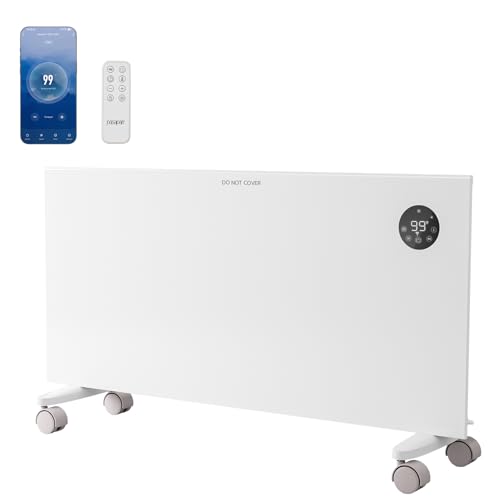
Pasapair 1500W Smart Panel Heater
- Power1500 W
- ModesP1, P2, ECO, Sleep
- Noise30 dB
- Smart controlApp, Alexa, Google Assistant, remote
- MountingFreestanding with casters or wall-mounted
- SafetyIP24 splash-proof, overheat protection, tip-over shutoff, ch
- 10-second heat-up with 1500 W convection element
- Smart app, Alexa, Google Assistant and remote control
- IP24 splash-proof for bathrooms and laundry rooms
- Sleep mode dims display and runs at 30 dB
- Relies on active heating; no thermal mass for steady warmth after cycling off
- ECO mode targets 73°F with limited manual override

Uthfy 1500W Convection Panel Heater
- Power1500 W
- ElementPatented Hedgehog, aerospace-grade aluminum
- Thermostat50°F to 95°F, adjustable in 1°F steps
- ModesBoost, Comfort, ECO
- Timer24 hours
- Noise0 dB (fanless)
- Hedgehog element boosts air contact by 36% for faster, more even heat
- 1°F thermostat adjustments from 50°F to 95°F
- Fanless convection for true silent operation
- 24-hour timer with Boost, Comfort and ECO modes
- No smart app or voice control—remote and panel only
- Convection alone; no thermal mass to continue radiating after thermostat cuts power
Do Panel Heaters or Oil Radiators Heat a Room More Evenly?
Oil-filled radiators heat a room more evenly because they store warmth in thermal mass and continue radiating heat for twenty to thirty minutes after the thermostat cuts power. Panel heaters warm faster but stop heating the moment they cycle off, which creates sharper temperature swings and more noticeable cold spots between cycles.
Even heating means consistent temperature across the floor area, not just warmth concentrated near the heater. Both types rely on convection: they warm air at the surface, the heated air rises, and cooler air moves in to replace it. The difference is what happens during the off-cycle.
A panel heater’s thin metal surface heats air immediately and cools down just as fast. When the thermostat is satisfied, convection stops. The room temperature drifts downward until the thermostat calls for heat again, and the cycle repeats. You feel this as uneven warmth—cozy one moment, cool the next—especially if you’re sitting still.
An oil-filled radiator heats more slowly because the element must warm several pounds of oil before the metal fins reach full temperature. Once warm, that oil holds heat. The thermostat may cut power, but the fins stay hot for half an hour, sustaining convection and adding gentle radiant heat to nearby surfaces. The room cools more slowly, the thermostat cycles less often, and the temperature stays steadier.
Pick a panel heater when you need a cold room warm in ten minutes and you’ll be there to feel it. Pick an oil-filled radiator for a bedroom or office you heat all day or overnight, where steady temperature matters more than speed. For intermittent heating—a bathroom before a shower, a garage workshop during a project—panel heaters heat faster and cost less to buy.
- Continues heating for 20 to 30 minutes after cycling off
- Steadier room temperature with fewer cold spots
- Adds radiant warmth to objects and nearby surfaces
- Stops heating immediately when thermostat cuts power
- Temperature swings more noticeable during cycling
- Relies entirely on convection with minimal radiant component
Heat-Up Speed and Room Coverage
A panel heater reaches operating temperature in under a minute. The element heats a thin metal surface directly, air touches it, warms, and rises. You feel warmth within five minutes in a small room. An oil-filled radiator takes ten to fifteen minutes before the fins are fully hot, because the element must transfer heat through oil before the surface can warm air effectively.
In the first twenty minutes, a panel heater spreads warmth faster. After thirty minutes, the oil radiator catches up as its sustained heat drives stronger convection currents and its radiant component warms the floor and furniture. Both deliver the same total heat if they run at the same wattage, but the panel front-loads it and the oil radiator spreads it more evenly over time.
Room coverage depends on wattage, not heater type. A rough guide is ten watts per square foot for a well-insulated room with standard ceiling height. A 1,500-watt heater—the maximum for a standard 120-volt outlet—handles about 150 square feet. An 850-watt unit suits a small bedroom or office up to 85 square feet. An 850-watt oil heater and a 2,000-watt panel heater are not comparable; the panel heater delivers more than twice the heat and will warm a small room much faster, but it also costs more than twice as much to run.
| Heater Type | Wattage | Heat-Up Time | Suitable Room Size |
|---|---|---|---|
| Panel heater | 1,500 W | Under 5 minutes | Up to 150 sq ft |
| Panel heater | 850 W | Under 5 minutes | Up to 85 sq ft |
| Oil-filled radiator | 1,500 W | 10 to 15 minutes | Up to 150 sq ft |
| Oil-filled radiator | 850 W | 10 to 15 minutes | Up to 85 sq ft |
Neither type heats a large or multi-story space evenly on its own. Warm air rises and stays upstairs; a single convection heater downstairs will not push heat up a stairwell against buoyancy. You need a unit on each floor or a ceiling fan to circulate air. Panel heaters work well for single-room heating; for whole-home warmth, central heating or multiple units are more practical.
Temperature Consistency and Thermostat Cycling
An oil-filled radiator maintains steadier room temperature because it continues radiating stored heat for twenty to thirty minutes after the thermostat cuts power. A panel heater stops heating the instant the circuit opens. The room temperature begins dropping immediately, creating larger swings between the thermostat’s upper and lower set points.
This thermal inertia smooths temperature variation and reduces cold spots. The oil inside the radiator holds heat energy and releases it gradually, bridging the gap until the thermostat calls for another cycle. Because the retained heat extends each heating period, oil radiators cycle less frequently—often three or four times per hour instead of six or eight. Fewer cycles mean less variation in air temperature at any given spot in the room.
Panel heaters rely entirely on active convection. Air cools as it drifts away from the heater, and the moment power stops, the metal fins lose heat within seconds. Rooms with poor insulation or drafts show the difference most clearly: an oil radiator keeps the far corner warmer between cycles, while a panel heater lets that corner drop a degree or two before the next heating pulse.
Infrared heaters face the same issue. When you turn off an infrared heater, the room goes cold quickly because infrared warms surfaces and objects, not the air itself. Once the radiant heat stops, those surfaces cool and the air temperature drops. Oil radiators and convection heaters that store thermal mass hold warmth longer.
Running Cost and Energy Efficiency
A 1,500 W panel heater costs exactly the same per hour as a 1,500 W oil-filled radiator when both run continuously. Wattage determines electricity consumption, not heater type. Calculate cost using watts ÷ 1,000 × hours × price per kWh. At $0.17 per kWh, any 1,500 W heater costs $0.255 per hour, whether it is a panel, oil radiator, ceramic or fan model.
The difference is total runtime per day. An oil radiator may run forty-five minutes out of every hour because stored heat keeps the room warm between cycles. A panel heater without modulating control might run fifty or fifty-two minutes to maintain the same average temperature. Over eight hours, that seven-minute-per-hour difference adds up to nearly an hour of extra runtime, or about $0.26 more per night.
| Appliance | Watts | Per hour | Per day (8 h) | Per month (30 days) |
|---|---|---|---|---|
| 1,500 W panel heater (52 min/hour avg) | 1,300 W | 22¢ | $1.77 | $53.04 |
| 1,500 W oil radiator (45 min/hour avg) | 1,125 W | 19¢ | $1.53 | $45.90 |
Panel heaters with responsive thermostats or ECO modes close the gap by modulating power instead of cycling hard. The heater drops to 900 W or 1,200 W to maintain temperature, reducing runtime and matching the oil radiator’s efficiency. Neither type is inherently more efficient; the thermostat logic and room insulation determine actual cost.
For four-hour evening use, the difference shrinks to ten or fifteen cents per session. Oil radiators show their advantage during all-day or all-night heating in bedrooms and home offices, where consistent warmth matters more than fast heat-up. Panel heaters work well for intermittent use—a bathroom in the morning, a garage workshop for two hours—where you value speed over retention.
Portability, Weight and Room-to-Room Use
Panel heaters weigh 10 to 15 pounds and move easily between rooms on caster wheels or with a carry handle. Oil-filled radiators weigh 20 to 30 pounds because of the diathermic oil inside the sealed columns. That extra mass makes them more stable and harder to knock over, but also harder to carry upstairs or relocate daily.
Many panel heaters include wall-mount kits for permanent installation in a bathroom, hallway or bedroom. Once mounted, they free up floor space and stay out of the way. Oil radiators stay freestanding. You can move one between a bedroom and a home office each day, but expect to wheel or carry 25 pounds each time.
Weight matters most when you heat different rooms at different times. A lightweight panel heater moves from a living room in the evening to a bedroom at night without effort. An oil radiator suits a single room you heat daily—a bedroom all night, an office all day—where you set it once and leave it. If you need a heater that stays in one spot and radiates warmth steadily, the extra weight becomes an advantage, anchoring the unit and lowering the chance of a tip-over.
Noise, Safety and Overnight Heating
Panel heaters and oil-filled radiators are both fanless, so operation is silent. The only sound either makes is a soft click when the thermostat cycles on or off. That makes both types suitable for bedrooms, offices and nurseries where fan noise would be a distraction.
Panel heaters with an IP24 splash-proof rating suit bathrooms and other damp spaces where humidity is present. The rating protects against water splashes from any direction. Oil radiators typically lack moisture protection and should stay in dry rooms. If you need a heater near a shower or sink, check for an IP rating and mount it outside the splash zone.
Oil-filled radiators are widely used for overnight heating because the retained heat continues warming the room for twenty to thirty minutes even if the thermostat cuts power or a breaker trips. That thermal buffer keeps the temperature steadier while you sleep. Panel heaters stop heating the moment power cuts, so the room cools faster. Both types need tip-over shutoff and overheat protection. Look for a UL or ETL listing, and follow the manual’s guidance on unattended use. Most manufacturers approve oil radiators for overnight heating but advise against leaving any heater running while sleeping unless the model is designed for it.
Neither type dries the air or reduces humidity. Both heat air without moving it forcefully, so they do not create the dry-air sensation some people notice with fan heaters. That sensation comes from airflow over skin, not actual moisture removal.
Lifespan, Maintenance and Long-Term Value
Panel heaters have fewer parts: a heating element, thermostat and safety cutoffs. There are no filters, motors or fluids. Dust the vents every few months to prevent buildup on the element; otherwise no maintenance is required. Lifespan is ten to fifteen years, limited by eventual thermostat wear or element failure.
Oil-filled radiators last fifteen to twenty years because the sealed oil bath protects the heating element from direct air exposure and oxidation. The oil never needs changing. If a weld or seal fails and oil leaks, the unit cannot be repaired and must be replaced. That failure is uncommon but permanent.
Neither type requires part replacement, belt changes or motor service during normal life. A panel heater costs less upfront, making replacement easier when it eventually fails. An oil radiator costs more but delivers longer service if the seals hold. For rooms you heat daily all season, the extra years justify the higher initial cost. For occasional use, a panel heater offers better value.
Frequently Asked Questions
Is a ceramic heater better than an electric panel heater for even heat?
Do convection heaters warm objects or just the air?
Can I use a panel heater to heat a large living room evenly?
What type of heater heats a person without warming the whole room?
Are panel heaters safe to leave on overnight or while sleeping?
Why does my room feel cold even though the heater is running?
Readers in this position usually ask about comparing heater power consumption as well.
Readers in this position usually ask about even heating with oil heaters as well.
