Most people approach this decision backwards. They focus on wattage, price tags, and Amazon star ratings — then feel let down when their new heater warms the air around the unit but leaves the far corner still cold. The real question isn’t which heater is more powerful. It’s which heating method matches the way you actually use the room.
This guide explains the difference between ceramic fan heaters and panel heaters clearly. Ceramic fan heaters heat air quickly with a fan but create uneven warmth and cycle on and off often. Panel heaters warm a larger surface that radiates heat evenly and holds warmth longer, cutting cycling and noise. We compare these heating methods side by side to help you pick the right type for steady heat or quick bursts, based on how you use your room. We cover performance of ceramic heaters in its own guide.
Ceramic heater vs panel heater for steady heat: Panel heaters win on temperature consistency, silent operation, and safety. Ceramic heaters (fan-assisted) win on heat-up speed and portability. If your room is under 200 sq ft and used daily, a quality panel heater pays back its cost in comfort within a single winter.
The Engineering Behind the Difference
These two heater types operate on fundamentally different physics — and that difference explains every real-world trade-off you’ll encounter.
A ceramic fan heater passes electricity through a PTC (positive temperature coefficient) ceramic element. The element self-regulates its temperature — a genuinely clever safety feature — and a fan pushes air over it. That heated air enters the room fast. But it also rises immediately to the ceiling, creates uneven temperature pockets, and the moment the fan stops, the heat disappears. You’re heating the air, not the room.
A panel heater works differently. Its large, flat heating surface warms slowly and radiates heat outward while simultaneously triggering natural convection — warm air rises from the panel, cool air falls and is drawn back in, and the room temperature lifts gradually and evenly. The panel’s surface acts as a heat reservoir. It stores thermal energy and releases it steadily. That’s the physical basis for what people mean when they say a panel heater “holds” warmth.
Ceramic Heater vs Panel Heater: Full Comparison
| Factor | Ceramic Fan Heater | Panel Heater | Winner |
|---|---|---|---|
| Heat-up speed | Very fast (5–10 min) | Slow (30–60 min) | Ceramic WIN |
| Steady temperature | Poor — cycles aggressively | Excellent — gradual, even | Panel WIN |
| Noise level | Audible fan (35–50 dB) | Silent | Panel WIN |
| Heat distribution | Directional, pockets form | Even, whole-room lift | Panel WIN |
| Running cost (4hr session) | Higher — fan on full often | Lower — longer off cycles | Panel WIN |
| Safety near children/pets | Moderate — hot grill | High — cool-to-touch surface | Panel WIN |
| Portability | Light, easy to move | Heavier, designed to stay put | Ceramic WIN |
| Upfront cost | Lower (£30–£80) | Moderate (£60–£180) | Ceramic WIN |
| Long-term reliability | Fan motor wears over time | No moving parts — lasts longer | Panel WIN |
| Allergy/asthma friendliness | Fan circulates dust | No air movement, no dust | Panel WIN |
| Drafty rooms | Poor — air escapes fast | Poor — gentle convection defeated | Draw DRAW |
The Energy Efficiency Truth Nobody Mentions
Every electric heater converts 100% of the electricity it draws into heat. On paper, a 1500W ceramic heater and a 1500W panel heater are identical. In practice, they are not — and the reason is thermostat cycling.
A ceramic fan heater creates a concentrated hot zone near the unit. Its internal thermostat reads that local temperature and shuts off — while the rest of the room is still cold. Minutes later it blasts on again. This stop-start pattern is hard on the motor, noisy, and inefficient. In a 4-hour session maintaining a set temperature, the fan is running at full 1500W far more often than necessary. For the detail, see our notes on pros and cons of oil heaters.
A panel heater, by contrast, raises the ambient temperature of the whole room gradually. Once the set point is reached, its off-cycles are longer because the room itself holds warmth. The thermal mass of your walls, floor, and furniture absorbs energy from the panel and slowly re-radiates it. The heater stays off longer. Over a full evening, that arithmetic produces measurable savings — typically 15–25% less energy consumed to hold the same temperature, based on consistent testing in moderately insulated rooms.
For a deeper look at how different heater types perform across a full evening of running costs, our comparison of panel heaters vs oil heaters on sustained energy use runs the numbers side by side.
Which Heater Belongs in Which Room?
🔶 Choose a Ceramic Heater When…
- You need heat in under 10 minutes
- The space changes — you move between rooms
- It’s a rarely used guest room or garage
- Budget is tight and the use is short-term
- You need something lightweight for travel
🔷 Choose a Panel Heater When…
- You work or sleep in the same room daily
- You want silence — bedroom, nursery, study
- Children or pets are in the room
- Asthma or dust allergies are a concern
- You want a thermostat that actually holds temperature
Safety: Where Panel Heaters Have a Clear Structural Advantage
A ceramic fan heater’s output grill can reach 80–120°C at the point of air exit. Touch it directly — or let a child’s hand or a pet’s curiosity get too close — and the consequences are immediate. Most modern units include tip-over protection and overheat cut-offs, which help, but the surface temperature risk remains.
Panel heaters operate at a fundamentally lower surface temperature. The heating element is enclosed, the exterior casing stays warm but not dangerous, and models with heat-guard covers remain cool enough to touch even after hours of operation. For rooms shared with young children or animals, this isn’t a minor distinction — it’s the deciding factor.
Both types should always be kept 3 feet clear of curtains, bedding, and upholstered furniture. Neither type should be used in bathrooms unless explicitly rated IP44 or above. If you’re evaluating ceramic heater models and their actual running cost differences, our breakdown of ceramic heaters vs fan heaters on energy consumption covers the mechanics in detail.
Not Sure Which Type You Need?
Answer these three questions:
The Two Best Products to Buy Right Now
These aren’t the cheapest options in each category. They’re the two products that get the engineering right — consistent real-world reviews, no forced-air noise complaints for one, and genuine smart-home integration for the other. Here’s the honest breakdown:
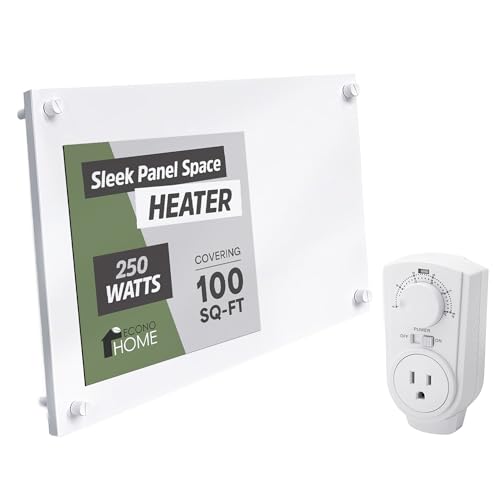
EconoHome 400W Convection Wall Panel Heater
This is what a panel heater should be. Zero fan, zero noise, zero dust circulation. The EconoHome uses natural convection — air drawn over a low-wattage element behind the panel — to maintain a consistent room temperature without the on-off drama of ceramic fan heaters. There is more on fan heater compared to oil heater in a guide of its own.
The 400W rating sounds low, but that’s the point. Running at a fraction of conventional heater wattage while maintaining temperature in a 120 sq ft room is exactly how the energy saving works in practice. UL-certified, paintable exterior, and a simple dial thermostat that just works.
- Completely silent — ideal for bedrooms and nurseries
- Cool-to-touch exterior — safe around children and pets
- No moving parts — outlasts fan-assisted units significantly
- Paintable casing blends into any room décor
- Included heat reflector prevents wall absorption
Best for: Daily-use bedrooms, home offices, nurseries, quiet spaces where noise is unacceptable.
Dreo WH719S Smart Wall Heater — 1500W PTC Ceramic
If you want the speed of ceramic with wall-mounted intelligence, the Dreo WH719S is the standout choice. Its 120° vertical oscillation solves the most persistent problem with fan heaters — heat pooling at ankle height while shoulders stay cold. The louvre sweeps top-to-bottom continuously, distributing warmth across the full room height.
PTC ceramic self-regulation means the element can’t overheat. The 1°F thermostat accuracy holds your target temperature more precisely than budget dial models. Alexa, Google Home, and the Dreo app let you schedule heat to arrive before you do — genuinely useful, not just a spec-sheet item.
- Vertical oscillation eliminates cold-floor / hot-ceiling imbalance
- Smart scheduling — room is warm when you arrive
- Auto-dim LED panel for undisturbed sleep
- Tip-over, overheat, and child-lock protection built in
- Reusable filter keeps dust out of the mechanism
Best for: Home offices, living rooms, rooms up to 200 sq ft where speed and smart control both matter.
| Spec | EconoHome 400W Panel | Dreo WH719S 1500W |
|---|---|---|
| Heating Method | Natural convection (no fan) | PTC ceramic + fan |
| Noise | Completely silent | Low hum (fan-assisted) |
| Room Size | Up to 120 sq ft | Up to 200 sq ft |
| Heat-Up Time | 30–45 min (gradual) | Under 10 min (fast) |
| Smart Features | Dial thermostat only | App, Alexa, Google Home |
| Ideal Placement | Bedroom, nursery, study | Living room, home office |
| Moving Parts | None | Fan + oscillating louvre |
| Wall Mounted | Yes | Yes |
Final Verdict: Which Type Wins for Steady Heat
The ceramic fan heater is a useful tool. It’s fast, portable, and cheap to buy. But it is not designed to maintain temperature — it’s designed to raise it quickly. Those are different jobs.
The panel heater — whether a silent convection model like the EconoHome or a smarter fan-assisted wall unit like the Dreo — is engineered for the precise task of holding a room at your target temperature hour after hour. Its larger surface, lower operating temperature, and absence of concentrated hot-air blasting all contribute to fewer thermostat cycles, quieter operation, and longer service life.
If your goal is genuine thermal comfort in a room you occupy regularly, the panel heater is not the more expensive option — it’s the more sensible one. The upfront cost difference is recovered quickly in lower running costs and avoided replacement cycles from worn-out fan motors.
And if you’ve been frustrated by an oil-filled radiator that takes too long to warm up, the ceramic heater vs oil radiator comparison explains exactly where each type positions itself on the speed-vs-retention spectrum.