
The appeal of a mica heater is its speed. You plug it in, the panel warms, and within a minute or two you feel heat on your skin without waiting for a fan to spin up or oil to circulate.
That speed comes from how mica heaters work: a thin heating element sandwiched between sheets of mica mineral, which conducts heat rapidly and emits it as radiant energy. Understanding what that means in practice helps you use one effectively and know when a different heater type makes more sense.
Do Mica Heaters Heat Up Instantly?
Mica heaters reach full operating temperature in 60 to 90 seconds, and you feel the radiant warmth almost immediately if you’re within a few feet. The panel itself heats fast, but warming an entire room takes longer because radiant heat works best on people and objects directly in front of the heater, not on circulating air throughout the space.

Stand within three to six feet of a mica heater and you’ll feel warmth on your skin within one to two minutes of switching it on. That’s faster than oil-filled radiators, which take 10 to 15 minutes to reach operating temperature, but slower than halogen heaters, which produce infrared heat the instant the element glows. The mica panel itself is hot to the touch in about a minute, but raising the air temperature in a 150-square-foot bedroom by five degrees typically takes 20 to 30 minutes, depending on insulation and the starting temperature.
The word instant describes how quickly you feel warmth when you’re near the heater, not how quickly the entire room becomes warm. Mica heaters emit radiant energy that travels in straight lines and heats surfaces and people directly, much like standing in sunlight. If you’re sitting at a desk or on a couch in the path of that radiant energy, you feel the effect within a minute or two. The air around you warms more slowly as heat transfers from those warmed surfaces.
Mica heaters work best for spot heating: warming one person or a small zone quickly rather than raising the temperature of every cubic foot of air in a large space. If you need whole-room heat in under 10 minutes, look at a ceramic fan heater that moves warm air. If you want steady, localized warmth that you feel within two minutes of sitting down, a mica panel delivers that.

How Mica Heaters Produce Heat So Quickly
A mica heater embeds a resistance heating element between thin sheets of mica mineral. When electricity flows through the element, it generates heat that transfers rapidly to the mica sheets. Mica has high thermal conductivity and low thermal mass, which means it absorbs and distributes heat quickly without requiring much energy to raise its own temperature. The large, flat surface area of the panel then emits that heat as infrared radiant energy.
The mica sheets reach operating temperature in 60 to 90 seconds because they’re thin and thermally efficient. Unlike the thick oil reservoir in an oil-filled radiator, which takes 10 to 15 minutes to heat through, mica panels warm almost as fast as the heating element itself. Once the surface is hot, it radiates infrared energy outward in every direction perpendicular to the panel. That energy travels at the speed of light and heats the first object it strikes: your skin, a couch, a wall.
Radiant heat works differently from convection. A ceramic fan heater warms air and blows it around the room, mixing it with cooler air until the temperature rises everywhere. Radiant heat travels directly to objects and people without warming the air in between. You feel it as soon as you’re in the path of the infrared rays, even if the air temperature hasn’t changed yet. That’s why standing near a mica heater feels warm within a minute or two, but a thermometer on the opposite wall takes much longer to register a difference.
The heating element inside a mica panel is typically a nickel-chromium wire or a thin metal ribbon. It heats to around 400 to 500 degrees Fahrenheit, and the mica sheets conduct that heat to their outer surfaces, which reach about 200 to 250 degrees. The entire panel acts as a large radiator, and because the surface area is spread across a tall, wide panel rather than concentrated in a small coil, the heat output is gentle and even rather than intensely focused.
Mica Heaters vs Other Types: Speed Comparison
Mica heaters sit in the middle for warm-up speed. They reach operating temperature faster than oil-filled radiators but slower than ceramic fan heaters. For warming you, mica delivers radiant heat you feel within seconds—comparable to infrared or halogen. For warming the room, ceramic fan heaters circulate air faster, while mica vs oil heaters shows oil-filled models take much longer to start but hold heat longer afterward.
| Heater Type | Warm-Up Time | Personal Warmth | Whole Room |
|---|---|---|---|
| Mica | 60–90 seconds | Immediate radiant | Moderate |
| Ceramic fan | 30 seconds | Fast (via airflow) | Fast |
| Oil-filled | 15–20 minutes | Gradual | Slow but steady |
| Infrared | Instant | Immediate, narrow | Very limited |
| Halogen | Instant | Immediate, focused | Very limited |
Ceramic fan heaters blow hot air the moment you switch them on, so the room temperature rises faster than with mica. The trade-off is noise and drier air. Mica heaters run silent and produce a gentler, steady warmth that doesn’t stir up dust.
Oil-filled radiators need fifteen to twenty minutes before the metal fins feel hot, and another twenty to thirty minutes to warm a small bedroom. They excel at maintaining temperature overnight, not at quick heat. Halogen heaters deliver a focused infrared beam you feel in under ten seconds, but only where the beam lands—step out of the cone and the warmth disappears.
Infrared panels work the same way as halogen: instant radiant heat with no warm-up lag, but limited room coverage. Mica combines radiant and a small amount of convection, so it spreads warmth more evenly than halogen while still heating faster than oil.
What Affects How Fast You Feel Warmth
Even a mica heater that reaches full temperature in ninety seconds can feel slow if the room is large, poorly insulated, or you sit too far away. Radiant heat intensity drops sharply with distance—double the distance and you feel roughly a quarter of the warmth.
Room size matters more for mica heaters than for ceramic fan models. A 1,500 W mica heater warms a 150-square-foot bedroom in fifteen to twenty minutes, but a 300-square-foot living room with a ten-foot ceiling takes twice as long because radiant heat doesn’t circulate air efficiently. High ceilings and open floor plans dilute the effect further.
Insulation and air leaks dictate how much heat escapes. Drafty windows, gaps under doors, and uninsulated walls let warmth bleed out as fast as the heater produces it. Closing interior doors and sealing obvious drafts with weatherstripping makes a measurable difference within the first ten minutes.
Wattage sets the upper limit on heat output. A 1,500 W heater delivers twice the energy of a 750 W model, so it warms you—and the room—roughly twice as fast. Most mica heaters top out at 1,500 W because that’s the safe maximum for a standard 15 A household circuit.
Starting temperature and your target both affect perceived speed. Raising a 50°F room to 68°F takes three times longer than lifting a 60°F room to the same point. If the heater feels slow, check whether you’re asking it to do more work than the wattage supports.
Running Costs: Do Mica Heaters Use More Electricity for Quick Heat?
A mica heater uses exactly the same electricity as any other 1,500-watt heater, whether it’s ceramic, oil-filled, or infrared. All electric resistance heaters convert close to 100 percent of electricity into heat. The speed at which the panel itself warms up does not increase power draw or running cost.
What does affect cost is how long you run the heater and whether you use a thermostat. A 1,500 W mica heater running for eight hours a day at 17 cents per kilowatt-hour costs about $61 per month. If the built-in thermostat cycles the heater on and off to maintain temperature, actual runtime drops to perhaps five or six hours, cutting the bill to around $38 to $46.
| Appliance | Watts | Per hour | Per day (8 h) | Per month (30 days) |
|---|---|---|---|---|
| 1,500 W mica heater, full runtime | 1,500 W | 26¢ | $2.04 | $61.20 |
| 1,500 W mica heater, thermostat cycling (67% runti | 1,000 W | 17¢ | $1.36 | $40.80 |
The real savings come from spot heating. Radiant warmth lets you heat your immediate zone—an office desk or bedroom corner—while keeping the whole-house thermostat a few degrees lower. Dropping the central heat by three degrees and running a 1,500 W space heater for the hours you occupy one room usually costs less than heating every room to the higher temperature.
When to Choose a Mica Heater for Speed
A mica heater suits personal zones where you want warmth on your skin within seconds: a home office chair, a reading nook, or beside your bed. The panel reaches full heat in ninety seconds, and you feel the radiant warmth immediately if you sit within a few feet. The slim profile and wall-mount option let you place it close without taking floor space, and the surface stays cooler than a halogen bulb or exposed coil.
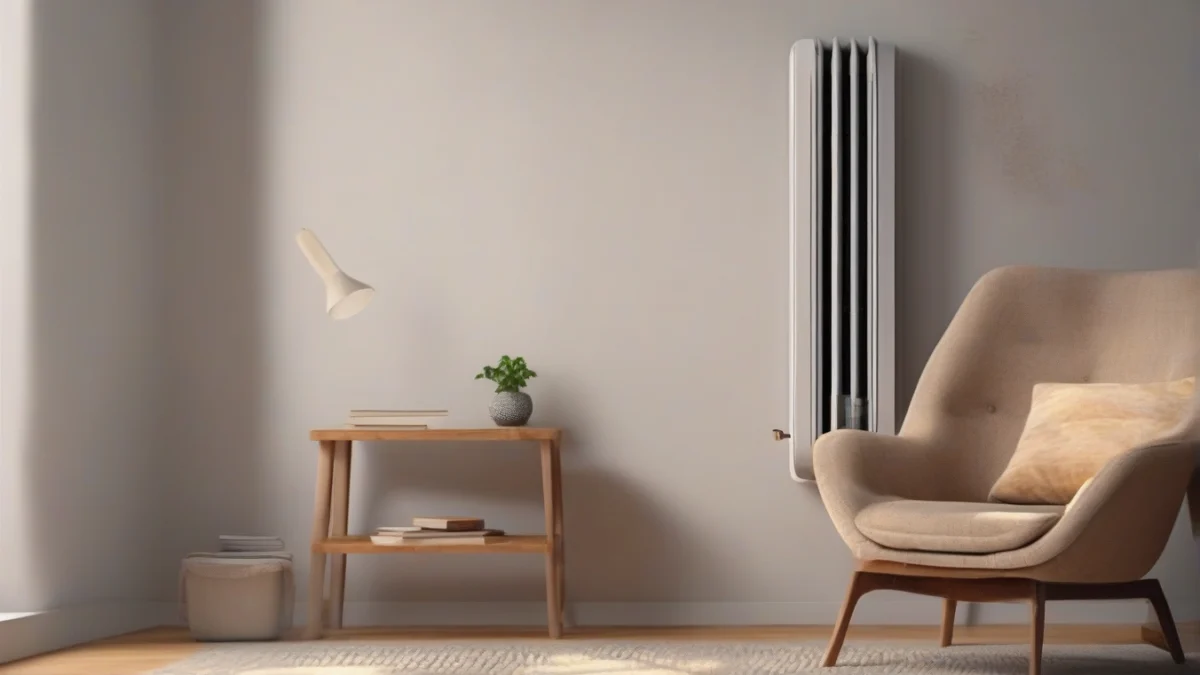

Mica heaters work well in bedrooms because they run quietly—no fan noise—and the gentle radiant heat does not stir dust. They also fit offices where you need steady background warmth without the blast of a fan heater cycling on and off. The thermostat maintains a set temperature once the room stabilizes, so you’re not adjusting controls all day.
- Spot heating a desk, chair, or bedside within a few feet
- Quiet operation in a bedroom or office
- Wall mounting to save floor space
- Radiant warmth that feels instant on skin
- Fast heating of a large open room or living room
- Strong air circulation to distribute warmth quickly
- Heating a high-traffic area where people move in and out
- Warming a space from across the room without sitting near the heater
If you need to warm an entire room fast, a ceramic fan heater or an oil-filled radiator paired with a fan moves air better. Mica heaters heat you quickly; they heat rooms slowly.
Safety and Practical Setup Tips
Mica heaters are safe when used correctly. The surface gets hot—around 160 to 180 °F at full power—but cooler than ceramic or exposed-coil models that can reach 200 °F or higher. Most include tip-over switches that cut power if the unit falls, and overheat protection that shuts the element off if internal temperature climbs too high. Look for a UL or ETL listing on the label.
Use the built-in thermostat if your model has one. It cycles the heater off when the target temperature is reached, then back on when the room cools. That maintains warmth without running at full power continuously, and it keeps the surface from staying hot for hours.
Do not leave a mica heater running unattended or while you sleep unless the manufacturer’s manual states the model is designed for it. Most are not. Turn it off when you leave the room.
Position the heater on a hard, level surface—never on carpet, a bed, or a couch where fabric can block the vents or tip it over. Point the panel toward the zone you want to warm, a few feet away, so radiant heat reaches you directly.
Frequently Asked Questions
How long does it take a mica heater to warm up?
Do mica heaters heat a room faster than oil heaters?
Can you feel heat from a mica heater immediately?
Why does my mica heater feel warm but the room stays cold?
Are mica heaters good for quick morning heating?
Do mica heaters cool down fast after turning off?
We cover which heater stays warm longest after turning off in its own guide.
For the detail, see our notes on understanding heater types.
