
Cold floors steal comfort from a room. Tile, concrete, and poorly insulated floors stay cold because they have high thermal mass and conduct heat away from the air and your feet. A furnace or convection heater warms the air, but that warm air loses heat to the cold floor faster than the floor warms up.
Infrared heaters work differently. They project invisible infrared waves that pass through air and are absorbed by solid objects. The floor, walls, and furniture heat up and re-radiate warmth. This direct approach changes how a room with a cold floor feels.
How Infrared Heaters Warm Cold Floors
Infrared heaters warm cold floors by emitting radiant energy that travels through air without heating it and strikes the floor surface directly, where it converts to heat. The floor absorbs this energy, its surface temperature rises, and it stops pulling warmth away from your feet and the air above it—turning from a heat sink into a secondary heat source that radiates warmth back into the room.
Convection heaters warm air, which then must transfer its energy to objects by contact. Infrared heaters reverse that: electromagnetic waves in the infrared spectrum travel at the speed of light from the heater to every object in their path. When those waves hit a cold tile, concrete, or hardwood floor, the floor material absorbs the energy and its molecules vibrate faster, generating heat. You feel this as warmth underfoot within minutes, not the half-hour wait typical of convection heating.
Once the floor warms, it holds that heat and reradiates it upward. A cold floor normally acts as a heat sink, continuously cooling the air layer just above it and forcing a convection heater to work harder. An infrared heater breaks that cycle by delivering energy directly to the surface. The floor becomes part of the heating system rather than an obstacle to it.
Gas infrared heaters and electric infrared heaters both emit radiant energy, but gas models burn propane or natural gas to heat a ceramic or metal emitter panel, producing far higher BTU output—often 30,000 to 40,000 BTU for outdoor or garage models. Electric infrared heaters, whether quartz tube or carbon fiber, are capped at 1,500 watts (around 5,100 BTU) by standard household circuits and plug directly into a wall outlet. For indoor cold floors, electric models are safer and simpler; gas models require ventilation and are typically used in workshops or patios.
Infrared heaters work in winter regardless of outdoor temperature because radiant heat transfer does not rely on the temperature of the air between the heater and the floor. A quartz infrared heater aimed at a 50°F concrete floor in January delivers the same radiant energy it would in October. The floor still absorbs it, warms up, and radiates heat back. Cold air slows convection heating by increasing the temperature differential a convection heater must overcome, but it does not block or weaken infrared waves.
Infrared vs Convection Heaters on Cold Floors
Convection heaters circulate warm air, which rises to the ceiling while the cold floor continuously chills the air near your feet. The floor remains cold, your legs stay cold, and the heater runs longer to maintain the air temperature the thermostat sees. Infrared heaters heat the floor and the objects in the room first. Air warms secondarily, by contact with those warmed surfaces, which means less energy disappears into the ceiling and more stays where you sit and stand.
| Factor | Infrared Heater | Convection Heater |
|---|---|---|
| Warm-up time to comfort | 2 to 5 minutes (you feel radiant heat immediately) | 15 to 30 minutes (air must circulate and warm) |
| Floor temperature after 30 min | Noticeably warmer; stops acting as heat sink | Remains cold; continues to cool air above it |
| Comfort feel | Warm skin and surfaces; less air movement | Warm air; feet and floor stay cold |
| Energy efficiency on cold floors | Higher: floor becomes secondary heat source | Lower: continuous heat loss to cold floor |
| Noise level | Silent (panel and carbon) or low fan (quartz/PTC) | Fan noise from forced air circulation |
The difference shows most clearly on tile, concrete, and stone floors, which have high thermal mass and conductivity. A ceramic space heater in a kitchen with a tile floor will blow warm air across your shoulders while your feet stay cold because the tile absorbs heat from the air faster than the heater can replace it. An infrared heater warms the tile directly, raising its surface temperature and cutting heat loss at the source.

Convection still makes sense in small, well-insulated rooms where the floor is already close to room temperature or covered with thick carpet that insulates you from the cold beneath. In a 100-square-foot carpeted bedroom with no drafts, a ceramic heater circulates warm air effectively because the floor is not pulling heat away. But in a basement, garage, sunroom, or any room with cold hard flooring, infrared heaters heat faster and keep you more comfortable by solving the floor problem instead of working around it.

Halogen vs Other Infrared Heaters
Halogen heaters are a type of infrared heater that use short-wave radiant energy. They emit a visible orange or red glow from halogen-filled quartz tubes and deliver very fast, intense heat concentrated in a narrow beam. That makes them useful for instant spot heating, but less effective than other infrared types when you want to warm a cold floor throughout an indoor room.
The difference comes down to wavelength. Halogen emits short-wave infrared, which heats objects intensely in its direct line but creates hot and cold zones. Quartz tube heaters emit medium-wave infrared, spreading heat more evenly across a wider area. Ceramic panel heaters emit long-wave infrared, which distributes warmth gently and uniformly across floors, walls and furniture.
| Type | Wavelength | Heat-Up Time | Best For |
|---|---|---|---|
| Halogen | Short-wave | Instant | Outdoor patios, garages, workshops |
| Quartz tube | Medium-wave | Under 1 minute | Indoor zones, cold floors, bathrooms |
| Ceramic panel | Long-wave | 5 to 10 minutes | Whole rooms, even background warmth |
Wind affects halogen heaters outdoors because the emitter itself heats the air immediately around the tube, and a breeze carries that warmth away. Quartz and ceramic types rely more completely on radiant transfer, so they perform better in drafty garages or patios with light wind.
For indoor cold floors, quartz tube or ceramic infrared heaters are the better choice. They warm the floor surface more evenly, eliminate the glare and intense hot spot of halogen, and create a comfortable zone without overheating the skin of anyone sitting directly in front of the unit.
Infrared Heaters and Energy Efficiency on Cold Floors
A 1,500 W infrared heater uses exactly the same amount of electricity as a 1,500 W convection heater. The efficiency gain comes from feeling warm at a lower air temperature, which lets you heat a smaller zone instead of raising the thermostat for the whole house.
Infrared warms your skin, clothes and the floor directly. Convection warms the air, which then warms you. Because radiant heat transfers directly, you feel comfortable when the air temperature is 2 to 4 °F lower than you would need with convection alone. That gap translates to real savings when you use an infrared heater to supplement central heating rather than replace it.
| Appliance | Watts | Per hour | Per day (8 h) | Per month (30 days) |
|---|---|---|---|---|
| 1,500 W infrared heater | 1,500 W | 26¢ | $2.04 | $61.20 |
| 750 W infrared heater (low setting) | 750 W | 13¢ | $1.02 | $30.60 |
The real savings appear when you compare zone heating to whole-house heating. Running a 1,500 W infrared heater for 8 hours costs about $2.04 per day at $0.17 per kWh. Raising your central heating thermostat by 3 °F to warm a 1,500 sq ft home typically costs $4 to $7 per day, depending on your furnace efficiency and outdoor temperature. Use the infrared heater in the room you occupy, leave the thermostat lower elsewhere, and the difference adds up over a heating season.
Efficiency depends entirely on using the heater as a supplement. If you turn off central heating and try to warm the whole house with portable infrared heaters, you will spend more, not less, because electric resistance heat costs roughly three times as much per BTU as natural gas in most US markets.
Using Infrared Heaters in Kitchens and Other Tile-Floor Rooms
Kitchens often have tile or vinyl floors that stay cold even when the room feels warm, pulling heat from your feet and making the space uncomfortable. Infrared heaters work well in kitchens because they warm the floor surface you stand on rather than circulating air that rises away from the cold tile.

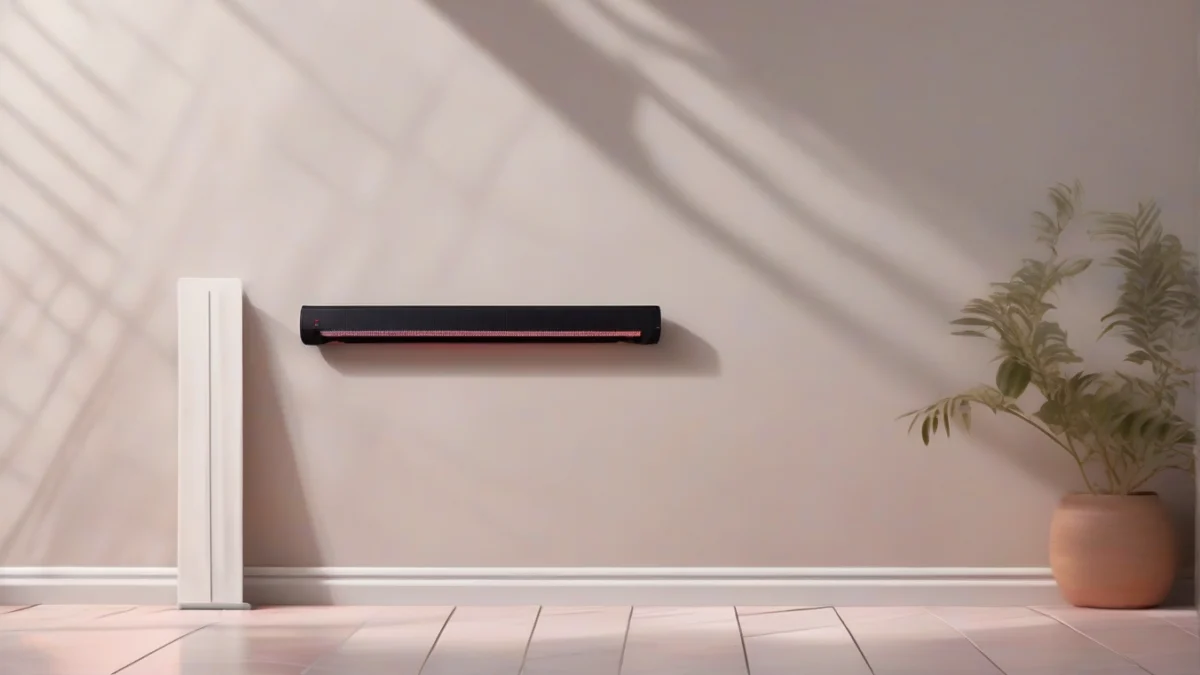
Wall-mounted infrared panels are the best choice for kitchens. They keep floor space clear for cooking and cleaning, aim heat downward at the exact zone where you work, and eliminate the tip-over risk of a portable unit near foot traffic. The panel mounts above an outlet so the cord tucks inside, and the surface stays cool to the touch.
Infrared heaters suit other cold-floor rooms for the same reason. Bathrooms with tile floors benefit from radiant warmth that reaches your skin directly while you towel off. Basements with concrete floors warm faster because the slab absorbs radiant energy and stops chilling the air. Garages and mudrooms, where you stand in one spot pulling on boots or working at a bench, get usable heat in minutes without waiting for the whole space to warm. North-facing rooms with cold floors see similar gains.
Placement and Strategy for Maximum Effect
Infrared heaters deliver the most warmth when you aim them at the coldest section of floor or the zone where you spend the most time. Point the heater at your desk chair, the couch, the side of the bed where you get dressed, or the stretch of kitchen floor in front of the stove. The floor in that spot absorbs radiant energy, warms up, and radiates heat back toward your body.
Position the heater 3 to 6 feet from your seating area. Closer than 3 feet can feel too intense on exposed skin; farther than 6 feet spreads the energy over a larger surface and reduces the warmth you feel. Elevate the heater slightly if possible so the radiant beam reaches more floor area rather than hitting the baseboard.
Match wattage to room size. A 1,500 W infrared heater covers up to 150 square feet effectively when used as zone heating. For larger rooms, heat only the section you occupy rather than trying to warm every corner. Infrared heaters excel at this targeted approach because the radiant energy travels in a straight line and heats surfaces, not air.
Treat the infrared heater as zone heating, not whole-room air warming. It makes the floor and objects in its path warm to the touch, which keeps you comfortable even when the air temperature stays lower. This strategy uses less energy than raising the thermostat for the entire house.
Look for tip-over and overheat protection, and a UL or ETL listing. Do not leave the heater running unattended unless the manual states the model is designed for it. Drafty rooms need the same careful placement to keep radiant heat where you need it.
Frequently Asked Questions
Do infrared heaters warm concrete floors?
Do infrared heaters glow when they are on?
Is a halogen heater the same as an infrared heater?
Do infrared heaters work in windy outdoor areas?
Can you use an infrared heater in a kitchen with a tile floor?
Are infrared heaters more energy efficient than convection heaters?
Before you buy anything, it is worth looking at halogen heater pros and cons for winter heating.
Readers in this position usually ask about infrared or panel heaters as well.