
Heating a whole room when you only use one corner wastes energy and money. Zone heating targets warmth where you actually sit, whether that’s a home office desk, a reading chair by the window, or a workbench in the garage.
The right heater depends on how you use the space. A desk corner needs fast, adjustable heat. A reading nook calls for silent, steady warmth. A drafty spot by a window responds best to direct radiant heat that warms your body, not the air around it.
Spec Comparison
| Product | Best for | Heat output | Oscillation | Noise level | Thermostat range | Price |
|---|---|---|---|---|---|---|
| DREO Atom One Ceramic Heater | Best overall | 1,500 W | 70° | 37.5 dB | 41–95°F | Check price |
| DREO Atom One Gold Portable Heater | Most portable | 1,500 W | None | 34 dB | 41–95°F | Check price |
| DREO 1500W Large Room Heater | Best for larger zones | 1,500 W | 70° | 34 dB | — | Check price |
| R.W.FLAME Mini Ceramic Heater | Best for desks | — | None | — | — | Check price |
| R.W.FLAME Electric Fireplace Insert | Best for ambiance | 750 W / 1,500 W | None | — | — | Check price |


Top Heaters for Spot Heating
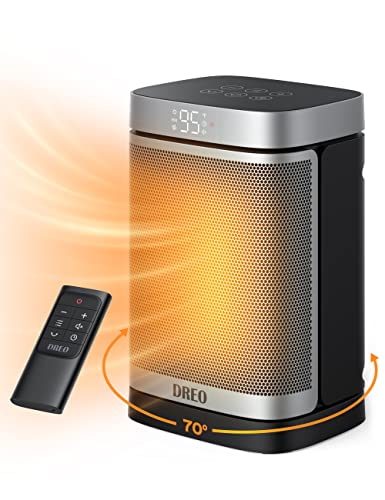
DREO Atom One Ceramic Heater
- Heat output1,500 W
- Oscillation70°
- Noise level37.5 dB
- Thermostat range41–95°F, 1°F increments
- SafetyETL-listed, tip-over and overheat protection, V-0 flame-reta
- 70° oscillation covers a zone without overheating one spot
- Reaches temperature in seconds with 1,500 W PTC ceramic
- 37.5 dB operation—quiet enough for focused work or sleep
- Thermostat adjusts in 1°F increments from 41 to 95°F
- No handle mentioned in the specs, less portable than the Gold model
- Oscillation fixed at 70°, cannot narrow the sweep
DREO Atom One Gold Portable Heater
- Heat output1,500 W PTC ceramic
- OscillationNone
- Noise level34 dB
- Thermostat range41–95°F, 1°F increments
- Timer12 hours
- Handle makes it easy to move between spots
- 34 dB noise level—the quietest model here
- Heat funnel extends reach up to 200% farther
- Five modes including ECO and Fan Only
- No oscillation, so you heat one direction at a time
- Slightly louder than claimed if you run it on Power heat mode
DREO 1500W Large Room Heater
- Heat output1,500 W PTC ceramic
- Oscillation70°
- Noise level34 dB
- Thermostat rangeAdjustable, range not specified
- Timer12 hours, plus 24-hour auto shut-off
- 70° oscillation with durable trackball system, 750,000+ cycle lifespan
- 20% wider heating coverage than fixed models
- ECO mode alternates between 1,000 W and 1,500 W for efficiency
- ETL-certified with tip-over, overheat protection, and 24-hour auto shut-off
- Heavier and less portable than the Atom One models
- No handle mentioned for moving between rooms
R.W.FLAME Mini Ceramic Heater
- TypeCeramic
- Timer24 hours
- ControlRemote and thermostat
- ModesECO mode
- UseOffice, bedroom, RV
- Small footprint fits on a desk or shelf
- 24-hour timer and remote for hands-off control
- ECO mode adjusts output to maintain temperature
- Quiet ceramic heating, noise level not specified but described as safe and quiet
- No oscillation, heats only the spot it faces
- Wattage and thermostat range not specified in the data
- Smaller coverage than full-size models
R.W.FLAME Electric Fireplace Insert
- Heat output750 W / 1,500 W
- Dimensions23″ × 18″
- ControlRemote
- FlameRealistic, adjustable colors and brightness
- InstallationRecessed or freestanding
- Adjustable flame colors and brightness create ambiance
- Two heat settings: 750 W and 1,500 W
- Remote control for heat and flame
- Recessed design keeps it out of walkways
- Larger and less portable than a ceramic fan heater
- No oscillation, heats only the area in front of the unit
- Flame feature uses electricity even when you don’t need extra heat
How to Choose a Heater for One Section of a Room
A ceramic fan heater beats an oil-filled radiator for spot heating because it delivers warm air to your desk or chair in seconds, not half an hour. The fan moves heated air exactly where you point it. Oil-filled models warm the air around themselves slowly, which works for a whole bedroom but not for a cold corner while you work.
Oscillation spreads heat across a small zone—a couch, a two-person desk, a reading nook—while a fixed direction puts all the heat on one chair or spot. A 70-degree sweep covers about 8 feet at desk distance. If you move between a chair and a filing cabinet, oscillation keeps both warm. If you sit still at a workbench, fixed direction wastes less energy.
Heat-up time separates the three types. Ceramic fan heaters reach full output in 10 to 30 seconds. Oil-filled radiators take 20 to 30 minutes because the oil must heat, then warm the metal fins, then warm the air around them. Infrared heaters deliver instant warmth the moment you switch them on because they heat objects and skin, not air.
Noise matters if the heater sits three feet from your head. Fan heaters produce 34 to 45 dB, about the volume of a quiet office or a refrigerator hum. Oil-filled radiators and infrared panels are silent except for an occasional tick as the metal expands. Panel heaters warm a room slowly and evenly by convection; they lack the airflow or directional focus to warm one section faster than the rest.
Thermostat precision controls comfort and cost. Models with 1-degree increments from 41 to 95°F let you dial in 68°F for your desk zone without overheating it to 75°F. Simple low/high switches cycle on and off at fixed temperatures, wasting energy when the zone gets too warm. The DREO Atom One offers degree-by-degree control; budget models with two or three heat settings do not.
Portability vs permanence depends on whether you heat one spot all winter or move the heater between rooms. Ceramic fan heaters weigh 3 to 5 pounds and carry easily. Oil-filled radiators weigh 15 to 25 pounds; the oil inside makes them stable but not portable. A handle and cord wrap help if you move the heater daily.
Heat Output and Coverage for a Corner or Desk Area
1,500 W is the standard maximum for any heater you plug into a wall outlet, and it’s enough to warm a 10 by 10 ft zone or heat a 150 sq ft bedroom. Every plug-in heater that maxes out a 15 A circuit delivers the same heat: 5,120 BTU per hour. Shape and brand do not change the physics.
Spot heating works because you raise the temperature of one zone 5 to 10 degrees above the rest of the room, not because you heat the entire space to 72°F. If the room sits at 62°F and you warm your desk area to 70°F, you stay comfortable and spend a fraction of the energy. A ceramic fan heater pointed at a chair heats that chair and the air around it; the rest of the room stays cool.
Oscillation increases effective coverage. A 70-degree sweep covers a couch, a corner desk setup, or two people working side by side. Fixed direction suits a single chair, a workbench, or a spot where you sit for hours. The DREO Atom One oscillates; the R.W.FLAME Electric Fireplace Insert does not. Match the feature to how much space you occupy.
A bedroom heater runs differently. For a one-bedroom apartment or a single cold bedroom, you heat the whole space to a comfortable temperature and leave the heater running for hours. A 1,500 W ceramic or oil-filled model handles up to 150 sq ft; larger spaces need multiple heaters or central heat. Best small space heaters cover bedrooms and whole-room scenarios in detail.
For a persistently cold corner caused by poor insulation, a draft under a door, or a wall that faces north, spot heating helps but does not fix the root problem. Weatherstripping, door sweeps, and thermal curtains stop the cold air from pouring in. If the corner stays cold even with those fixes, a heater for a cold room matched to the square footage and the cause of the cold makes more sense than pointing a fan heater at the wall all winter.
Running Cost: What Zone Heating Actually Saves
A 1,500 W space heater running 8 hours a day for 30 days costs about $61 at $0.17 per kWh, the average US residential rate. The arithmetic is straightforward: 1,500 watts ÷ 1,000 × 8 hours × 30 days × $0.17 = $61.20. A small 500 W personal heater at a desk costs about $20 per month under the same usage.
| Appliance | Watts | Per hour | Per day (8 h) | Per month (30 days) |
|---|---|---|---|---|
| 1,500 W ceramic heater | 1,500 W | 26¢ | $2.04 | $61.20 |
| 500 W personal heater | 500 W | 8.5¢ | 68¢ | $20.40 |
The real savings come from lowering your central thermostat, not from the heater itself. Drop the whole-house temperature by 5 degrees and you cut heating costs by roughly 10 percent; a 10-degree drop saves closer to 20 percent. A $200 monthly heating bill falls to $160 or $140, dwarfing the $61 the space heater adds.
ECO mode on models with precise thermostats cycles between 1,000 W and 1,500 W to maintain temperature, cutting runtime by 30 to 40 percent once the zone is warm. The math above assumes continuous use. Actual cost is lower if you heat the zone only while occupied—four hours in the morning and evening, for example, halves the monthly electricity use for a 1,500 W unit.
Safety for Heaters in Close Quarters
Keep 3 feet of clearance from curtains, furniture, bedding, and anything flammable, even in a small zone. A heater warming a desk or corner sits closer to walls and fabric than one heating a whole room, making the clearance rule harder to follow and more important. Measure before you run it.
Tip-over and overheat shut-off are mandatory for any heater used near a desk, chair, or bed. Models without both protections belong nowhere near furniture or people. Look for ETL, UL, or CSA certification and V0 flame-retardant housing, which self-extinguishes if a component overheats.
- Place the heater where the cord will not cross a walkway or create a tripping hazard
- Check that the plug fits snugly in the outlet; a loose connection generates heat
- Keep the heater on a hard, level surface, never on carpet, a rug, or a cushion
- Do not leave a heater running unattended or while sleeping unless the manual states the model is designed for it
Spot heating puts the unit within arm’s reach of papers, bags, blankets, and charging cables. A heater for a cold dressing room or heater for a cold living room has more space to work with, but a desk heater does not. Clear the zone and check it daily.
What Humidity and Heaters Actually Have to Do with Each Other
No electric space heater adds or removes moisture from the air. The dryness you notice comes from the physics of heating air, not from the device itself.
Warm air holds more water vapor than cold air. When you heat a room from 60°F to 72°F, the absolute amount of moisture stays the same, but the relative humidity percentage drops because the warmer air could hold much more. A room at 50% relative humidity and 60°F might measure 30% at 72°F, even though not a single water molecule left the space.
This effect happens with ceramic heaters, oil-filled radiators, infrared panels, and your central furnace. The technology makes no difference. You’re heating indoor winter air that already has low moisture content, and the warmth makes that dryness more noticeable on your skin and in your throat.
A small humidifier in the same zone solves the problem if dry air bothers you. No heater design avoids the physics, and no model retains humidity better than another when both raise the temperature by the same amount.
Warming a Space Without a Heater
Stopping cold air from entering costs less than heating the air that replaces it. Block drafts with door sweeps, window insulation film, or a rolled towel along the sill where you feel a breeze.
Close doors to unused rooms so your home’s existing heat concentrates in the area where you spend time. Heat migrates toward cold spaces, and an open door to a cold extension room or hallway pulls warmth away from where you sit.
- Hang thick curtains or thermal blinds over windows at night to reduce heat loss through glass, which conducts cold faster than insulated walls.
- Let sunlight through south-facing windows during the day for free passive heating, then close the coverings at dusk.
- Layer clothing and keep a throw blanket within reach for personal warmth without raising the air temperature.
- Use a rug on tile or hardwood floors to insulate your feet from cold surfaces.
Frequently Asked Questions
Can you put two 30,000 BTU ventless heaters in one room?
What is the difference between a heater and a fan heater?
Do panel heaters actually warm a room?
Which heater type is best for heating a corner of a room?
Do space heaters make the air dry?
How much does it cost to run a 1,500 watt heater for 8 hours a day?
The other half of this decision is strategies for quick heat loss.
We go through dealing with cold drafts step by step in a separate article.
