
Space heating with halogen and infrared heaters involves distinct advantages and drawbacks. Understanding their differences helps you choose the right heater for your needs.
Halogen Heater vs Infrared Heater at a Glance
| Feature | Halogen Heater | Infrared Heater |
|---|---|---|
| Heat output and room size | Best for small, focused areas with quick heat | Effective for larger rooms with even heat |
| Running cost | Higher energy consumption for extended use | Lower energy consumption and cost-effective |
| Safety standards and features | Basic safety features, bright light can disturb | Advanced safety features, no light emission |
| Noise levels | Quiet but bulb may emit slight humming | Operates silently without fans |
| Portability and convenience | Lightweight and compact for easy moving | Heavier, often with wheels for mobility |
| Lifespan and maintenance | Around 8,000 hours lifespan, bulbs need replacing | 50,000 to 100,000 hours lifespan, low upkeep |
| Light emission | Produces bright visible light with heat | No light emitted during operation |
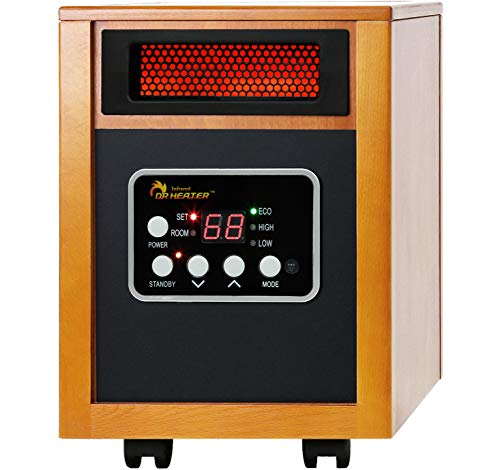
DR. INFRARED HEATER DR-968 Portable Infrared Heater
- Power1500 Watts
- Amperage12.5 Amps
- Heating OutputAround 5200 BTU
- Thermostat Range50 to 85 degrees
- Cord Length72 inches (6 feet)
- Weight19 lbs
- Dual Heating System provides strong heat output
- Quiet operation at 39 dB
- Caster wheels for portability
- Weighs 19 lbs, heavier than some portable heaters

DR. INFRARED HEATER DR-968H Infrared Heater with Humidifier
- Power1500 Watts
- Amperage12.5 Amps
- Heating Output5200 BTU
- Temperature Range50 to 85 degrees
- Cord Length72 inches
- Built-in humidifier improves indoor air quality
- Dual Heating System for efficient heat
- Safety features include tip-over and overheat protection
- Designed for indoor use only, not for damp or outdoor areas
Halogen vs Infrared Heater: Key Differences
Halogen heaters produce bright, visible light and heat quickly at high temperatures, making them ideal for short-term, spot heating. Infrared heaters use cooler quartz, ceramic, or carbon elements to emit invisible infrared radiation that warms objects deeply and efficiently over longer periods.
The key difference lies in how they deliver radiant heat. Halogen heaters contain tungsten filaments inside halogen gas bulbs, which extend the bulb’s lifespan while producing near-infrared heat and bright light. Infrared heaters rely on elements that operate at lower temperatures, emitting longer-wavelength infrared radiation that penetrates surfaces instead of just heating the air around them.
Halogen heaters shine light as they heat, which can be distracting in living spaces but useful in outdoor or workshop settings. Infrared heaters produce no visible light, providing a more natural warmth similar to sunshine without glare.
Because halogen heaters operate at higher temperatures, they are better suited for quick bursts of heat in small areas. Infrared heaters are more energy-efficient for continuous use, providing deeper and more comfortable warmth in larger rooms or for whole-room heating.
| Feature | Halogen Heater | Infrared Heater |
|---|---|---|
| Operating Temperature | High (bright light) | Lower (invisible heat) |
| Heat Type | Near-infrared radiant heat | Far-infrared radiant heat |
| Light Emission | Bright visible light | No visible light |
| Best Use | Short-term spot heating | Long-term whole-room heating |
| Energy Efficiency | Lower for extended use | Higher for continuous use |
| Lifespan | Around 8,000 hours | 50,000 to 100,000 hours |
Heat Output and Room Size
Halogen heaters deliver immediate warmth by emitting intense radiant heat, but their effective range is limited to small spaces or a focused area. They are best for spot heating where quick heat is needed for a few minutes to an hour.
Infrared heaters warm objects and people directly, not just the air. This allows them to heat larger rooms more evenly and maintain warmth longer after they are turned off. Their heat penetrates surfaces like furniture and walls, which then radiate warmth back into the room.
For large rooms, infrared heaters outperform halogen models in heating efficiency. Halogen heaters lose much of their heat quickly beyond a few feet, making them less practical for open or bigger spaces.
Infrared models are also better suited for outdoor use, such as patios or garages. Their radiant heat can reach people without needing to warm the surrounding air, which dissipates quickly outdoors.
Infrared heaters maintain warmth longer because their elements and heated objects retain heat after the unit powers down. Halogen heaters cool rapidly once turned off, so their heat stops almost immediately.
| Appliance | Watts | Per hour | Per day (4 h) | Per month (30 days) |
|---|---|---|---|---|
| 1,500 W halogen heater | 1,500 W | 26¢ | $1.02 | $30.60 |
| 1,500 W infrared heater | 1,500 W | 26¢ | $1.02 | $30.60 |
Both heater types typically draw similar wattage, but infrared heaters convert more energy into lasting warmth, reducing overall runtime and cost. Halogen heaters require continuous power for sustained heat, increasing electricity use in larger or longer heating sessions.
Choose halogen heaters for quick, targeted heat in small indoor or sheltered outdoor areas. Choose infrared heaters for consistent, efficient heating in larger rooms or outdoor spaces where lasting warmth is needed.
Running Costs of Halogen vs Infrared Heaters
Infrared heaters are generally cheaper to run than halogen heaters. Both typically use about 1,500 watts, but infrared models heat more efficiently, reducing the time needed to reach comfortable temperatures.
Halogen heaters emit intense radiant heat immediately, but only over a small area. This means they often run longer or at higher settings to maintain warmth in larger rooms, increasing energy use.
Infrared heaters heat objects and people directly rather than warming the air first. This direct heat reduces energy waste and keeps rooms comfortable faster, lowering overall electricity consumption.
Calculating running costs requires multiplying the heater’s wattage by hours used, then dividing by 1,000 to convert to kilowatt-hours (kWh). Multiply kWh by your electricity rate to get the cost. For example, a 1,500 W heater running 6 hours daily at 17¢ per kWh costs about $9.18 per month.
Since infrared heaters warm the space more efficiently, they often need less runtime than halogen heaters for the same comfort level. This difference can reduce monthly electricity bills noticeably over a heating season.
Halogen heaters may have higher running costs in winter because they are best for short bursts of heat rather than continuous use. Infrared heaters are designed for longer operation and maintain consistent warmth with lower energy input.
Safety Standards and Features
Infrared heaters are safer for homes with children and pets. They operate at cooler surface temperatures compared to halogen heaters, which can get very hot and pose a burn risk.
Both halogen and infrared heaters must include tip-over and overheat protection to meet safety standards. These features shut off the heater if it falls or overheats, preventing fires or injuries.
Infrared heaters produce radiant heat without bright light or hot bulbs, making them safer in bedrooms or living areas where pets and children roam freely.
Halogen heaters are not recommended for overnight use or in bedrooms unless the manufacturer explicitly states they are designed for that purpose. Their high surface heat and bright light can disturb sleep and increase safety risks.
Noise Levels: Halogen vs Infrared Heaters
Halogen and infrared heaters both operate quietly, but there are some differences. Halogen heaters work silently because they rely on a glowing filament inside a halogen bulb to produce heat, without any moving parts or fans. This makes them ideal for environments where noise is a concern, such as bedrooms or offices.
Infrared heaters also run quietly if they use radiant heat without a fan. Some infrared models include fans to help distribute heat faster, which adds noise. The noise level depends on the presence and quality of the fan, but many infrared heaters are designed for silent operation.
| Heater Type | Noise Level | Reason |
|---|---|---|
| Halogen | Silent | No fans or moving parts |
| Infrared (no fan) | Silent | Radiant heat without mechanical components |
| Infrared (with fan) | Low to moderate | Fan operation for heat circulation |
For quiet operation, choose halogen heaters or infrared models without fans. Both types avoid the hum or buzz common with ceramic or oil-filled heaters that use fans or pumps. Silent operation is a key advantage of radiant heaters, especially in rooms where conversation or sleep is important.
Portability and Convenience
Halogen heaters are typically lightweight and compact. Their small size and low weight make them easy to carry from room to room. Most have simple plug-and-play designs with no installation required beyond plugging into a standard 120 V outlet.
Infrared heaters tend to be bulkier because they often include larger heating elements and sometimes fans or control panels. This makes them less portable than halogen heaters but still movable. Many models include handles or wheels to improve mobility.
Infrared heaters often come with added convenience features like remote controls, programmable thermostats, and multiple heat settings. These features allow more precise temperature control and scheduled operation, which can improve energy efficiency and comfort.
Installation for both heater types is straightforward. Neither requires permanent mounting or special wiring. They plug directly into a wall outlet. Halogen heaters, being smaller, are easier to place in tight spaces. Infrared heaters may need more floor or shelf space due to their size.
- Halogen heaters: Lightweight, easy to move, simple plug-in operation.
- Infrared heaters: Bulkier but often include remote controls and programmable settings.
- Both types require no special installation, just a grounded wall outlet.
Choose a halogen heater if you want fast, portable heat that you can carry around easily. Select an infrared heater if you want more control over temperature and scheduling, and don’t mind a larger unit. Both types suit different needs for convenience and portability.
For more on heater types and their comfort features, see Noise Levels: Halogen vs Infrared Heaters and Radiant vs Halogen Heater: Best for Small Cold Rooms.
Lifespan and Maintenance of Heaters
Infrared heaters have a much longer lifespan than halogen heaters. Typical infrared heater elements last between 50,000 and 100,000 hours. In contrast, halogen heaters usually last about 2,000 to 5,000 hours before the bulb needs replacement.
The main reason for this difference is the heating element. Infrared heaters use durable quartz or ceramic elements that withstand continuous use. Halogen heaters rely on halogen gas bulbs with tungsten filaments that degrade faster due to high operating temperatures and constant cycling.
Maintenance for halogen heaters mainly involves replacing the halogen bulb when it burns out. This can be frequent if you use the heater daily for long periods. The bulbs are generally easy to replace but require careful handling since they operate at very high temperatures and can shatter.
Infrared heaters require less frequent maintenance. Their heating elements last much longer and usually only need cleaning to remove dust buildup. Keeping the heater free of dust ensures efficient heat output and prevents overheating. Wiping the exterior and vacuuming vents every few months is usually enough.
| Heater Type | Lifespan (hours) | Maintenance Needs |
|---|---|---|
| Halogen | 2,000 to 5,000 | Bulb replacement every few months to years depending on use; careful handling required |
| Infrared | 50,000 to 100,000 | Periodic cleaning of dust; rare element replacement |
- Replace Halogen BulbUnplug the heater and allow it to cool completely. Remove the old bulb carefully following the manufacturer’s instructions. Install the new bulb without touching it with bare hands to avoid oil deposits.
- Clean Infrared HeaterTurn off and unplug the heater. Use a soft, dry cloth to wipe the exterior. Use a vacuum with a brush attachment to clean vents and remove dust from the heating element area.
Choosing an infrared heater reduces maintenance time and replacement costs over the heater’s life. Halogen heaters can cost more over time due to the need for frequent bulb changes, especially if used daily. Consider your usage pattern and willingness to perform regular maintenance when deciding between the two types.