
Cold floors can significantly impact your comfort at home. Underfloor heating mats provide an efficient solution, ensuring consistent warmth without the hassle of traditional heating systems.
Comparison of Underfloor Heating Mats
| Product | Best for | Size | Watts | Thermostat Type | Safety Features | Price |
|---|---|---|---|---|---|---|
| LuxHeat 20 sqft Heated Floor Mat Kit | Best for Small Rooms | 20 Sqft | 240 @ 12 W/sqft | OJ Microline UDG-4999 programmable | Integrated Class A GFCI, low EMF | Check price |
| BLARALA 100 Sq.ft Electric Heated Floor Mat | Best for Large Bathrooms | 100 Sqft | 1200 @ 12 W/sqft | Programmable with floor sensor | Built-in GFCI, overheat protection, CSA-certified | Check price |
| VEVOR 10 Sq.ft Electric Floor Heating Mat | Best Budget Option | 10 Sqft | 110 @ 11 W/sqft | Touchscreen programmable with GFCI | Built-in GFCI, child lock, power logging | Check price |
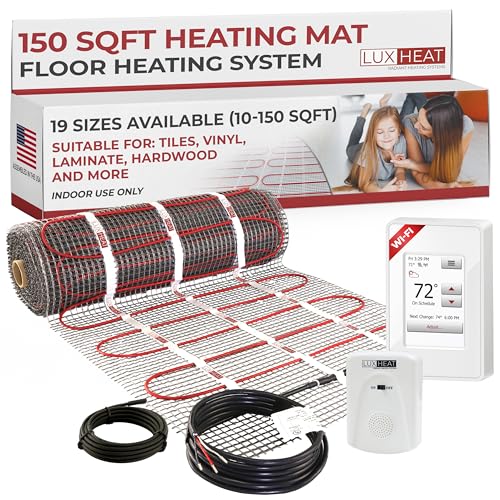
| LuxHeat 150 sqft Floor Heating System WiFi | Best for Large Areas | 150 Sqft | 1800 @ 12 W/sqft | OJ Microline UWG4-4999 WiFi touchscreen | Integrated Class A GFCI, WiFi monitoring, low EMF | Check price |
| MAXKOSKO 15 sq ft Radiant Floor Heating Mat | Best for Renovations | 15 Sqft | 180 @ 12 W/sqft | — | Self-adhesive mat, indoor use only | Check price |



Top Picks for Underfloor Heating Mats
LuxHeat 20 sqft Heated Floor Mat Kit
- Size20 Sqft
- Watts240 @ 12 W/sqft
- Voltage120 V
- Amps2.0
- ThermostatOJ Microline UDG-4999 programmable with floor sensor
- Self-adhesive for easy installation
- Programmable thermostat with GFCI
- Low EMF dual wire technology
- 25-year limited warranty
- Limited coverage area at 20 sqft
- Only supports 120V circuits
BLARALA 100 Sq.ft Electric Heated Floor Mat
- Size100 Sqft
- Watts1200 @ 12 W/sqft
- Voltage120 V
- Amps10.0
- ThermostatProgrammable with floor sensor
- Large 100 sqft mat for big areas
- Thermostat with multiple safety features
- CSA-certified for wet locations
- Includes installation monitor
- High amperage draw at 10 amps
- Mat must not be shortened or cut
VEVOR 10 Sq.ft Electric Floor Heating Mat
- Size10 Sqft
- Watts110 @ 11 W/sqft
- Voltage120 V
- Amps1.25
- ThermostatTouchscreen programmable with GFCI
- Affordable small mat
- Installation monitor included
- Touchscreen thermostat with GFCI
- Flexible mat can be flipped or rotated
- Small coverage area
- Lower wattage limits heating power
LuxHeat 150 sqft Floor Heating System WiFi
- Size150 Sqft
- Watts1800 @ 12 W/sqft
- Voltage120 V
- Amps15.0
- ThermostatOJ Microline UWG4-4999 WiFi touchscreen
- Large 150 sqft coverage
- WiFi-enabled thermostat for remote control
- Integrated GFCI for safety
- Dual wire technology reduces EMF
- Requires 15 amp circuit
- Higher installation complexity
MAXKOSKO 15 sq ft Radiant Floor Heating Mat
- Size15 Sqft
- Watts180 @ 12 W/sqft
- Voltage120 V
- Amps1.5
- Thermostat—
- Flexible design for easy installation
- Self-adhesive backing for secure placement
- Suitable for humid indoor areas
- Reliable 12 W/sqft heating power
- No thermostat included
- Limited to indoor use only
How to Choose an Underfloor Heating Mat
Underfloor heating mats warm cold floors by delivering radiant heat directly from beneath. They work best on hard surfaces like tile or stone, not under thick carpets, which block heat transfer. This method is a form of ambient heating, which raises the overall room temperature by warming the floor surface.
Start by matching the mat size to your floor area. Mats come in fixed sizes, typically from 10 to 150 square feet. Choose a mat that covers about 80 to 90 percent of the floor to leave room for fixtures or furniture. The power output, measured in watts, determines how much heat the mat generates. Most mats deliver between 12 and 15 watts per square foot, which is enough to warm a standard room floor.
| Mat Size (sq ft) | Power Output (watts) |
|---|---|
| 10 | 120-150 |
| 20 | 240-300 |
| 150 | 1800-2250 |
Thermostat control is essential for efficiency and comfort. Basic models offer manual settings, while advanced thermostats provide programmable schedules and WiFi connectivity. A thermostat with a floor temperature sensor ensures the surface does not overheat.
Safety certifications like UL, ETL, or CSA confirm the mat meets electrical and fire safety standards. Look for mats with built-in overheat protection and waterproof features if installing in wet areas.
For staircases, choose mats designed for narrow, irregular spaces. These mats often come in flexible strips or rolls that can be cut to fit steps. They provide safe, even heating on stairs without bulky hardware.
Sizing and Heat Output Considerations
Calculate the required mat size by measuring the room’s heated floor area, excluding cabinets or permanent fixtures. Multiply length by width for square or rectangular rooms. For irregular shapes, measure each section and add the areas.
Heat output depends on the room type and insulation. Bathrooms and kitchens need higher watt density—around 15 watts per square foot—to combat tile coldness. Living rooms with carpet or wood floors can use lower wattage mats, about 12 watts per square foot.
Entryways and landings benefit from underfloor heating to prevent cold spots where people stand. For these areas, choose mats that fit the exact shape and size to maximize efficiency.
| Appliance | Watts | Per hour | Per day (6 h) | Per month (30 days) |
|---|---|---|---|---|
| 1,500 W heating mat | 1,500 W | 26¢ | $1.53 | $45.90 |
| Bathroom heating mat, 15 W/sq ft | 2,250 W | 38¢ | $2.30 | $68.85 |
Safety and Certification in Heating Mats
Underfloor heating mats are designed for indoor use and must meet strict safety standards to prevent electrical hazards and fire risks. The most critical safety feature is built-in ground-fault circuit interrupter (GFCI) protection. A GFCI quickly cuts power if it senses a fault current, reducing shock risk in wet or damp areas where heating mats are often installed.
Look for heating mats certified by UL (Underwriters Laboratories) or CSA (Canadian Standards Association). These certifications indicate the product has passed rigorous testing for electrical safety and performance. Certified mats comply with national electrical codes and reduce the chance of overheating or short circuits.
Proper installation is essential to maintain safety. The mat should be laid on a clean, dry surface without overlapping or folding, which can cause hot spots and damage the heating wires. Use a compatible thermostat with built-in safety features like temperature limits and automatic shut-off to prevent overheating.
- Turn off powerBefore installing, switch off the circuit breaker to avoid electric shock.
- Check the floorEnsure the subfloor is dry, clean, and free of sharp objects.
- Lay out the matPlace the heating mat flat without folds or overlaps.
- Test resistanceUse a multimeter to check the mat’s resistance matches the manufacturer’s specification.
- Connect thermostatInstall a compatible thermostat with a GFCI breaker or built-in protection.
- Cover carefullyApply thinset mortar or tile adhesive evenly over the mat without damaging wires.
Understanding Ambient Heating
Ambient heating warms the whole room by gently raising the air and surface temperatures, unlike traditional heating that blasts hot air from a single source. Underfloor heating mats provide true ambient heat by radiating warmth evenly across the floor, which then rises naturally.
Convection heating moves warm air around the room, but it can create drafts and uneven temperature zones. Underfloor heating produces radiant heat that warms objects and people directly, reducing cold spots and improving comfort.
One key benefit of underfloor ambient heating is lower dust circulation. Conventional forced-air systems blow dust and allergens around, which can aggravate respiratory issues. Radiant floor heat does not rely on air movement, so it keeps dust settled and the air cleaner.
Frequently Asked Questions
What is the best use case for underfloor heating mats?
How much does it cost to run an underfloor heating mat?
Can I install underfloor heating mats myself?
What flooring materials can I use with heating mats?
How do I maintain my underfloor heating system?
Are underfloor heating mats safe for wet areas?
If that sounds like your room, read up on what is radiant heat and how does it work explained next.
Readers in this position usually ask about best hydronic floor heating systems as well. There is more on underfloor heating benefits in a guide of its own.
The other half of this decision is cheap basement heating solutions. For the detail, see our notes on infrared heating explained.
