
Feeling the chill indoors? Micathermic heaters provide quick and efficient warmth for various spaces. With numerous options available, it can be challenging to choose the right one for your needs.
Micathermic Heater Comparison
| Product | Best for | Wattage | Heat Settings | Portability | Safety Features | Price |
|---|---|---|---|---|---|---|
| DR. Infrared Heater DR-123 Portable Space Heater | Best Overall | 1500W | Eco, High, Low | 4 caster wheels | Tip-over and overheat protection, auto shut-off | Check price |
| Heat Storm HS-1500-PHX-WIFI Wall Mounted Infrared Heater | Best Wall Mount | 1500W | — | Wall mounted only | Tip-over safety shutoff | Check price |
| BEYOND HEAT Milkhouse 1500W Space Heater | Best Portable | 1500W | Fan-only, 1300W, 1500W | Carry handle | Tip-over switch, overheat protection | Check price |
| DeLonghi Mica Panel Space Heater HMP1500 | Best for Medium Rooms | 1500W | Two settings | Freestanding or wall mount | Thermal shutoff, tip-over switch | Check price |
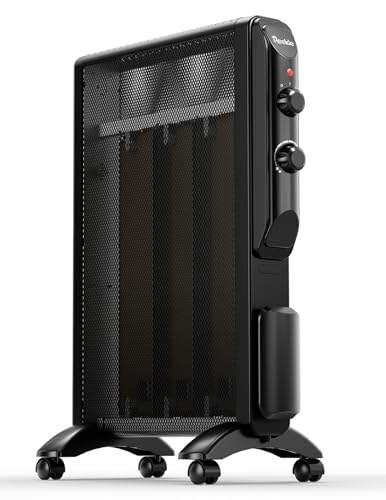
| Reekie 1500W Portable Mica Space Heater | Best Quiet | 1500W | 1000W and 1500W | 4 caster wheels | Overheat and tip-over protection | Check price |


Top Micathermic Heater Picks
DR. Infrared Heater DR-123 Portable Space Heater
- Wattage1500W
- Heat SettingsEco, High, Low
- Portability4 caster wheels
- Safety FeaturesTip-over and overheat protection, auto shut-off
- Dual heating technology for fast, natural warmth
- Programmable 12-hour timer and remote control
- Whisper-quiet operation with tip-over and overheat protection
- Long 6-foot cord and lifetime filter, no replacements needed
- Remote control requires batteries not included
- Larger footprint due to wheels
Heat Storm HS-1500-PHX-WIFI Wall Mounted Infrared Heater
- Wattage1500W
- Heat Settings—
- PortabilityWall mounted only
- Safety FeaturesTip-over safety shutoff
- Wi-Fi enabled for remote temperature control
- Space-saving wall mount design
- Cord hidden when installed over the outlet
- Safe-to-touch grill and cool wall surface
- No feet included, must be wall mounted
- Limited portability
BEYOND HEAT Milkhouse 1500W Space Heater
- Wattage1500W
- Heat SettingsFan-only, 1300W, 1500W
- PortabilityCarry handle
- Safety FeaturesTip-over switch, overheat protection
- Three adjustable power levels including fan-only and anti-freeze
- Tip-over and overheat protection with ETL certification
- Durable heavy-duty construction
- Fast heating in small spaces
- No wheels, carry handle only
- Limited heat settings compared to some models
DeLonghi Mica Panel Space Heater HMP1500
- Wattage1500W
- Heat SettingsTwo settings
- PortabilityFreestanding or wall mount
- Safety FeaturesThermal shutoff, tip-over switch
- 100% energy conversion for efficient heating
- Quiet operation with adjustable thermostat
- Slim design with freestanding or wall mount options
- Thermal shutoff and tip-over safety features
- Only two heat settings
- No timer or remote control
Reekie 1500W Portable Mica Space Heater
- Wattage1500W
- Heat Settings1000W and 1500W
- Portability4 caster wheels
- Safety FeaturesOverheat and tip-over protection
- Fast heating with far-infrared and convection
- Silent operation with no fan noise
- Four swivel caster wheels for mobility
- Overheat and tip-over safety features
- Only two heat settings
- Slight white smoke may appear on first use
How to Choose a Micathermic Heater
A micathermic heater uses a thin mica heating element to deliver both radiant and convection heat. The mica panel heats up in seconds and radiates warmth directly to people and objects, while air circulating through the panel heats the room. No fan means quiet operation and no blown dust.
Micathermic heaters heat faster than oil-filled radiators but cool down faster too. An oil radiator takes twenty to thirty minutes to reach full output and keeps radiating warmth for an hour after you switch it off, making it better for steady all-night heat. A micathermic heater delivers warmth within minutes and stops heating shortly after you turn it off, so it suits shorter sessions or rooms you heat on and off through the day.
Ceramic heaters blow heated air with a fan. They warm a room quickly but the fan adds noise and circulates dust. A micathermic heater provides more even heat without moving air, and most models run nearly silent.
| Heater Type | Heat-Up Time | Retains Heat After Off | Noise Level |
|---|---|---|---|
| Micathermic | 1 to 3 minutes | No | Very low |
| Oil-Filled Radiator | 20 to 30 minutes | Yes, 30 to 60 min | Very low |
| Ceramic Fan | 2 to 5 minutes | No | Moderate to high |
Most micathermic heaters draw 1,500 watts and cover 100 to 150 square feet. That wattage is the maximum a standard 15-amp household circuit can safely handle. Running cost is the same for any 1,500-watt heater—micathermic, oil-filled or ceramic—because wattage determines the cost, not the heating method. At $0.17 per kWh, 1,500 watts for eight hours costs about $2.04 per day.
Look for tip-over shutoff and overheat protection. Both features are standard on reputable models and cut power if the heater falls or the element gets too hot. Check for a UL, ETL or CSA safety listing on the box or manual. Plug directly into a wall outlet; extension cords and power strips cannot safely carry 1,500 watts for hours.
Portability matters if you move the heater between rooms. A built-in handle and a weight under fifteen pounds make carrying easy. The DR. Infrared Heater DR-123 weighs twelve pounds, has a top handle and runs quietly, so you can move it from a home office during the day to a bedroom in the evening without lugging a heavy unit.
Sizing and Heat Output
Wattage directly affects heat output. One watt equals about 3.41 BTUs per hour. A 1,500-watt micathermic heater produces roughly 5,115 BTUs per hour, enough to warm a small to medium room efficiently.
Match the heater output to your room size: about 10 watts per square foot is a common rule. For example, a 150-square-foot room needs a 1,500-watt heater for comfortable warmth.
Running costs depend on wattage and electricity rates. A 1,500-watt heater running 8 hours a day at 17 cents per kWh costs about $2.04 daily. Micathermic heaters are more efficient than fan heaters since they transfer heat directly and maintain warmth longer.
| Appliance | Watts | Per hour | Per day (8 h) | Per month (30 days) |
|---|---|---|---|---|
| 1,500 W micathermic heater | 1,500 W | 26¢ | $2.04 | $61.20 |
| Oil-filled radiator | 1,500 W | 26¢ | $2.04 | $61.20 |
| Heated blanket | 100 W | 1.7¢ | 14¢ | $4.08 |
In NSW, Australia, electricity prices and insulation quality affect running costs. Micathermic heaters can be cheaper to run than oil column heaters because they heat up faster and don’t waste energy warming oil. Oil heaters hold heat longer, which helps overnight but uses more energy initially.
Consider your heating habits. For short bursts in a well-insulated room, a micathermic heater saves energy. For long periods or poorly insulated spaces, oil heaters might be more cost-effective despite slower startup.
For practical advice on heater types suited to specific spaces, see our best convection heater guide.
Safety and Certification
Micathermic heater reviews often highlight safety as a top concern. Certified models from UL or ETL ensure the heater meets strict electrical and fire safety standards. These certifications confirm the manufacturer has tested the unit for safe operation under normal conditions.
Common safety features include tip-over protection, which automatically shuts off the heater if it falls. Overheat protection is another essential feature that turns the heater off if internal temperatures rise too high. These features reduce fire risk and protect users from burns.
Check the heater’s manual and label for safety certifications before buying. Models without these certifications might save upfront cost but increase fire risk. Micathermic heaters with certifications and built-in safety features provide peace of mind during use.
Unique Features of Micathermic Heaters
Micathermic heaters deliver heat two ways at once: radiant warmth that travels directly to you and nearby objects, and convection heat that warms the air. This dual method heats a room faster than an oil-filled heater, which relies on convection alone and can take twenty to thirty minutes to reach full output. A micathermic panel reaches working temperature in minutes because the mica element itself radiates heat the moment power flows.
The mica heating element is a thin, flat panel wrapped in sheets of mica mineral. Mica conducts heat efficiently and tolerates high temperatures without breaking down. Most micathermic heaters run at 1,500 W on high and use no fan, so operation is nearly silent—no motor hum, no oil-expansion clicks. That makes them a better fit for bedrooms and home offices than ceramic fan heaters, which push air and generate steady noise.
Radiant heat warms surfaces and people without heating all the air first, so micathermic heaters do not dry the room as much as a pure convection or forced-air heater. Humidity stays closer to ambient levels, which can reduce static, dry skin and throat irritation during long heating sessions. Ceramic heaters that rely on a fan to distribute heat tend to lower perceived humidity faster.
| Feature | Micathermic | Oil-Filled | Ceramic Fan |
|---|---|---|---|
| Heat method | Radiant + convection | Convection | Forced convection |
| Time to warmth | 2–5 minutes | 20–30 minutes | 1–3 minutes |
| Noise level | Silent | Occasional clicks | Fan hum |
| Humidity impact | Low | Low | Moderate |
| Portability | Light, slim panels | Heavy, bulky | Compact, light |
| Surface temperature | Warm to hot | Warm | Cool cabinet, hot outlet |
Because the panel is thin and the cabinet is typically a slim tower or flat rectangle, micathermic heaters weigh less and store more easily than oil-filled radiators. Most models weigh under fifteen pounds and fit against a wall or behind furniture when not in use.
Frequently Asked Questions
What is a micathermic heater?
How does a micathermic heater differ from an oil-filled heater?
What are the advantages of using a micathermic heater?
Can micathermic heaters be used in large rooms?
What should I look for in a micathermic heater?
Are micathermic heaters energy efficient?
Before you buy anything, it is worth looking at comparing heater running costs.
Before you buy anything, it is worth looking at bathroom heaters for warmth.
