
Basements lose heat to concrete foundation walls and floors that act like heat sinks, absorbing warmth before the air feels comfortable. The cold infiltrates through rim joists and small cracks, and higher humidity makes the air feel colder than it is.
The right heater matches how you use the space. A living room or home office needs sustained, even warmth. A workshop or laundry area needs a blast of heat when you walk in, then nothing when you leave.
Compare Basement Heater Specs
| Product | Best for | Watts | Heat coverage | Oscillation | Auto shut-off | Price |
|---|---|---|---|---|---|---|
| Dr Infrared DR-968 Infrared Space Heater | Best overall | 1,500 W | 5,200 BTU | — | 12 hours | Check price |
| DREO 1500W Ceramic Heater with Oscillation | Best for large areas | 1,500 W | — | 70° | 12 hours + 24-hour auto power-off | Check price |
| Dura Heat EUH4000R 240V Forced Air Heater | Best for workshops | 240V (12,800 BTU) | 400 sq ft | — | Overheat shutoff only | Check price |
| R.W.FLAME Mini Ceramic Heater with Remote | Most portable | — | — | — | 24 hours | Check price |
| R.W.FLAME 1500W Ceramic Heater | Best budget | 1,500 W | — | — | — | Check price |
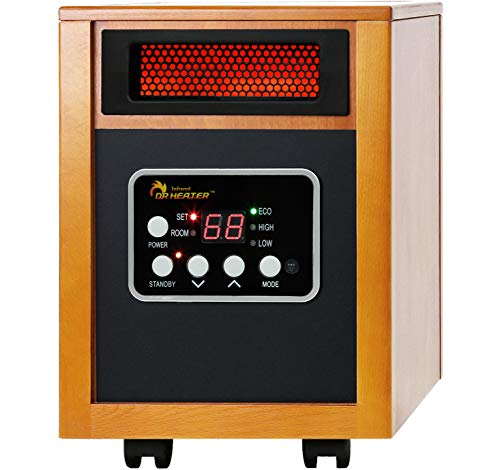


Five Heaters That Handle Concrete and Cold Air
Dr Infrared DR-968 Infrared Space Heater
- Watts1,500 W
- Heat output5,200 BTU
- Thermostat range50–85°F
- Noise level39 dB
- Cord length72 inches
- Infrared quartz tube warms concrete and furniture, not just air
- 5,200 BTU output heats larger basement zones
- 12-hour auto shut-off and tip-over protection
- 39 dB operation, quieter than most forced-air models
- 19 lbs and caster wheels make it harder to carry upstairs
- 6-foot cord may need careful outlet placement in a large basement
DREO 1500W Ceramic Heater with Oscillation
- Watts1,500 W
- Oscillation70°
- Timer12 hours
- Noise level34 dB
- SafetyETL certified, tip-over and overheat protection
- 70° oscillation covers large basement floor plans evenly
- ECO mode toggles between 1,000 W and 1,500 W to save energy
- 34 dB noise level, quiet enough for a basement office
- Remote control and 12-hour timer
- Ceramic element heats air, not surfaces, so concrete stays cold
- No caster wheels; you carry the unit to move it
Dura Heat EUH4000R 240V Forced Air Heater
- Voltage240V
- Heat output12,800 BTU
- Coverage400 sq ft
- Heating elementStainless steel
- SafetyOverheat shutoff
- 12,800 BTU output heats 400 sq ft faster than 120V models
- Wall or ceiling mount saves floor space in a crowded workshop
- Fan-only mode circulates air year-round
- Stainless steel element handles basement dust and moisture
- Requires a 240V circuit; you cannot plug it into a standard outlet
- No tip-over protection, so mount it or keep the floor clear
- Forced air can stir up dust in an unfinished basement
R.W.FLAME Mini Ceramic Heater with Remote
- TypeCeramic
- Timer24 hours
- ControlRemote and thermostat
- SafetyTip-over and overheat protection
- Small footprint fits under a desk or on a shelf
- 24-hour timer and ECO mode for hands-off operation
- Quiet ceramic element
- Remote control included
- Low output, suitable only for very small spaces
- No oscillation, so it heats one spot
- Minimal product data; wattage and coverage not specified
R.W.FLAME 1500W Ceramic Heater
- Watts1,500 W
- TypeCeramic
- SafetyETL certified, tip-over and overheat protection
- ThermostatYes
- 1500W ceramic heating at a lower price point
- ETL certified with tip-over and overheat protection
- Quiet operation
- Built-in thermostat
- No remote control or timer
- No oscillation, so heat stays in one direction
- Minimal product detail available
How to Choose a Heater for Your Cold Basement
A basement heater needs to match the space you’re warming and how you use it. Convection heaters—oil-filled radiators and ceramic tower models—circulate warm air to heat the whole room, which suits finished basements where you spend hours at a time. Radiant heaters, including infrared models like the Dr Infrared Heater DR-968, aim heat at objects and people in front of them, warming a workshop corner or seating area without heating unused storage space.
Thermostat precision shapes both comfort and cost. Analog dials let temperature swing by three to five degrees before the heater clicks back on, so the room feels warm then cool in cycles. Digital thermostats, standard on models like the DREO and Dura Heat forced-air heaters, hold within one degree and cut wasted runtime. That tighter control matters most when you heat all day or overnight.
Safety certifications—ETL, UL or CSA listings—confirm the heater passed tests for tip-over shutoff, overheat protection and electrical integrity. Basements collect storage boxes, laundry piles and extension cords, so a heater you leave running while upstairs needs those protections and a stable base. Look for a three-foot clearance rule in the manual and never plug into a power strip or extension cord.
Size the heater to your square footage and layout. Compact ceramic units like the R.W.FLAME models cover 150 to 200 square feet—a bedroom-sized finished area or a single workbench zone. Open basements above 400 square feet need a larger oil-filled radiator, a high-output forced-air model, or two heaters placed to push warmth into separate zones. For living areas with furniture and insulated walls, start with choosing a heater designed for basement conditions.
Oil Heater vs Ceramic Heater: Which Uses Less Energy in a Basement
Both oil-filled radiators and ceramic heaters draw 1,500 watts on high, so they cost the same per hour when the heating element runs. The difference appears in how often each type cycles on. An oil-filled radiator heats thermal oil inside sealed fins; that oil holds heat and keeps radiating warmth for ten to fifteen minutes after the thermostat clicks the element off. The heater runs less frequently once the room reaches temperature, cutting total energy use over a long session.
Ceramic heaters blow air across a heated ceramic element, warming the room faster but losing that heat the moment the fan stops. In a poorly insulated basement with concrete walls and a cold floor, the temperature drops quickly and the heater fires up again. The result: ceramic units run more total minutes per hour to maintain the same comfort level, especially in spaces you heat for four hours or longer.
| Appliance | Watts | Per hour | Per day (8 h) | Per month (30 days) |
|---|---|---|---|---|
| Oil-filled radiator (cycling 70% of runtime) | 1,050 W | 18¢ | $1.43 | $42.84 |
| Ceramic heater with fan (cycling 85% of runtime) | 1,275 W | 22¢ | $1.73 | $52.02 |
The gap widens when you heat all day or overnight. Oil-filled radiators suit finished basements used as living rooms, home offices or guest bedrooms where the heater runs six to ten hours straight. Ceramic heaters fit workshops, laundry areas and storage zones where you need fast heat for one to two hours, then leave. A ceramic model warms your hands at the workbench in five minutes; an oil-filled unit takes twenty but keeps the room comfortable without constant cycling.
Sizing and Heat Output for Basement Square Footage
A basement heater needs more wattage than an upstairs room of the same size because concrete floors and walls absorb heat before the air warms. The standard rule is 10 watts per square foot for insulated rooms, but basements need 12 to 15 watts per square foot to reach comfortable temperatures.
A 1,500 W heater covers 100 to 150 square feet in a typical basement with poured concrete or block walls. The same heater handles 200 square feet or more in a finished upstairs room with carpet and drywall. Unfinished basements with exposed foundation walls need the higher end of that range, while finished basements with insulation and floor covering retain heat better.
| Basement Area | Recommended Wattage | Solution |
|---|---|---|
| Up to 100 sq ft | 1,200–1,500 W | Single 120V heater |
| 100–150 sq ft | 1,500 W | Single 120V heater |
| 200–250 sq ft | 2,400–3,000 W | Two 1,500 W heaters on separate circuits |
| 300–400 sq ft | 3,600–6,000 W | 240V hardwired heater or multiple 120V units |
Ceiling height affects how long it takes to warm the space. An 8-foot ceiling is typical, but older basements with 7-foot ceilings heat faster because there’s less air volume. Anything above 9 feet adds another 10 to 15 percent to your wattage needs.
Open layouts spread heat unevenly. A heater with oscillation helps in a cold basement flat where the bedroom, laundry, and storage share one open area. Two smaller heaters placed at opposite ends work better than one large unit in the corner, as long as each plugs into a separate 15-amp circuit.
Safety Features That Matter in Damp, Cluttered Spaces
Tip-over and overheat protection are non-negotiable in a basement where boxes, laundry, and tools crowd the floor. Tip-over protection uses a tilt switch that cuts power if the heater falls or leans past a safe angle, usually 30 degrees. Overheat protection relies on a thermal fuse that breaks the circuit when internal temperature exceeds the design limit, preventing the heating element from igniting nearby materials.
Look for a UL, ETL, or CSA certification mark on the heater and the box. These marks confirm the design meets North American safety standards for electrical insulation, grounding, and fire resistance. Models without certification have not been tested by an independent lab.
V0 flame-retardant plastic in the housing and plug slows fire spread if something goes wrong. Basements typically have one stairway exit, so a fire that starts near the stairs traps you. Heaters with flame-retardant materials give you a few extra seconds to notice smoke and respond.
The 3-foot clearance rule means three feet of open air in every direction from the heater’s intake and exhaust. Stored boxes, laundry baskets, furniture, and curtains all count as obstructions. A heater pushed against a wall or wedged between a washer and a shelf will overheat, even with a thermal fuse, because the fuse only stops catastrophic failure—it does not prevent the plastic from warping or the heating element from cooking dust into smoke.
Auto shut-off timers that turn the heater off after 12 to 24 hours act as a failsafe if you forget it is running. Many basement electric heaters for damp spaces include this feature alongside tip-over and overheat switches. It will not replace active supervision, but it reduces the risk of leaving a heater on for days when you are traveling or asleep upstairs.
Why Your Basement Feels Colder Than the Thermostat Says
A basement stays cold because the concrete foundation absorbs heat faster than the air can warm it. Concrete has high thermal mass: it pulls warmth from the air and your skin, then radiates cold back into the room even after the thermostat clicks off. You feel colder than the temperature reading suggests because the surfaces around you—walls, floors, joists—are colder than the air itself.
Rim joists and sill plates leak cold air where the foundation meets the first-floor framing. These gaps let outdoor air infiltrate continuously, replacing warm air faster than a heater can keep up. Poor or missing insulation in basement walls and around ductwork compounds the problem, letting heat escape through every surface.
Higher humidity makes the air feel colder because moisture conducts heat away from your skin faster than dry air does. A space heater alone will not fix this; pair it with a dehumidifier to drop humidity below 50 percent, which makes the same air temperature feel several degrees warmer.
Oil-filled radiators and infrared heaters address thermal mass better than ceramic fan heaters because they warm surfaces, not only air. An oil radiator radiates heat in all directions, warming walls and floors directly. Infrared heaters emit rays that heat objects and people first, the way sunlight does, so the concrete absorbs warmth and holds it longer. Fan heaters push hot air into the room, but that air rises and escapes before the cold surfaces warm up. Choose heaters for freezing weather that match the thermal challenge, not only the square footage.
Frequently Asked Questions
Are oil-filled heaters more efficient than ceramic heaters in a basement?
What size heater do I need for a 300 square foot basement?
Can I leave an electric heater running in my basement overnight?
Why does my basement feel cold even when the heater is on?
Is it safe to use a space heater in a damp basement?
What is the most efficient low-wattage heater for a small basement room?
Readers in this position usually ask about comparing heater power consumption as well.
Before you buy anything, it is worth looking at best heaters for enclosed spaces.