
The most common mistake people make with a heated blanket with portable battery is focusing only on runtime. They see “2+ hours” and think their problem is solved. The real challenge is managing the intricate dance between heat demand, battery capacity, and real-world usage patterns. It’s not just about staying warm; it’s about maintaining that warmth efficiently, safely, and adaptably wherever you are whether you’re stuck in a drafty office, on a bleacher at a night game, or in a tent as the temperature plummets.
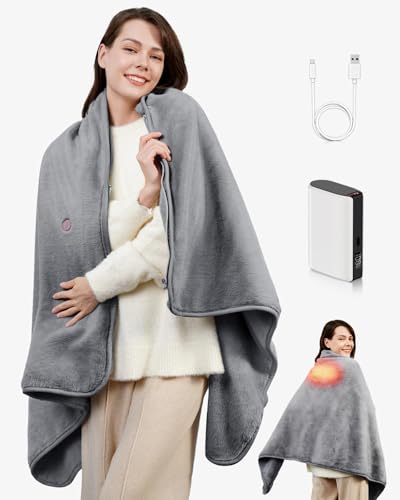
Why This Approach Solves heated blanket with portable battery Challenges
Thinking of a battery-powered blanket as a simple appliance is where plans fall apart. You must view it as a personal thermal management system. This mindset shift forces you to consider the entire energy chain: the heat generation technology, the energy storage medium, the controller logic, and the user’s behavior. When you solve for the system, you solve for the cold.
Here’s what I mean: A traditional plug-in blanket has, for all intents, an infinite power source. A portable unit does not. Every design choice, from the heating element to the fabric, is a trade-off between power draw, comfort, and durability. Get one part wrong, and you’re left with a dead battery and a chilly disappointment.
The Core Triad: Heat, Battery, and Fabric
Every viable solution must balance three critical pillars. Ignore one, and the experience fails.
- The Heating Element: This is the engine. Old-school wire elements are power-hungry and can create uncomfortable hot spots. Modern solutions like carbon nanotube or graphene-based films (often marketed as far-infrared systems) are thinner, more flexible, and distribute heat more evenly. They also tend to be more efficient, converting more battery juice into usable warmth.
- The Battery Pack: This is the fuel tank. It’s not just about watt-hours (Wh). You need to consider voltage compatibility, charge cycles, and where the pack is located. An integrated, non-removable battery is a single point of failure. A removable, rechargeable pack offers flexibility you can carry a spare, like an extra magazine for your warmth.
- The Textile & Construction: This is the chassis. A heavy, non-breathable fabric will trap heat but also make the blanket cumbersome and sweaty. A lightweight, plush fabric like faux fur adds insulation value, meaning the heating element doesn’t have to work as hard to achieve the same perceived warmth, thereby extending battery life.
“I used to think a portable heated blanket was just for the car. Then I spent a winter working from my poorly insulated sunroom. My plug-in throw’s cord was a tripping hazard to my dog, and I was tethered to one outlet. Switching to a battery-powered model wasn’t just about warmth; it was about reclaiming the use of my entire room. The unexpected benefit? It became my go-to for movie nights on the couch, no outlet hunting required.”
The Runtime Illusion and Power Management Realities
Let’s bust a myth: advertised runtime is almost always a best-case scenario. They test it on the lowest heat setting, in a stable 70 F room, with the blanket laid flat. Your reality is different. You’ll use a higher setting, you’ll be in a colder environment, and you’ll be wrapping it around yourself, creating folds that affect heat distribution and sensor feedback.
The result? You might get 1.5 hours instead of 2.5. This isn’t necessarily a product flaw; it’s physics. The solution lies in smart power management, both in the blanket’s design and your habits. Look for units with multiple, finely-tuned heat settings. The jump from level 1 to level 2 shouldn’t double the power draw. A good system uses pulse-width modulation to maintain temperature efficiently, rather than just blasting full power constantly.
| Technology | Power Efficiency | Heat Quality | Durability/Washability | Typical Draw |
|---|---|---|---|---|
| Traditional Wired | Low | Can have hot spots | Risk of wire fatigue; often hand-wash only | High (50-80W) |
| Carbon Nanotube/Far-Infrared Film | High | Even, deep-penetrating warmth | Very robust; often machine-washable | Medium-Low (20-50W) |
| Microfiber Heating Panels | Medium | Even, but can feel less “deep” | Good; varies by | Medium (30-60W) |
The Unexpected Analogy: It’s a Tactical Gear System
Think of your heated blanket with portable battery not as a household comforter, but as a piece of tactical outdoor gear. Your battery pack is your power source, akin to a water bladder in a hiking pack. You need to know its capacity, its fail-safes (overheat protection = a pressure release valve), and have a plan for resupply (a charging port or spare pack). The blanket itself is your shelter layer, providing active insulation. And the controller? That’s your comms unit, allowing you to adjust your strategy (heat level) based on changing conditions (ambient temperature). This mindset prepares you for real-world, variable use.
A Brief Case Study: The Football Parent
Sarah’s problem was specific: four-hour football games in late October, sitting on metal bleachers. A plug-in stadium seat was useless. She needed a solution for three hours of consistent, medium-level heat in 45 F weather with wind.
Her first attempt was a cheap battery blanket with a built-in, non-removable battery. It died after 90 minutes. Failure point: fixed, small-capacity battery with no recharge option during the game.
Her solution (and yes, I helped her spec it) involved a two-part system: a blanket with a removable, high-capacity rechargeable pack and a separate USB-C power bank in her bag. The blanket itself used a low-draw carbon fiber heating element. She’d start the game with the blanket’s full battery. At halftime, she’d plug the blanket’s battery pack into the 20,000mAh power bank in her backpack for a quick boost. This gave her more than enough warmth for the entire game, with power to spare. The product she ended up with, something like the RayoLife, worked because its removable battery and efficient heating system fit into this tactical energy plan.
The Charging Conundrum and Ecosystem Lock-In
Here’s a contrarian point: USB-C charging doesn’t automatically make a product better. It depends on the implementation. A blanket that charges its internal battery via USB-C is convenient. But a blanket whose battery pack outputs heat via a proprietary connector, yet charges via USB-C, gives you the worst of both worlds: you’re still locked into their battery format, but now you also need to manage another charger.
The ideal? A system that uses a common, high-wattage USB-C Power Delivery (PD) standard for both input and output. This would allow you to power the blanket from a laptop charger, a car USB-C port, or a standard power bank. We’re starting to see this in 2024, but it’s not yet the norm. Most systems, for safety and control, use a proprietary magnetic or DC connector for the heat output which is fine, as long as the battery pack itself is swappable and can be charged independently.
Actionable Recommendations for Your Warmth Strategy
So, how do you actually solve your heated blanket with portable battery challenge? Don’t just buy a product. Build a solution.
- Audit Your Use Case: Be brutally honest. Is it for 90-minute movies? All-day camping? Commuting? Your required runtime dictates the battery capacity (look for Wh ratings, not just mAh).
- Prioritize the Heating Tech: Seek out carbon nanotube or far-infrared systems. They are more efficient, safer, and more comfortable than old wire models. This is the hill to die on for performance.
- Demand a Removable Battery: This is non-negotiable for serious use. It future-proofs your blanket and allows for spares or using the pack for other devices (if compatible).
- Plan Your Logistics: Have a charging station. Consider a high-capacity USB power bank as a backup generator for your blanket’s battery pack. Know how you’ll recharge it in your car, at your desk, or in a campsite.
- Treat it as a System: The blanket, the battery, the charger, and your backup plan are all part of your personal heating system. Maintain all components. Keep connections clean. Store batteries at half-charge if not used for months.
The goal isn’t to own a heated blanket. It’s to never be unexpectedly cold again. By understanding the engineering trade-offs and planning your power logistics, you turn a clever gadget into a reliable piece of personal climate control. You move from hoping the charge lasts to knowing your system will deliver. And that’s a fundamentally warmer feeling.
📈 Shop Smart, Buy Quality – Add to Cart
👉 Check the Latest Price on Amazon 👈
⭐️ Trusted by 1,000+ Customers Worldwide