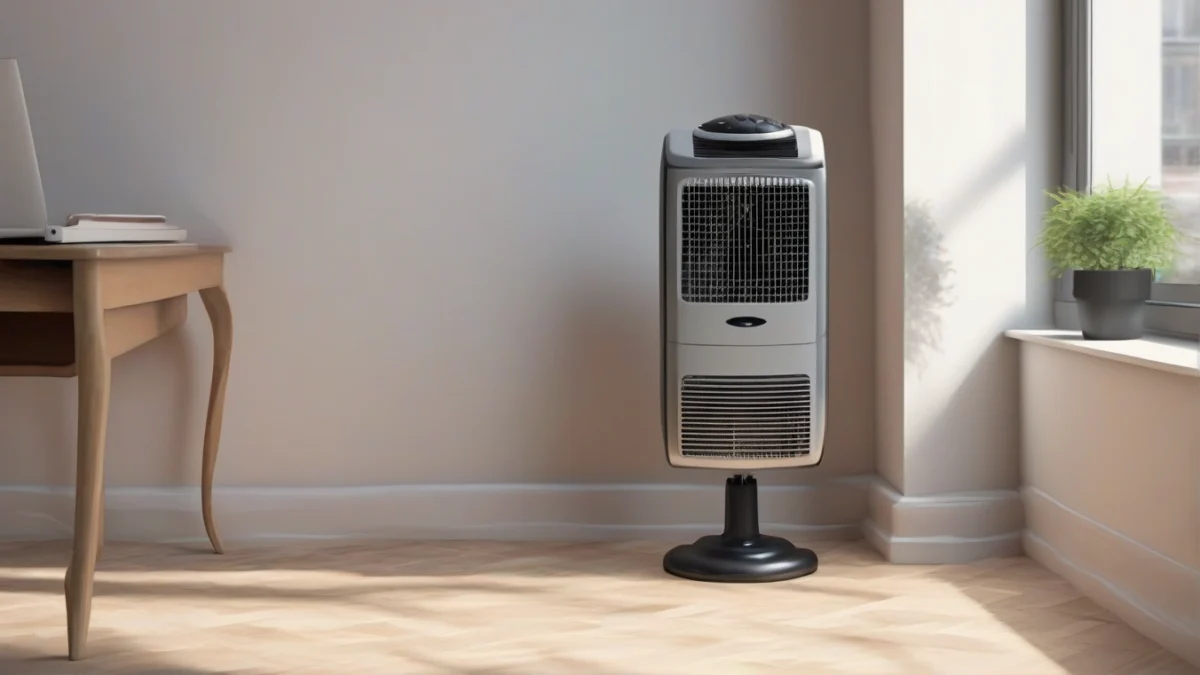
The problem isn’t the fan heater itself. It’s the mismatch between what the heater does well—deliver fast, targeted heat—and what a large room demands: sustained warmth across hundreds of cubic feet of air volume. Large rooms lose heat faster through more exterior walls, windows, and often higher ceilings, forcing any heater to run longer and harder.
The efficiency question turns on how you use the heater. Run a fan heater all day trying to raise a 400-square-foot living room to 22°C, and you’ll burn through kilowatt-hours. Use it for two hours of zone heating while you work at a desk, with a thermostat holding 19°C, and the cost drops to reasonable.
Fan Heaters Waste Energy in Large Rooms
Fan heaters waste energy in large rooms when you run them to heat the entire space, but they’re efficient for zone heating—warming the person, not the room. The problem is math: a 250-square-foot room with an eight-foot ceiling needs roughly 4,500 watts to maintain comfortable warmth, but most fan heaters max out at 1,500 watts. Running an underpowered heater continuously costs more and delivers less comfort than using it strategically to warm the area you occupy.

All electric resistance heaters convert 100% of electricity to heat, so a 1,500 W fan heater, a 1,500 W oil-filled radiator, and a 1,500 W ceramic heater produce identical heat output. Where they differ is how they distribute that heat and how quickly it escapes. Fan heaters heat air through forced convection, pushing warm air into the room fast. That speed is an advantage in a bathroom or small office where you need warmth now and will leave in twenty minutes. In a large room, though, warm air rises to the ceiling, stratifies, and leaks out through gaps around doors and windows faster than the heater can replace it.
Calculate heating needs by multiplying room volume in cubic metres by 25 watts. A 250-square-foot room (about 23 square metres) with a 2.4-metre ceiling has 55 cubic metres of volume and needs 1,375 watts just to maintain temperature in a well-insulated space. Add exterior walls, single-pane windows, or a door that opens to an unheated hallway, and the requirement climbs past 2,000 watts. A 1,500 W fan heater can’t keep up. It runs at full power all day, cycling rarely, while the room stays cool. That continuous runtime is where the waste happens.
| Room Size | Volume (cu m) | Heating Need (W) | 1,500 W Fan Heater |
|---|---|---|---|
| 100 sq ft, 8 ft ceiling | 22 | 550 | Adequate |
| 150 sq ft, 8 ft ceiling | 33 | 825 | Adequate |
| 250 sq ft, 8 ft ceiling | 55 | 1,375 | Underpowered |
| 300 sq ft, 10 ft ceiling | 84 | 2,100 | Inadequate |
How Room Size Affects Fan Heater Efficiency and Cost
Room size determines whether a fan heater is a practical tool or an energy drain. In a 100 to 150-square-foot bedroom or office, a 1,500 W fan heater raises the temperature by 5°C in under three minutes and cycles off once the built-in thermostat is satisfied. Short heating bursts mean the heater runs fifteen to thirty minutes per hour in a well-insulated space, and monthly costs stay under $20 if you heat for eight hours a day. The heater matches the load.
Medium rooms—150 to 250 square feet—sit at the margin. A fan heater can warm the space if the ceiling is standard height, insulation is decent, and you close the door. Expect runtime to climb to forty minutes per hour, with the thermostat cutting power less often. Cubic volume matters more than floor area here. An eight-foot ceiling gives you 33 cubic metres in a 150-square-foot room; a ten-foot ceiling pushes that to 42 cubic metres and adds 225 watts to your heating requirement. Heat stratification becomes visible: the air near the ceiling is warm while the floor stays cold, and the fan heater works harder without improving comfort at sitting or standing height.

Large rooms—250 square feet and up—overwhelm a fan heater. The unit runs continuously because it can’t satisfy the thermostat, and you’re paying for 1,500 watts every hour it’s on. At $0.17 per kWh, that’s $0.26 per hour or $62 per month for eight hours a day, and the room never feels warm. A thermostat reduces runtime by 40 to 60% in smaller, well-insulated spaces, but in a large or poorly insulated room, the heater rarely cycles off. You’d spend less and gain more comfort with a heater rated for large rooms or by using the fan heater for zone heating—pointing it at your desk or chair rather than trying to warm the whole volume.
| Room Size | Typical Runtime/Hour | Hours per Day | Monthly Cost |
|---|---|---|---|
| 100 sq ft, good insulation | 20 min | 8 | “Cost estimate based on 1,500 watts running 8 hours daily at $0.17 per kWh” |
| 150 sq ft, good insulation | 30 min | 8 | “Cost estimate based on 1,500 watts running 8 hours daily at $0.17 per kWh” |
| 250 sq ft, average insulation | 50 min | 8 | “Cost estimate based on 1,500 watts running 8 hours daily at $0.17 per kWh” |
| 300 sq ft, poor insulation | 60 min | 8 | “Cost estimate based on 1,500 watts running 8 hours daily at $0.17 per kWh” |
| Appliance | Watts | Per hour | Per day (8 h) | Per month (30 days) |
|---|---|---|---|---|
| 1,500 W fan heater, small room (20 min/hr) | 500 W | 8.5¢ | 68¢ | $20.40 |
| 1,500 W fan heater, medium room (30 min/hr) | 750 W | 13¢ | $1.02 | $30.60 |
| 1,500 W fan heater, large room (continuous) | 1,500 W | 26¢ | $2.04 | $61.20 |


Fan Heater vs Oil-Filled Radiator vs Convection Heater Energy Use
All three heater types draw similar wattage—1,500 W is standard—so they consume the same energy per hour at full power. The efficiency difference emerges over time, driven by how each heater delivers and retains warmth.
A fan heater blasts heat instantly by forcing air over a hot element. You feel warmth in seconds, but the room cools just as fast when the unit clicks off. Over four hours of heating, a fan heater runs more total minutes because it has no thermal mass to carry heat through thermostat cycles. Research shows fan heaters are 40 to 60 percent less efficient for sustained heating compared to oil-filled models.
An oil-filled radiator warms slowly—fifteen to thirty minutes to reach temperature—but the heated oil keeps radiating for thirty minutes or more after shutoff. The thermostat cycles less often, and you’re still getting heat during the off phase. For all-day heating in a large room, oil-filled radiators waste less energy because they coast on stored heat rather than cycling the element constantly.
Convection heaters sit between the two. They warm air by natural or gentle fan-assisted circulation, reaching temperature faster than oil-filled but slower than a fan heater. They retain little heat after shutoff but run quieter and distribute warmth more evenly than a forced-air fan.
| Heater Type | Warmup Time | Cooldown | Best For | Noise |
|---|---|---|---|---|
| Fan heater | Instant | Immediate | Quick zone heating, occupied spaces | High |
| Oil-filled radiator | 15–30 min | 30+ min heat retention | All-day heating, bedrooms | Silent |
| Panel convection | 5–10 min | Minimal | Even warmth, living areas | Low |
In a large room, use a fan heater only for zone heating—warming the person, not the air. Choose oil-filled for background warmth you maintain all day. Pick a convection heater when you need moderate speed and low noise.
Zone Heating Strategy: How to Use Fan Heaters Without Waste
Zone heating means warming the person, not the room. A fan heater excels at this because it delivers concentrated heat exactly where you sit, allowing you to leave the rest of the space cooler. The strategy cuts energy waste by reducing the volume of air you’re paying to heat.
- Position the heater 3 to 6 feet from your seating areaAim the airflow at your lower body—legs and feet feel cold first. Closer than 3 feet risks discomfort and violates most manufacturers’ clearance specs; farther than 6 feet dilutes the heat before it reaches you.
- Close doors to isolate the zoneHeating a 10-by-12-foot zone wastes far less energy than heating a 20-by-20-foot open-plan room. Every closed door shrinks the volume the heater must maintain.
- Set the thermostat to 18 to 20°CThe thermostat prevents continuous runtime. Most fan heaters cycle off when the zone reaches setpoint, then fire again only when temperature drops. Continuous operation at 1,500 W costs about $0.26 per hour at $0.17 per kWh; cycling cuts that by a third or more.
- Combine with background central heat set lowerRun your central system at 15°C to keep the whole house from freezing, then boost your occupied zone to 20°C with the fan heater. You avoid the waste of heating empty rooms to full comfort temperature.
Use a timer to preheat your zone fifteen minutes before you arrive. You walk into warmth without running the heater while the room sits empty. This tactic pairs well with a fan heater’s instant output but wastes energy with oil-filled models that need longer to reach temperature.
The Role of Insulation and Draft Control
Insulation determines whether a fan heater maintains comfort or burns through electricity fighting heat loss. Poor insulation forces the heater to cycle on two to three times as often to hold the same temperature, doubling or tripling your runtime and cost. The heat you pay for escapes through gaps, single-pane windows and uninsulated walls faster than the heater can replace it.
Drafts create convection currents that pull warm air away continuously, so a fan heater in a drafty room fights a losing battle regardless of wattage. Seal window and door gaps with adhesive-backed weather stripping—a low-cost fix that stops cold air intrusion immediately. Heavy curtains reduce window heat loss by 25 to 30 percent at night by trapping a layer of still air between fabric and glass.
The math is simple: if draft sealing and insulation halve the time your heater runs to maintain 68°F, they halve your cost. Combined with proper sealing, a fan heater’s effective range increases 40 to 50 percent, letting a 1,500 W unit hold comfort in a 200-square-foot room instead of struggling past 130. Drafty rooms defeat any portable heater, but the fixes are faster and cheaper than upgrading the heater itself.
Running Costs and When to Choose a Different Heater
Calculate the cost of any electric heater with watts ÷ 1,000 × hours × your rate per kilowatt-hour. A 1,500 W fan heater running four hours daily at $0.17 per kWh costs 1.5 × 4 × 0.17 = $1.02 per day, or $30 to $35 per month. An oil-filled radiator at the same wattage and runtime costs the same per hour at full power, but its thermal mass lets it cycle off more often, cutting actual consumption by 10 to 20 percent over a full evening.
| Appliance | Watts | Per hour | Per day (2 h) | Per month (30 days) |
|---|---|---|---|---|
| 1,500 W fan heater, 2 hours daily | 1,500 W | 26¢ | 51¢ | $15.30 |
| 1,500 W fan heater, 4 hours daily | 1,500 W | 26¢ | 51¢ | $15.30 |
| 1,500 W fan heater, 8 hours daily | 1,500 W | 26¢ | 51¢ | $15.30 |
A fan heater makes sense for under two hours daily in zones under 200 square feet—a bathroom before a shower, a home office during work hours, a corner of a basement workshop. Choose an oil-filled radiator or a panel heater for all-day heating or rooms over 250 square feet; their gentler, sustained warmth suits longer cycles and larger volumes. Infrared heaters work for very large spaces where you cannot zone effectively, heating objects and people directly rather than mixing air.
| Heater type | Best for | Skip if |
|---|---|---|
| Fan heater | Under 2 hrs daily, zones under 200 sq ft, fast warmth | All-day use, quiet spaces, over 250 sq ft |
| Oil-filled radiator | All-day heating, bedrooms, 150–300 sq ft, silent operation | Quick heat needed, portability matters |
| Infrared heater | Large spaces, direct heating, high ceilings, outdoor patios | Heating air evenly, enclosed small rooms |
Noise matters in large rooms where the heater runs longer. Fan heaters produce 45 to 55 decibels—audible and disruptive during calls, sleep or focused work. Oil and panel heaters are silent. If a fan heater runs more than four hours daily or costs over $35 per month, the most energy-efficient heater types for your space will pay for themselves in a single season.
Frequently Asked Questions
Are oil heaters energy efficient for large rooms?
Do thermostats on fan heaters significantly reduce energy use?
What is the best heating method for large rooms?
How does fan heater noise affect usability in large spaces?
Are there fan heater models optimized for large rooms?
Can I use a fan heater and central heating together to save energy?
Readers in this position usually ask about oil-filled radiator vs. fan heater: which uses less power as well.
It helps to understand best heaters for insulation issues before spending anything.