
The trip happens the moment you plug in the heater, or a few minutes later when the room starts to warm. Either way, the lights go out and you’re back where you started. The breaker is doing its job, stopping an overload before it becomes a hazard.
Most portable heaters pull 12.5 amps at 1,500 watts, which fills most of a standard 15-amp household circuit. Add a laptop, a lamp, and a phone charger on the same circuit and you’ve exceeded the limit. The fix starts with understanding what’s on the circuit and how much power each device uses.
Why Circuit Breakers Trip When You Plug in a Portable Heater
A portable heater trips the breaker when it draws more current than the circuit can safely supply. The breaker detects the overload and cuts power to prevent the wires inside your walls from overheating and starting a fire.
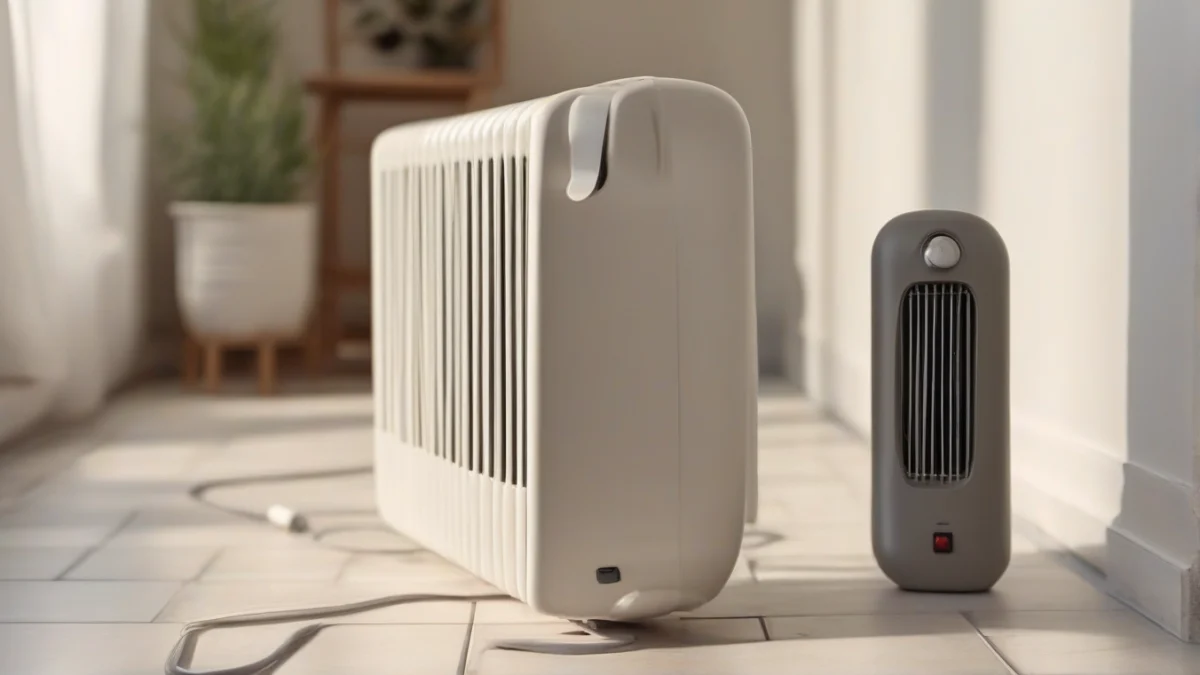
Most portable heaters run at 1,500 watts, the maximum a standard plug-in heater can draw. To find the amp draw, divide watts by voltage: 1,500 W ÷ 120 V = 12.5 amps. A typical household circuit is rated for 15 amps, so a single heater already uses 83 percent of the available capacity before you plug in anything else.
The breaker trips when the total load on the circuit exceeds its rating. A laptop charger adds 0.5 amps, a hairdryer adds 12 amps, and a vacuum cleaner adds 9 amps. If your heater is already pulling 12.5 amps and you turn on a hairdryer on the same circuit, the combined 24.5 amps trips the 15-amp breaker instantly.
| Device | Typical Watts | Amp Draw at 120 V |
|---|---|---|
| Portable heater (high setting) | 1,500 | 12.5 |
| Hairdryer | 1,200–1,800 | 10–15 |
| Vacuum cleaner | 900–1,200 | 7.5–10 |
| Window air conditioner | 1,000 | 8.3 |
| Microwave | 1,000–1,200 | 8.3–10 |
| Coffee maker | 800–1,200 | 6.7–10 |
| Laptop charger | 60 | 0.5 |
| LED bulb (10 bulbs) | 100 | 0.8 |
Two space heaters on the same circuit will always trip a 15-amp breaker, since 12.5 + 12.5 = 25 amps. Even on a 20-amp circuit, two 1,500-watt heaters draw 25 amps and exceed the limit.


How to Find What Else Is on the Same Circuit
You need to know which outlets and lights share the circuit with the heater before you can reduce the load. Most homes group multiple rooms or parts of rooms on a single breaker, so the outlet where your heater trips may share a circuit with outlets in another room, overhead lights, or hardwired devices.
- Turn off the tripped breakerGo to your breaker panel and flip the tripped breaker to the off position if it has not already moved there. Leave it off for now.
- Walk through your home and note what stopped workingCheck every outlet, light fixture, and hardwired device. Plug a lamp into each outlet to see if it powers on. Write down which rooms and which specific outlets or lights are dark.
- List the devices normally plugged into those outletsCount phone chargers, lamps, televisions, computers, alarm clocks, and anything else that stays plugged in. Include overhead lights and ceiling fans on the circuit.
- Estimate the amp draw of each deviceCheck the label on each device for its wattage, then divide by 120 to get amps. A television might draw 150 watts, or 1.25 amps. A desktop computer and monitor together might draw 300 watts, or 2.5 amps. Add these figures to the heater’s 12.5 amps to see your total load.
If the total exceeds 15 amps, the breaker is doing its job. Bedroom circuits often power outlets in two or three rooms plus closet lights and hallway fixtures, so a heater in one bedroom may share a circuit with devices in an adjacent room.
Once you know what is on the circuit, you can unplug enough devices to bring the total below 15 amps, or move the heater to a different circuit with less load. A space heater with auto shut-off reduces the risk if you forget to unplug other devices, but it does not prevent breaker trips caused by overload.
Check the Heater and Outlet for Damage
A breaker can trip because the heater itself is defective, not because you overloaded the circuit. Unplug the heater and let it cool for at least fifteen minutes before inspecting it. Look closely at the plug and the entire length of the cord for melting, fraying, scorch marks, or exposed wire. Check the outlet for black or brown discoloration around the slots, a burning smell, or a loose fit when you insert the plug.
Test the outlet with a low-wattage device like a lamp that you know works. If the lamp does not turn on, the outlet itself may be faulty. If the lamp works but the heater still trips the breaker immediately when you plug it in, the heater has an internal short or a failing heating element.
Dust buildup inside the heater blocks airflow and causes the heating element to overheat, which can trigger the breaker or activate the heater’s internal overheat shutoff. If the heater is old or has sat unused for months, turn it off, unplug it, and clean the intake and exhaust vents with a vacuum and a soft brush. Some heaters let you remove a front grille for deeper cleaning; check the manual before disassembling anything.
Fixes That Work Without Calling an Electrician
The simplest fix is to reduce the total load on the circuit. Walk through the room and unplug non-essential devices—phone chargers, desk lamps, a television, a hair dryer left plugged in—before you turn the heater back on. Each device you remove frees up current for the heater.

If your heater has multiple heat settings, run it on the lower wattage. A typical portable heater offers 750 W and 1,500 W modes. The 750 W setting pulls 6.25 amps instead of 12.5 amps, leaving more room on a 15-amp circuit for other devices. The room will take longer to warm, but the breaker will not trip.
Move the heater to an outlet in a different room, ideally one on a separate circuit. Bedrooms and living rooms are often on different circuits from kitchens and bathrooms. Plug the heater in, turn it on, and check whether the breaker holds. If it does, that circuit has enough capacity.
If you only need warmth at your desk or in bed, a heating pad or heated blanket draws 50 to 100 watts—one-fifteenth the load of a space heater—and will not trip a breaker. It will not heat the room, but it will keep you warm without overloading the circuit.
When You Need a Dedicated Circuit
A dedicated circuit is a single outlet served by its own breaker and wiring, with no other devices sharing the load. It solves the tripping problem permanently because the heater has the full circuit capacity to itself.
A standard 20 A dedicated circuit at 120 V supplies 2,400 watts of capacity. That handles a 1,500 W heater with 900 watts to spare, enough margin to prevent nuisance trips from startup surges. A 15 A circuit supplies 1,800 watts, which works but leaves less headroom.
Two 1,500 W heaters draw 3,000 watts combined, or 25 amps at 120 V. No single circuit can handle that load. You need two separate dedicated circuits, each feeding one heater, or you need to stagger their use so only one runs at a time.
Call a licensed electrician if the breaker trips the instant you plug in the heater, if you smell burning plastic or see sparks at the outlet, or if the outlet or breaker feels hot to the touch. These signs point to a wiring fault, not simple overload.
Homes built before 1970 may have aluminum branch wiring or knob-and-tube wiring. Both require special techniques and materials for safe connection. An electrician experienced with old wiring can assess whether the existing circuits can support modern loads or whether upgrades are needed.
If you rent, ask the landlord or property manager to arrange the work. Most lease agreements require the landlord to maintain safe electrical systems, and a breaker that trips repeatedly under normal use suggests the circuit is undersized for the space.
What Not to Do
Even heavy-duty extension cords labeled for 15 A are designed for short-term use with tools that cycle on and off. A space heater runs continuously at full load. The resistance in the cord’s connections and wire generates heat that builds up over hours, and most cords have no thermal protection.
Other dangerous shortcuts:
- Replacing the breaker with a higher-amp breaker without upgrading the wire. A 15 A breaker protects 14-gauge wire; a 20 A breaker requires 12-gauge wire. Putting a 20 A breaker on 14-gauge wire allows the wire to overheat before the breaker trips.
- Holding the breaker in the on position or jamming it so it cannot trip. The breaker is the last line of defense against an electrical fire. Disabling it removes that protection entirely.
- Plugging the heater into a UPS or battery backup. A UPS does not increase the circuit’s capacity and most models shut down or fail when asked to supply 1,500 watts continuously. The heater draws power from the circuit whether the UPS is in the path or not.
If the load-reduction methods in section four do not work and you cannot install a dedicated circuit, the safe answer is a lower-wattage heater or a small space heater for targeted warmth instead of trying to heat the whole room. A 500 W or 750 W model draws less current and may run without tripping on a shared circuit, though it will heat a smaller area more slowly.
Frequently Asked Questions
Can a 1,500 watt heater trip a 15 amp breaker?
Why does my heater trip the breaker after a few minutes?
Can I use two portable heaters on the same circuit?
Will a portable heater work on a GFCI outlet?
How do I know if my heater is defective or if it’s the circuit?
Can portable heaters overheat and trip the breaker even when nothing else is plugged in?
We go through troubleshooting heating devices step by step in a separate article.
We go through convenient portable heaters step by step in a separate article. There is more on understanding heater failures in a guide of its own.
