
Working in a cold garage can be uncomfortable and unproductive. An electric garage heater can transform your workspace into a warm and inviting environment, making it easier to complete projects.
With various options available, it’s important to choose a heater that fits your specific needs. Our roundup includes models that excel in heating efficiency, safety features, and user convenience.
Comparison of Electric Garage Heaters
| Product | Best for | Heating Power | Coverage Area | Safety Features | Price |
|---|---|---|---|---|---|
| InoKraft 7500W Electric Garage Heater | Best Overall | 7,500 W | Up to 750 sq ft | — | Check price |
| GiveBest Smart Wall Heater 1500W | Best Smart Heater | 1,500 W | Up to 200 sq ft | Tip-over and overheat protection | Check price |
| Shinic 2-Pack 1500W/750W Ceiling Heater | Best Ceiling Mount | 1,500 W / 750 W | — | Overheat auto-off, ETL listed | Check price |
| Buyplus 1500W Portable Outdoor Heater | Best Portable | 1,500 W | Up to 200 sq ft | Overheat and tip-over protection | Check price |
| 1500W Outdoor Patio Heater for Garage | Best Budget | 1,500 W | Up to 200 sq ft | Overheat protection | Check price |


Top Picks for Electric Garage Heaters
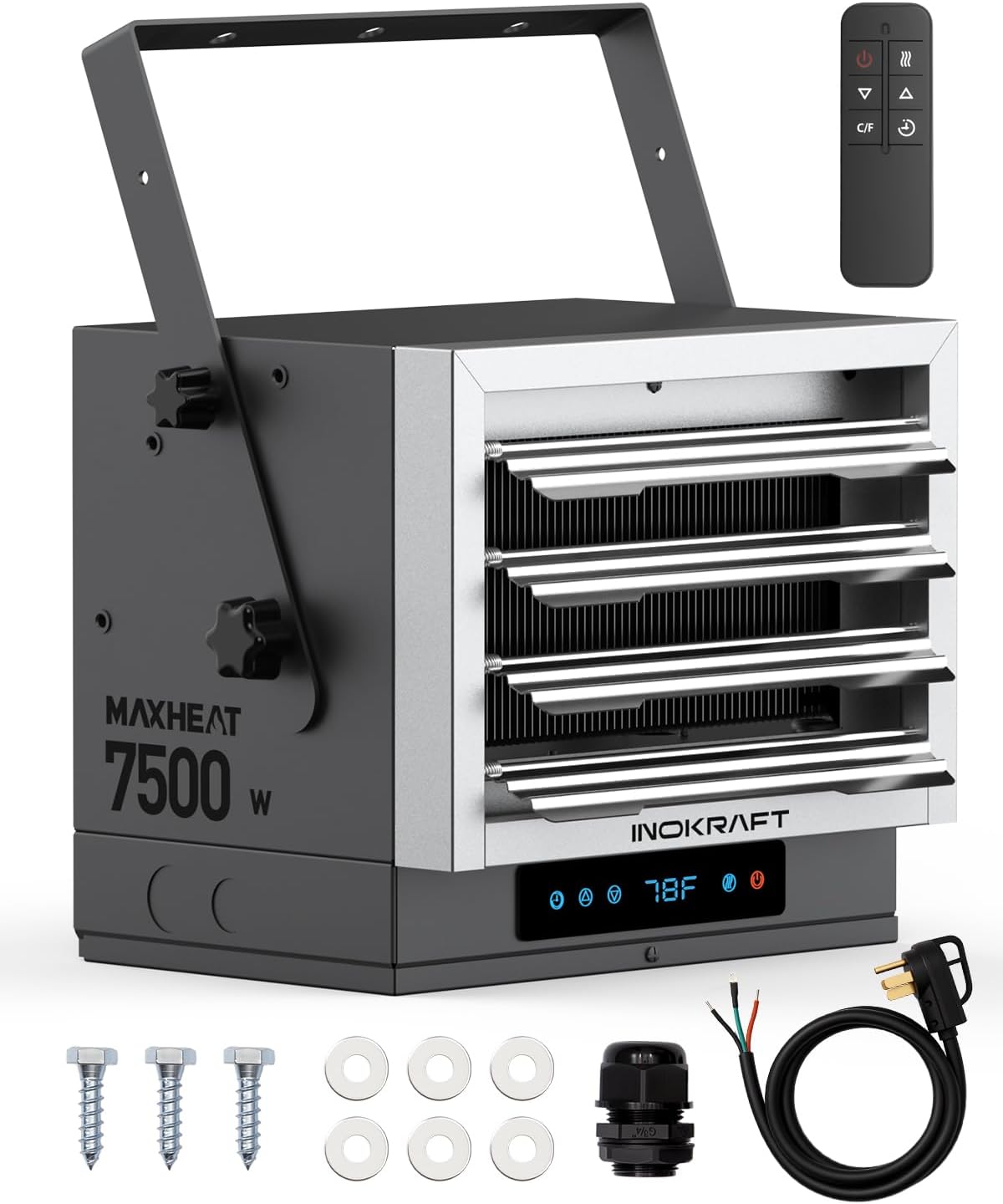
InoKraft 7500W Electric Garage Heater
- Heating Power7,500 W
- Coverage AreaUp to 750 sq ft
- Voltage240 V
- Cord Length8.2 feet
- Plug TypeNEMA 14-50P
- High heating power for large spaces
- Precise digital thermostat with timer
- Adjustable louvers for even heat distribution
- Flexible installation options
- Requires professional electrical installation
- Heavier and bulkier than smaller models
GiveBest Smart Wall Heater 1500W
- Heating Power1,500 W
- Coverage AreaUp to 200 sq ft
- Safety FeaturesTip-over and overheat protection
- Mount TypeWall mount
- WiFi and remote control options
- Energy-efficient ECO mode
- Wall-mounted to save space
- Multiple safety protections
- Limited to smaller room coverage
- Requires wall installation
Shinic 2-Pack 1500W/750W Ceiling Heater
- Heating Power1,500 W / 750 W
- Mount TypeCeiling
- Adjustability90° rotation
- Safety FeaturesOverheat auto-off, ETL listed
- Instant radiant heat
- Built-in halogen work light
- Adjustable 90° ceiling mount
- Multiple heat and light settings
- Limited coverage area compared to fan heaters
- Requires ceiling installation
Buyplus 1500W Portable Outdoor Heater
- Heating Power1,500 W
- Coverage AreaUp to 200 sq ft
- Safety FeaturesOverheat and tip-over protection
- Weight3.2 lbs
- Rapid heat with PTC technology
- Compact and portable design
- Overheat and tip-over protection
- Suitable for indoor and outdoor use
- Lower heating power than large wall units
- Limited coverage area
1500W Outdoor Patio Heater for Garage
- Heating Power1,500 W
- Coverage AreaUp to 200 sq ft
- Safety FeaturesOverheat protection
- Voltage120 V
- Fast 3-second heat-up
- Multiple heat modes
- Compact and portable
- Overheat protection
- Limited to smaller areas
- No advanced controls or thermostat
How to Choose the Right Electric Garage Heater
Start by matching the heater’s power output in watts to your garage size. Most garages need between 1,500 and 7,500 watts depending on square footage and insulation.
Calculate the coverage area to ensure the heater can warm the entire space. A 1,500-watt unit typically covers about 150 square feet, while larger heaters like the InoKraft 7500W handle up to 500 square feet or more.
Safety features are crucial. Look for overheat protection and tip-over switches to prevent fire hazards. Choose models with UL or ETL certification.
Check your garage’s electrical system before buying. High-power heaters may require a 240-volt circuit or a dedicated 15-amp line at 120 volts. Confirm compatibility with your setup to avoid tripped breakers.
Electric heaters that run on solar panels or battery systems are available but need careful matching of wattage and voltage. They suit garages with renewable energy sources or backup power.
For stairwells or smaller zones inside the garage, consider an electric unit heater designed for narrow spaces. These typically mount on walls or ceilings and direct heat where needed.
- Measure Your GarageCalculate the length, width, and height to find the volume and square footage you need to heat.
- Determine Heater WattageMatch heater wattage to your square footage: 10 watts per square foot is a good rule of thumb for insulated garages.
- Check Electrical CompatibilityVerify your garage’s circuit amperage and voltage to select a heater that matches without overloading.
- Select Safety FeaturesChoose models with overheat protection, tip-over switches, and certification marks for safe operation.
Understanding Heating Output and Running Costs
Heating output is measured in BTUs and watts. One watt equals about 3.41 BTUs. To heat a garage, calculate the needed BTUs based on size and insulation. For example, an uninsulated garage requires roughly 50 BTUs per square foot.
Use this formula to estimate running costs: watts ÷ 1,000 × hours used × electricity rate per kWh. For instance, a 1,500-watt heater running 8 hours daily at 17 cents per kWh costs about $2.04 per day.
| Appliance | Watts | Per hour | Per day (8 h) | Per month (30 days) |
|---|---|---|---|---|
| 1,500 W space heater | 1,500 W | 26¢ | $2.04 | $61.20 |
| Heated blanket | 100 W | 1.7¢ | 14¢ | $4.08 |
Efficiency ratings affect your electric bill. Most electric resistance heaters convert nearly 100% of electricity into heat, so the main savings come from insulation and usage time rather than efficiency differences.
Oil-filled heaters warm slowly because they heat the oil inside, which radiates heat after the element shuts off. They do not give electric shocks if used properly since the heating element is sealed and the surface stays warm, not hot.
For uninsulated garage ceilings, choose a heater with higher wattage or supplemental insulation to reduce heat loss. Infrared or radiant heaters can be effective since they warm objects and people directly rather than the air.
Safety Features to Look for in Electric Garage Heaters
Look for electric garage heaters with safety certifications like UL or ETL. These marks mean the heater meets strict safety standards for electrical and fire hazards. A certified heater reduces the risk of malfunction or fire.
Tip-over protection is essential for portable heaters. It shuts off the heater automatically if it falls, preventing fires. Overheat protection stops the heater if it gets too hot, avoiding damage or ignition of nearby materials.
- Check the Heater’s Safety CertificationsVerify it has UL or ETL certification to ensure compliance with safety standards.
- Confirm Tip-Over and Overheat ProtectionEnsure the model includes these automatic shut-off features for safe operation.
- Install ProperlyFollow the manufacturer’s instructions for mounting or placement. Keep heaters at least 3 feet from flammable objects.
- Maintain the Heater RegularlyClean dust from vents and fans to prevent overheating. Inspect the power cord for damage and replace if worn.
Unique Features of Electric Garage Heaters
Smart controls with WiFi let you adjust the heater remotely from a phone or voice assistant. This convenience helps preheat your garage before work without leaving the house.
Portability is a key feature for some garages. Lightweight models with handles or caster wheels let you move heat exactly where you need it. This is useful for shared heaters in multi-use spaces.
Programmable timers allow heaters to run only when needed, saving energy and cost. Energy-saving modes adjust power automatically to maintain temperature without wasting electricity.
| Feature | Benefit |
|---|---|
| WiFi and Smart Controls | Remote temperature adjustment and scheduling for convenience |
| Portability | Easy to move and position heat where needed |
| Programmable Timers | Set heating times to cut energy waste |
| Energy-Saving Modes | Automatic power adjustment to maintain comfort efficiently |
A convector heater uses a fan or natural convection to circulate warm air quickly. It generally consumes about the same electricity as an oil-filled radiator of the same wattage. The difference lies in heat retention: oil-filled radiators keep warming after power off, while convectors cool faster.
If you share an electric heater in a garage, choose one with easy controls and a timer. This prevents overheating and wasted power when multiple users have different schedules.
For more options on electric garage heating, see the full buying guide on best electric shop heaters for garages workspaces.
Frequently Asked Questions
What is the best electric garage heater for a small garage?
How much does it cost to run an electric garage heater?
Are electric heaters safe for garages?
What features should I look for in a garage heater?
Can I use a portable heater in my garage?
What size heater do I need for my garage?
If that sounds like your room, read up on top small heaters next.
There is more on electric heater for 400 sq ft in a guide of its own.
